Hong Kong was built on fabric.
In the 1950s, the city was one of Asia’s biggest textile exporters, and in the ’60s and ’70s, hundreds of thousands of Hong Kongers were employed by the garment manufacturing industry.
Today, most of the manufacturing has moved across the border into mainland China and to places like Bangladesh and Vietnam, where labor is much cheaper. Nonetheless, tangible reminders of the textile industry remain, in particular in the busy Sham Shui Po neighborhood and the formerly industrial town of Tsuen Wan. Here, on Bead Street and Button Street, and in the Redress Closet and the Center for Heritage, Arts and Textiles, visitors can trace the threads that weave together the city’s past and present.
Heart of the Textile Industry
In much of Hong Kong, life happens inside tall, air-conditioned buildings, but in the Sham Shui Po neighborhood, the buzz is on the streets. Open-air markets, cafes, restaurants and all manner of shops make this busy, rapidly gentrifying neighborhood a favorite destination for local designers and craftspeople.
That buzz is not new. The neighborhood was once the heart of Hong Kong’s textile industry. It started in the late 1940s and early ’50s, when refugees from China’s civil war and its aftermath flooded the area looking for ways to make a living, and apartments in Sham Shui Po were soon turned into small garment factories. Later on, the working-class neighborhood became a place for wholesale buyers to connect with mainland Chinese factories.
Speak to young people in Hong Kong and ask them what their parents or grandparents did for a living, and there is a good chance that they will tell you they worked for the textile industry, said Takahashi Mizuki, executive director and chief curator for the Center for Heritage, Arts and Textiles (CHAT), an institution in Tsuen Wan which traces the city’s history in textiles.
Over the past decade or so, thanks to lower rents and a congregation of creative industries, Sham Shui Po has become a place where people feel free to experiment. Artists, designers and restaurateurs have opened (and closed) businesses there, and that cycle continues today.
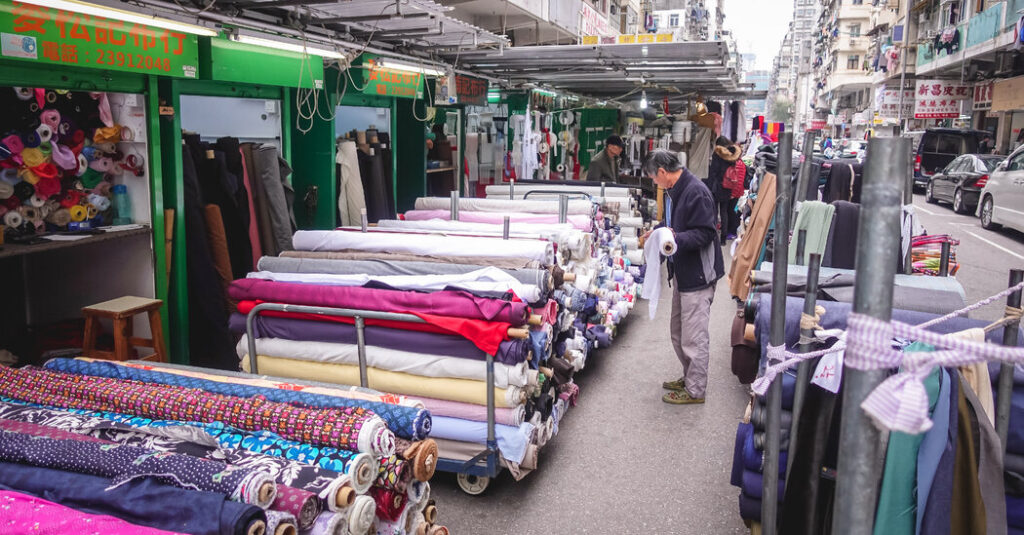
The streets are colloquially named after the shops that might be found along them. Yu Chau Street is known as Bead Street, because it is where the beads and sewing supplies are. Ki Lung Street or Button Street has buttons, zippers, clasps and fastenings, along with a row of open-air stalls with rolls and rolls of fabric in every print imaginable — harking back to the area’s cotton-spinning past.
Some know Tai Nan Street as Leather Street. It is home to the Alri Star Leather Factory, which sells hides, tools and leather care products, but also kits that allow customers to make their own leather bags and wallets. The shop also carries a line of bags inspired by patterns found in Hong Kong’s markets. A block down is the Lederer, a branch of the Shui Hing Tannery and one of the last few leather factories in the city that also caters to casual shoppers.
Changing Times
While constantly in flux, Sham Shui Po is one of the few neighborhoods in the city that has managed to keep its character and community alive. Although many of the original shops may have closed, the next generation of merchant families who live here is adapting to the times.
“I think it’s a Hong Kong thing that things change really, really fast,” Kit Ho, 40, one half of the husband-wife duo who founded Years and the Park by Years, two vegan cafes in the neighborhood, said in a recent phone interview.
Ho noted that she grew up in the neighborhood and that her father ran a fabric wholesale shop on the same street.
Her husband, Kay Kwan, 39, said that he also grew up in Sham Shui Po and that his family was also involved in the apparel industry there.
The menu at the Park changes with the seasons; offerings include a Taiwanese-style basil eggplant rice bowl, tom yum fried “prawn” gnocchi and a Sichuan mala fried mushroom burger. And while it is tough to be consistent, the couple said that they tried to use ingredients from local farms.
Ho and Kwan have also opened a clothing and lifestyle goods shop next door to the Park by Years in the spot where, Ho said, her father first joined the textile industry as an apprentice.
Because they grew up in the neighborhood, the two are community-focused and say they partner with local N.G.O.s, including animal welfare groups and social workers.
“We host breakfast events for the homeless,” Ho said. “The social worker suggested it would be better for them to have a real experience, to have a meal inside a restaurant, because that’s not really usual for them.”
Just around the corner on Apliu Street, the Hong Kong N.G.O. Redress is also working for social good. With the fashion industry contending with its waste, Redress was among the first groups in Hong Kong to champion circular fashion and in Sham Shui Po, its secondhand shop, the Redress Closet, is part of that mission to keep clothing and accessories out of landfills. The store stocks items including designer bags and wares from popular mass-market brands like Zara and Uniqlo, and is a glimpse into the closets of Hong Kong’s people.
Mills and the Future of Textiles
A little further afield in the former industrial town of Tsuen Wan, the Hong Kong property developer Nan Fung Group has taken one of its old cotton mills and turned it into a creative hub.
Here, people can delve into Hong Kong’s material memories at CHAT, the Center for Heritage, Arts and Textiles.
Takahashi, the museum’s director, noted that, for many, talking about heritage in Hong Kong meant discussing the city’s heritage during British colonial rule, but that, in contrast, CHAT focused on “heritage, which was driven by the common people.”
The museum looks back with a permanent exhibition on the city’s textile industry, but also has a hand in shaping the direction of textile art moving forward. A smaller operation than the grand contemporary art museum M+ that opened in 2021, CHAT has been focused on developing and showcasing the work of emerging and midcareer artists since it opened in 2019.
They include the Berlin-based Kazakh felt artist Gulnur Mukazhanova and the Korean visual artist and filmmaker Mooni Perry, who explores what she calls people with “double-fallen” identities, which, according to the museum’s materials, are “those who exist between categories of gender, history and belonging.”
This week at Art Basel, CHAT will show the work of the local artist Chan Wai Lap, whose immersive installations are inspired by swimming pools and school uniforms.
Textiles, Takahashi said, were a “medium to convey the story of the people, underserved minorities,” noting that while, in her view, much of the dialogue in the art world centered on textile and fiber has been Euro and American-centric, CHAT was looking to place it in an “Asian context.”
CHAT’s current exhibition, “Threading Inwards” (through June 28), features works by 14 Asian artists that explore how textiles have been part of spiritual life, appearing in rituals and ceremonies. The show includes work by the Chinese artist Hu Yinping, who invited women from rural communities in China to crochet or knit a soul bottle — a funerary urn designed as a dwelling for the dead.
Wang Weiwei, one of the show’s curators, explained that the bottle was a medium to connect a person’s physical body to heaven. However, instead of soliciting the kind of elaborate vessels that might be seen in places like the Palace Museum, Hu asked the women to create soul bottles in the form of daily objects, such as a thermos, and to create designs on those objects that show what paradise and heaven look like to them.
“They combined different kinds of religious or folk stories, like the Journey to the West as something they consider as heaven,” Wang said.
There is also the work of the Korean-Japanese artist Kim Sajik that explores Bashofu, a type of textile produced in Okinawa, through the memories of local community members who wove the fabrics and wore them in daily life and as part of festivals. The fabric, made from banana fibers, was nearly lost after World War II, when the war wiped out some 25 percent of the island’s population, but was revived by the Japanese textile artist Toshiko Taira, who was designated a living national treasure by Japan in 2000.
While “Threading Inwards” occupies much of the museum’s exhibition space, the show, “Artefacts of Blue,” explores the cultural impact of Indanthrene Blue, the world’s first synthetic vat dye that in 1930s China was promoted as a color that would bring happiness.
“It’s to provoke people into thinking about how our perception, our feelings are being shaped by economic development, political development,” Wang said.
CHAT will provide a free shuttle bus every hour from 11 a.m. to 5 p.m. from the Hong Kong Convention and Exhibition Center, where Art Basel is being held, to the Mills, home of CHAT, for the duration of the fair.
The post Pulling the Threads of Hong Kong’s Textile Heritage appeared first on New York Times.