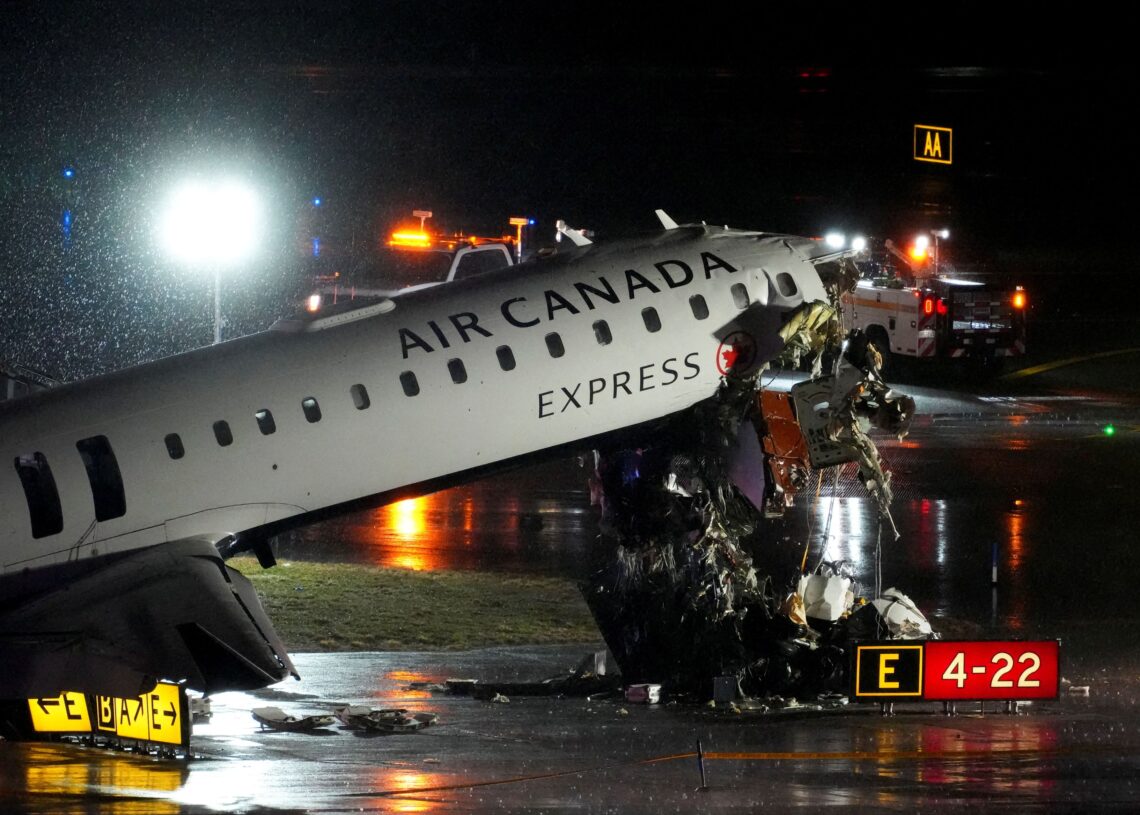
An air traffic controller pleaded with the driver of an emergency vehicle to stop in the seconds before the deadly crash on the runway of New York’s LaGuardia Airport on Sunday and said afterward that he had been focused on an unrelated crisis and “messed up,” a review of air traffic control communications shows.
The Air Canada Express passenger jet crashed into a firefighting vehicle as it landed, killing the plane’s two pilots and injuring dozens, the first fatal incident at the airport in more than three decades.
The plane struck an emergency vehicle on the runway that was responding to an issue with a separate aircraft, Kathryn Garcia, executive director of the Port Authority of New York and New Jersey, said at a news conference early Monday.
Forty-one people were taken to the hospital, some with serious injuries, she said. Thirty-two people have since been released from hospital, Garcia added.
Airport officials identified the two people killed as the jet’s pilot and co-pilot but did not provide their names, saying only that they were both young men at the start of their aviation careers.
At a news conference Monday, federal aviation officials rebutted suggestions that the airport was not properly equipped to navigate its air and ground movement but gave few details about what transpired, citing the ongoing investigation. The National Transportation Safety Board, the federal agency that investigates civil transportation accidents, also shared little new information at a news conference Monday evening.
NTSB investigators began their work around 3 a.m. and cut a hole through the plane’s roof to recover its cockpit voice recorder and flight data recorder, NTSB Chair Jennifer Homendy said. Those recorders will be analyzed, and Homendy said the agency would aim to share some details that those devices may have captured this week.
The airport was closed until 2 p.m. Monday to allow investigators time to work at the scene. Shortly after 2 p.m., a flight departed the airport for the first time since the crash, officials said.
The firefighting vehicle, with two officers inside, was responding to an unrelated issue involving a United Airlines jet when the collision happened, about 11:40 p.m. Sunday. The two officers are in stable condition, Garcia said.
The Jazz Aviation Bombardier CRJ jet was operating as an Air Canada Express flight, arriving from Montreal, Jazz Aviation said. A preliminary passenger list for Flight 8646 indicated the aircraft was carrying 72 passengers and four crew members, the airline said in a brief statement.
A recording of air traffic control communications posted on LiveATC.com, a website that hosts live broadcasts from air traffic control towers, appeared to capture the moments leading up to and immediately after the crash.
Around 11:20 p.m., after an aborted takeoff, a United Airlines plane reports an odor onboard and requests fire services: “Hi LaGuardia Ground, United 2384, we have an odor on the plane as well here at this time, we are gonna be going back to the gate, request fire as well.”
The ground and tower controllers are kept busy trying to handle the situation for 10 minutes. Then, at 11:31 p.m., air traffic control says the United plane has declared an emergency, as air traffic control continues to organize emergency vehicle support while coordinating other airport traffic.
Then, around 11:35 p.m., personnel clear an Air Canada plane to land at Runway 4.
Two minutes later, a person in an emergency vehicle en route to the United plane requests permission to cross the same runway: “Truck 1 in company, LaGuardia Tower, requesting to cross four at Delta,” they say in the recordings. The air traffic controller grants permission.
Seconds later, a controller speaks to a plane taxiing in the area: “Frontier 4195, stop there, please. ” Then, air traffic control addresses the vehicle: “Stop, stop, stop. Stop, Truck 1, stop!”
A loud beeping noise follows. “Jazz 646. Jazz 646, I see you collided with a vehicle there. Just hold position. I know you can’t move,” air traffic control says to the Air Canada plane around 11:38 p.m.
Just over 15 minutes after the crash, a controller tells a pilot that he tried to prevent the collision.
“I tried to reach out to ’em … and we were dealing with an emergency earlier, and I messed up,” the controller says.
“No, man, you did the best you could,” the pilot responds.
Air safety consultant and aviation professor Anthony Brickhouse reviewed the recording at The Washington Post’s request. “In a normal situation, if a fire truck is cleared to cross the active runway, that means that the controller would verify that there’s a small window for that fire truck to get across the runway before anything takes off or lands,” he said.
Based on the recording, it appeared that one air traffic controller was solely responsible for granting runway clearance to landing and departing plans and vehicles on the ground, said Jeff Guzzetti, a former accident investigator for the Federal Aviation Administration and National Transportation Safety Board. During the Monday news conference, Transportation Secretary Sean P. Duffy said there was more than one controller in the tower Sunday night, though he did not clarify the exact number.
Duffy added that the airport’s target number of controllers is 37 and that it currently has 33 certified controllers, alongside seven who are in training.
The number of controllers during nighttime and early hours varies by airport, but having only one is not out of the ordinary, Guzzetti said. Sometimes, airports add a second controller if their schedule is busier during those times.
Air traffic controllers communicate with ground-vehicle crews in the way they do with pilots as they take requests for runway clearance. Generally, planes have priority over ground vehicles, Guzzetti said.
In the LaGuardia crash, air traffic control was clearly an issue, Guzzetti said, while noting that these types of accidents can rarely be attributed to just one cause.
“The airplane was barreling down on them, but the vehicle still began to cross the runway anyway,” he said. “So there’s still a lot of open questions there.”
Photos of the aftermath show the jet positioned at the edge of Runway 4, its nose in pieces, with debris piled on the tarmac. Others showed severe damage to a nearby emergency vehicle, which appeared to have overturned, as a large team of responders surrounded the area.
LaGuardia Airport, in Queens, is the third-busiest airport serving the area, transporting more than 30 million passengers in 2024, according to Port Authority statistics.
According to the flight-tracking website FlightAware, over 500 flights scheduled to fly into or out of LaGuardia were canceled on Monday.
The post In tense moments after deadly LaGuardia crash, controller said he ‘messed up’ appeared first on Washington Post.