President Trump said on Monday that the United States and Iran were negotiating a “total resolution of our hostilities in the Middle East,” backing away from his threats over the weekend to attack Iranian power plants.
Mr. Trump said Jared Kushner, his son-in-law, and Steve Witkoff, one of his most senior advisers, were leading the talks.
“We have had very, very strong talks,” Mr. Trump told reporters on Monday. “We’ll see where they lead. We have major points of agreement.”
The prospect of negotiations to end the war launched by the United States and Israel on Feb. 28 sharply reversed some of the steep declines in global financial markets. But Iran publicly denied that negotiations were taking place, with the speaker of Iran’s Parliament taking to social media to call it fake news.
Still, according to four Iranian officials and an Iranian diplomat, Tehran and Washington have been exchanging messages through intermediaries about de-escalating the conflict, though the messages appeared to be short of negotiations. The talks aimed to avert attacks on critical energy infrastructure. Three officials said Iran’s foreign minister, Abbas Araghchi, and Mr. Witkoff had spoken on the phone in recent days in what were described as preliminary discussions.
Mr. Trump’s dizzying fluctuations in recent days have raised many questions about whether an end to the war might truly be at hand and if the blockage of oil shipments that have rocked the global economy will be resolved.
With the war now in its fourth week, Iran’s main leverage in the conflict remains oil. Its price has risen more than 50 percent since late February, amid a de facto Iranian stranglehold on the critical Strait of Hormuz in the Persian Gulf. The International Energy Agency, which was created by industrialized economies in the 1970s to confront disruptions to the supply of oil, said on Monday that the oil shock had led to greater daily losses of oil supply than in 1973 and 1979 combined.
Iran’s Fars news agency reported late on Monday that shipping through the Strait of Hormuz, the choke point for oil, gas and fertilizer exports, remained very limited, with only a small number of vessels, mainly from China and India, transiting.
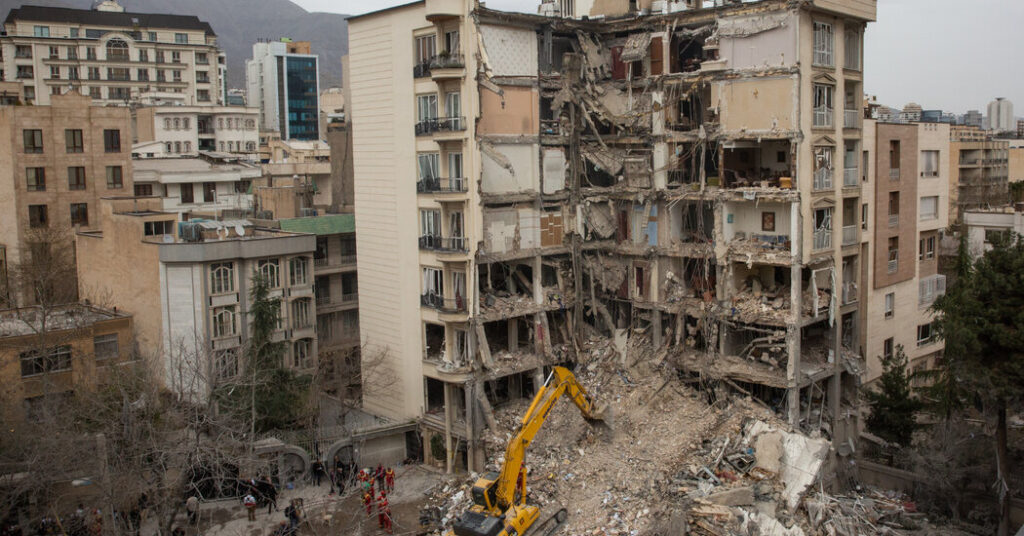
On the ground in the Iranian capital, Tehran, there was no letup in the war, with Iranians who were able to connect to the internet reporting intense and terrifying strikes. “If you knew how it hit just now,” posted one resident, Mitra Shahsavand, adding that “the earth and sky shook.”
Israel reported that its fighter jets had carried out a “wide-scale wave” of attacks in the “heart of Tehran.”
On Monday night, Prime Minister Benjamin Netanyahu of Israel said that he had spoken with Mr. Trump and that the American president believed it was possible to “leverage” the allies’ military gains to “realize the objectives of the war in an agreement.”
Mr. Netanyahu said that Israel was continuing its campaign of targeted killings in Iran, which had already hit some of the country’s most senior leaders. “Just a few days ago, we eliminated two more nuclear scientists — and we are still active,” he said.
Mr. Trump declined to disclose whom the United States was communicating with in Iran, except to say that it was not the newly anointed supreme leader, Ayatollah Mojtaba Khamenei. Mr. Trump said he was demanding an end to Iranian nuclear enrichment and to the country’s uranium stockpiles that could be used to one day make a bomb.
Multiple officials from Iran denied that the country had held direct talks with the United States, although some conceded or left open the possibility that it had been passing messages through intermediaries.
The spokesman for Iran’s foreign ministry, Esmail Baghaei, said Iran had held no direct talks with the United States during the entire conflict. The speaker of the Iranian Parliament, Mohammad Bagher Ghalibaf, said on X that claims of negotiations were being used to “manipulate the financial and oil markets and escape the quagmire in which the US and Israel are trapped.”
But Iran’s state-run Mizan news agency said there had been regional initiatives aimed at reducing tensions. And the foreign minister of Oman, which has frequently mediated between the United States and Iran, said on social media shortly before Mr. Trump’s announcement that Oman was working to establish “safe passage arrangements for the Strait of Hormuz.”
It was unclear whether Israel was involved in the negotiations or would be bound by any agreement. Mr. Trump said that Israel was going to be “very happy with what we have,” adding that U.S. officials had just discussed the talks with Israeli counterparts.
Prime Minister Keir Starmer of Britain told senior lawmakers on Monday that his government was aware of talks between the United States and Iran. The priority, he said, is to achieve “a negotiated agreement which puts tight conditions on Iran particularly in relation to nuclear weapons.”
Mr. Starmer said that he hoped for a swift end to hostilities but that Britain had “to plan on the basis there may not be.”
Mr. Trump threatened on Saturday to bomb Iranian power plants in 48 hours unless Tehran agreed to fully reopen the Strait of Hormuz. On Monday, he promised a five-day moratorium on any U.S. attacks on Iranian energy sites, but did not promise a broader cease-fire.
By the end of Mr. Trump’s extended deadline, 2,200 Marines will have arrived in the region. That will give Mr. Trump more options for the blockaded strait — but also raise the risk of further escalation. Marine Expeditionary Units are capable of rapidly putting detachments of troops and vehicles on the ground, conducting counter-drone operations and escorting tankers and other commercial ships, according to experts.
An additional 2,500 Marines aboard three warships are also heading to the Middle East from the 11th Marine Expeditionary Unit based at Camp Pendleton, Calif. They will join more than 50,000 American troops in the region.
Reporting was contributed by David E. Sanger, Julian E. Barnes, Vivian Nereim,Farnaz Fassihi, Richard Pérez-Peña, Johnatan Reiss, Ephrat Livni, Greg Jaffe, Eric Schmitt, Ravi Mattu, Stephen Castle, Joe Rennison and Adam Rasgon.
Luke Broadwater covers the White House for The Times.
The post Trump Says U.S. Is Negotiating End to War, but Iranians Push Back appeared first on New York Times.