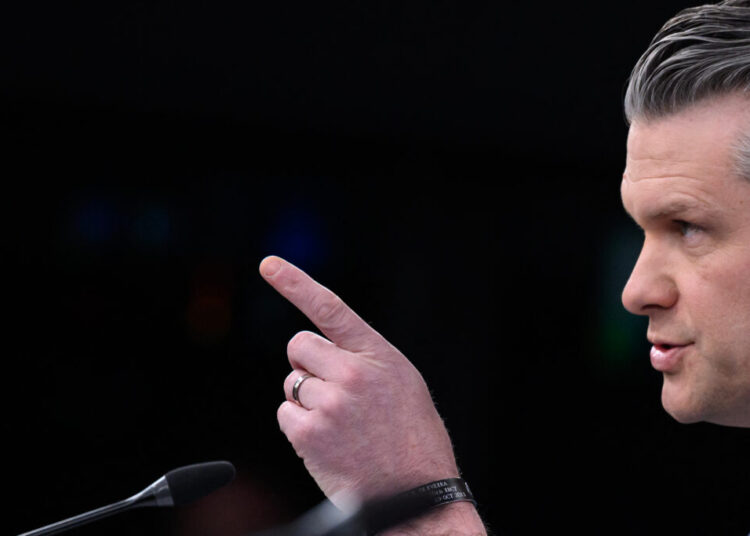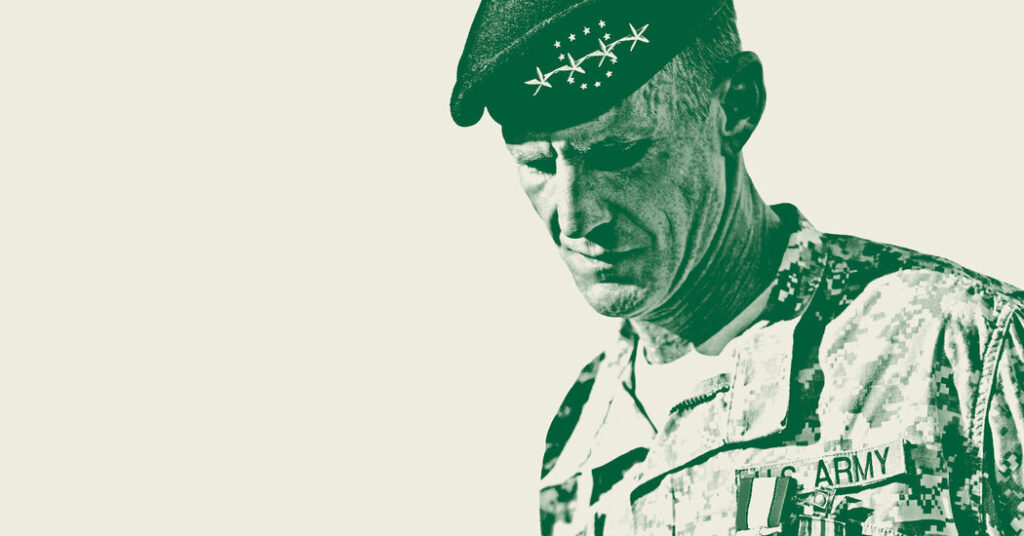
Did President Trump fall for the myth of surgical warfare? Gen. Stanley McChrystal joins the columnist David French, both veterans of the Iraq War, to discuss what may have been overlooked in the planning of Operation Epic Fury. McChrystal, who retired from the Army in 2010, argues that the United States often overestimates the decisive power of aerial bombing while underestimating the weight of historical grievance. And the general weighs in on the current culture of bravado coming from Secretary of Defense Pete Hegseth.
Below is a transcript of an episode of “The Opinions.” We recommend listening to it in its original form for the full effect. You can do so using the player above or on the NYTimes app, Apple, Spotify, Amazon Music, YouTube, iHeartRadio or wherever you get your podcasts.
This conversation was recorded on Friday, March 20. The transcript has been lightly edited for length and clarity.
David French: General, thank you so much for joining us.
Gen. Stanley McChrystal: All right. David, please call me Stan — even though you are a former JAG officer. We have to set the table at the beginning.
French: It’s going to be hard for me.
We served together in very different capacities. I was a JAG officer for an armored cavalry squadron in eastern Diyala Province during 2007-08. You were orchestrating one of the most effective and efficient Special Operations missions our nation’s ever seen, which really helped turn the tide of the war.
I want to actually begin our discussion of current events there, because there is something that I have seen since this most recent conflict with Iran broke out, which is that the veterans’ perspective on this conflict is different than the perspective of the folks who didn’t serve, especially in Iraq.
So, even if someone maybe objects to the way that this conflict began or has some questions about its prudence, there’s a lot of feelings about Iran and Iran’s role in the Iraq war and the losses and damage it inflicted upon us.
When I was in eastern Diyala, we lost guys to explosively formed penetrators planted by Iranian-backed militias.
So, General, if you could table-set, what has been the recent American experience in our long-running conflict with Iran?
McChrystal: If we go back to the American experience starting in 1979, I was a young Special Forces officer, and I remember that the American Embassy in Tehran was seized, and there were people chanting “death to America.”
That was upsetting. And that was only a few years after Vietnam, so I think America was vulnerable emotionally.
Then suddenly you had this country that had been our ally, at least in the minds of most Americans during the Peacock Regime of the Shah, from 53 to 78, we felt comfortable with that. They were the bulwark of stability — and then suddenly in ’79 we saw the rise of Ayatollah Khomeini. And he doesn’t want to negotiate.
We watched a war break out between Iraq and Iran, and most of us were far enough away to say, “Wow. Good. Somebody’s taken on the Iranians. They don’t like Americans, so it’s somebody taking them on.”
Then in 1988, the U.S.S. Vincennes mistook an Iranian airliner for an attacking F-14, and they killed 290 civilians. If you take that period, Iran seemed like a recalcitrant enemy that hated us for some reason that we couldn’t really understand.
Then we get into 2007, when you were in Diyala and I’m leading a counterterrorist task force.
We had to stand up an entirely new task forcefocused on the Shia militia that were supported by Iran — the explosively formed projectiles and all of the things that Iran did to give them capability — and it became a bitter fight.
So, in the minds of someone like me and my force, of course, they were the enemy. They were killing us and we were killing them. It looked as though they were also a threat to not just the mission in Iraq, but the stability across the region.
It becomes emotional; Iran feels like our lifelong enemy right now. I’ll stop there. But I think that’s only part of the story.
French: Well, of course, if you say that’s only part of the story, we have to keep going. When the surge started to wind down around 2008, 2009, 2010, there was a real sense that we had won in many ways, that we had really turned the tide by the time I left in late ’08.
I remember the statistics when we got there. If you drove out of the front gate of our base, it was about a 25 percent chance of enemy contact — whether it’s an I.E.D., sniper fire, rockets, mortars, whatever. By the time we left, it was less than a 1 percent chance.
But the story doesn’t end there. The story keeps going, and Iranian-supported militias have been a thorn in our side in Iraq ever since. So, let’s pick it up after the surge. What happens next?
McChrystal: Well, let’s really pick it up before that, because I think it’s important.
We have a tendency in America to view things in very short periods — our year in Iraq, or in my case, five years in Iraq. We tend to come in and say we are going to fight the war to end all wars, at least in our minds.
But for the Iraqi about my age — I’m 71 now — for an Iraqi, it really starts in 1953, when the U.S. and British intelligence services overthrew the constitutionally elected prime minister and put back into power the Peacock Regime of the Shah.
They oppressed the people tremendously, particularly through Savak, the secret police. So, when the Iranian revolution erupts in 1978, we may have been surprised, but the Iranian people were not surprised.
When they suddenly say “death to America,” most Americans are saying, “What’s your problem? Why are you angry at us?”
Then, of course, we spoke earlier about the Iran-Iraq war, which was for eight years. It was a brutal bloodletting. Iran survives this eight-year, extraordinary experience, twice as long as the First World War. And it sets a mark upon the Iranian population that we shouldn’t forget to this day — because the baby boomers are veterans of that experience, and the clerics get a lot of support from them.
After 2002, when George W. Bush names Iran to the “axis of evil,” reportedly to their surprise, you start to continue this set of grievances. So, I try to remind people whenever we think of what’s happening now: If we don’t understand that journey to this point, we don’t understand the attitudes that are going to drive decisions people make.
French: I’m so glad we have dived into this from the Iranian perspective, because I think understanding the Iranian perspective really helps us maybe understand how the rest of this war might go, what kind of staying power, for example, the Iranians might have.
There have been comparisons, for example, to the lightning-quick raid to get Maduro out of Venezuela. There was some expectation that you could do something very rapid, a very fast decapitation strike, and really alter the behavior and composition of the regime in a substantial way.
My perception of that from the beginning was that that was a bit of a vain hope, because you have a very different composition of the enemy when you’re talking about, say, a South American strongman versus an Islamic Revolutionary regime — the level of commitment that exists within the regime is theological. Sometimes it’s apocalyptic.
When we were in Iraq taking on Shia militias, the level of their commitment was such that, for example, the medics who were treating wounded Shia fighters would sometimes report that the Shia fighters, even gravely wounded, would try to bite them or harm them in some way, even though they were gravely wounded. That was the level of commitment.
So, we hear a lot that the Iranian people are ready to rise up, that they’re ready to overthrow this government. But at the same time, we have seen extreme levels of commitment.
How are you judging the state of the Iranian opposition at this moment? Is it brittle? Is it fragile? Or are you seeing that 47-year-long commitment continuing?
McChrystal: I really want to go two lines on this. The first is that question, because the Iranian opposition is not really evident. We saw in 2009, they came out in the streets and were beaten back into submission, and then reportedly thousands of Iranians protesting were killed by the regime in recent months.
But I couldn’t name the opposition leader. I couldn’t tell you the liberation front of Iran. I know that the shah’s son is going around, but I don’t think he’s a legitimate alternative. I think that we can’t gauge the actual strength of the desire of Iranian people to change.
And, of course, a war will often cause people to coalesce around their government. In your really well-written article , you said something I really believe in. You said, I’m an American. I want our side to win.
I feel the same way, even though I disagree with many of the things my government’s doing, I’m unequivocally on this side. And that may be the case.
The other thing I wanted to talk about, though, because you brought up the Maduro raid: There are three great seductions that happen to American administrations and to the military.
The first is the idea of covert action. A new president comes in, and he’s told by the intelligence community, “We can create this great effect and it will be covert. No one will ever know who did it, and it’ll just be a good outcome.” And in my experience, it never stays covert and it rarely works.
French: Right.
McChrystal: But it’s seductive because it seems like an easy approach to a knotty problem.
The second seduction, which I lived as a part of, is the surgical Special Operations raid. That is probably epitomized by the Maduro raid. I would argue that we demonstrated extraordinary competence that night, but not much changed. I don’t think that we actually demonstrated the ability to change the facts on the ground to any extent.
Which gets to the third great seduction, and that’s air power. We all love air power. In World War II, we went into the war with the Douhet theory, that air power, the bomber, will always get through, and therefore air power will be dominant.
It was certainly very, very contributory, but it was never dominant.
When we got into Vietnam, which was the classic case, we developed a strategy that said: For North Vietnam, we will have an escalation strategy, and we will raise the pressure on them until we hit the point at which they’re willing to quit.
It’s not worth it anymore. What we didn’t perceive is — like the Shia wounded that your medics ran into — there was no point for North Vietnam. They were asymmetrically committed to the outcome.
So, we entered Iraq in 2003 with “shock and awe,” and then we spent a decade there fighting after it.
I think, in this case, we again fell for the seduction that if we bomb key targets, we will produce the outcome we want — but the outcome’s in the minds of the people. And unless you’re going to kill all the people, you may not affect that outcome.
We may be at a point — you used the word “quagmire” in your article — but we may be at a point where we’ve run into a country that has an extraordinary capacity to be bombed.
French: General, let me make the case to you that has been made to me about air power in this current war, and that is: Everything that you’ve walked through — from the daylight bombing raids in 1943 to the air war over Kuwait during Desert Storm, all of those things — we just weren’t as capable then as we are now.
We have loitering drones, we have high visibility over the battlefield. We have, in connection with the Israelis, deep penetration into the Iranian regime. This time it is different. This time we have more capability.
What’s your response to that argument?
McChrystal: Since I’ve retired from the military, I’ve been involved in some investing, and I love that line: “This time it’s different.”
I go, “OK, I agree the capability is so much more.” And I have to keep an open mind that it is possible that the dynamic has changed so much that we finally hit a tipping point where it will be decisive.
But I’m not seeing that, and I don’t feel that. The other part that I would bring out is we thought really early in Afghanistan that the people on the ground who we were targeting would be awed and intimidated by the bombing and that they would respect our capability. In many ways, what we found, particularly with the tribal members, is that they were disdainful of it.
They knew you could bomb them. But they said, if you’re not willing to get down on the ground, look me in the eye, and fight me mano a mano, then you are not morally on my level. I think that we can’t forget that people fight because of their passions.
It’s not a geopolitical calculation that’s going to drive what Iran does eventually. It will be what’s in their hearts.
So, this idea of decapitating the regime, and now we’ve got this current leader where we killed his father and we killed his wife, we apparently banged him up pretty good. Then we say, “Well, that will make him more willing to negotiate.” It wouldn’t have that effect on me.
French: No. And it’s 100 percent opposite of my own experience in dealing with Al Qaeda.
One of the things that you see when you’ve been in the military and you’re out of the military, one thing I’m very grateful for, is that the military is still the most highly respected public institution in the United States. I think there are a lot of good reasons for that. But it has also sort of led to a sense that we are supermen, that the military can accomplish almost the impossible.
And so we look at a situation like the Strait of Hormuz , and we think, “We can open that. Of course we can open that.”
Just give us some perspective on, as a practical, realistic matter, why is it hard? Why would it be hard to force open the Strait of Hormuz? Or would it be hard?
McChrystal: Yeah, it would be hard to keep it open. It is like what we found in Iraq. We could bomb Iraq pretty easily; we could even take Baghdad with relative ease. We could get rid of the existing government.
But once we wanted to change the reality on the ground, who actually controlled things, how things worked, now you’re not at 30,000 feet. You’re at six feet.
And you’re the same height as your potential opponent. I tell people about this war, if you like this war, enjoy this first part, because this is the best part. Because everything after this will be harder, because it will be more equal, even though we will have bombed them. We’ll have to get down to a level.
In the Strait of Hormuz, we’ve got ships potentially facing mines or even autonomous surface and undersurface vehicles — all the different threats that they can bring out, just to make it lousy.
They’re not all coming after U.S. warships. They don’t have to; they only have to shoot a civilian tanker or a cargo vessel once a week, and then people go, “Well, I don’t know what day they’re going to strike somebody, so I’m not going to let my ships go now.”
So, they can have an effect with a fairly low level of effectiveness.
French: And the insurers won’t insure the ships in that circumstance. The financial risk becomes unacceptable, which renders it virtually impossible to transit the Strait because nobody’s doing that with total financial exposure.
So, General, when we’re talking about the risks of the current war, there’s been such an emphasis on the economic risk. In other words, if the Strait of Hormuz remains closed or nearly closed, we’re going to talk about higher gas prices, rippling economic problems across the globe.
We’ve been hearing about budgetary risks. The administration is seeking $200 billion or more. But there’s also another risk, which is above these — the risk to the human lives of the soldiers, sailors, airmen, marines who are out there.
How are you seeing the risk here to human life? What kind of escalating risks could we be facing to our own service members in this conflict?
McChrystal: Yeah, I think it’s great to bring up because we’ve fortunately suffered few casualties today, but every casualty has a family and carries a loss, and we need to remember that.
But if the war were to drag on, and, for example, if it gets grittier — if we get forces on the ground, whether they’re inside Iran or in neighboring areas — casualties will go up. Frustration will go up.
We have a volunteer military now, so it’s largely limited to people who self-selected in. But the reality is there is part of our society that goes in the military, and there’s a lot of our society that does not. There starts to be a divide that comes from that and a resentment. Those are dynamics that you don’t see early in a war, but over time come home.
French: One thing that concerns me is this civilian-military divide — that we do have only a very small percentage of people who serve. I believe it’s still the case that the greatest indicator of service for you is that you had a family member serve. So, it’s a small, self-perpetuating part of our culture.
I’m not sure that’s necessarily healthy for us over the long term — that we essentially have a soldier caste or a warrior class that defends this democracy, but is increasingly separate from the rest of our society and culture.
One of the questions I have is, do you see that yourself also? And do you think that could potentially result in too great a willingness to use force? Obviously, we have an extremely respected military, very trusted military, but do you see warning signs in that kind of divide?
McChrystal: Well, I do, in several ways. One, I agree with you that it’s not healthy to have a military caste grow up, even though it’s been largely professional and apolitical and all the good things.
But if you think about it, the propensity to go to war, at the end of the day — people who are professional soldiers have a reason to want conflict. The reality is it gives you a chance to work your craft and promotions. They wouldn’t even really think about it directly, but you become incentivized for the kinds of military actions that give that opportunity. Plus, it increases defense budgets and whatnot.
Then the other great danger is the more insulated the force is, the more potential for politicization. Particularly in the current environment, where there have been generals fired simply because they don’t fit in politically to the current administration.
You start to shape that military, and it starts to maybe align with a certain political leaning. When I was in the service, you never knew what your peers felt politically. You never talked about it. And I think that that’s under pressure.
So, I think the danger of having this separate entity is that after a while, it starts to think of itself, as we’ve seen in some countries, as the guardians of the republic or of the nation.
French: Right. Let’s even get a little bit bigger picture for a moment. How do you see this conflict fitting in with a more global grand American strategy? Or does it fit in with a particular grand American strategy?
We’ve had a lot of debates over the 10 years of the Trump era — is he isolationist? — and I think that people have turned the page on that. Is he a guy who is interested in spheres of influence? Where are you seeing the Trump, for lack of a better term, grand strategy in Trump 2.0?
McChrystal: I think the first thing we saw that was obvious is the “America first” idea. Economically, the tariffs were designed to encourage on-shoring, things like that. The direct confrontation economically with China, it’s the same thing.
But then you step back from that, and you say, “OK, what really provides security in a world that’s interconnected?”
We can onshore things, but the reality is it’s still interconnected, and it’s going to stay that way. We’re not going to undo that. In my view, it is credibility in the world. It is alliances, it is relationships you can trust. It is the rule of law writ large, international norms and rules and things like that.
I think President Trump took most of those on and said, “They’re unfair to America. You allies don’t carry your weight on any number of things.” So, he weakened institutions. He challenged norms. He, in many cases, eliminated relationships that we had under the idea that that was going to advantage the strongest dog left on the block — which would be us.
I think that’s proven not to be true. You can’t be that strong to do that. I think the recent adventurism, I’ll call it, comes from this idea that there was a fair amount of success in threatening people early.
I could threaten Canada, I could threaten Greenland, and there was no cost to it. Now, there was no military action taken. But there was no cost to it.
And then shooting at the drug boats in the Caribbean was a muscular way to do something. I don’t think it had any effect.
But the Maduro raid, I think, crossed a point in which the president got seduced by one of the things I mentioned — the idea that you can do something on the cheap if you’re clever enough and you can pull it off.
The thing about Special Operations missions is they are high risk. We say, “Well, they’re high risk, but they always work.” No, they don’t. That’s what makes them high risk.
I think he got emboldened by that. And then I think that the other dynamic was, of course, Israel.
The Oct. 7 attacks created a dynamic in Israel, then the operations in Gaza. There has been a dynamic driven by Prime Minister Netanyahu, largely to expand Israel’s security, expand Israel’s power, expand all of the things that he would like and to do away with the boogeyman, which was Iran.
Those became just absolutely defining objectives that President Trump had always been in sympathy with. Now, I think he got caught up in the current of it.
French: Well, there was a phrase used before Oct. 7: “mowing the lawn,” or “mowing the grass,” where essentially you periodically have conflict with Hamas or Hezbollah, and you knock them back. You knock them back on their heels, and it takes them months or years to recover, and you can just cycle, rinse, repeat and just keep doing that.
But I think Oct. 7, in my view, should have blown up that idea that they had “mowed the grass” time and time again. And then Hamas, far from being cowed, was plotting this horrific, purely evil massacre.
So, that creates this situation: You have threatening enemies, you have enemies who wish you harm, you have an enormous capacity to damage them, but you have no real capacity to eliminate them, to destroy them. It’s a serious strategic dilemma.
McChrystal: It is, and we’ve seen it around the world. You see it in the West Bank now. You see the reality that all of the resentment you create through what you do now at some point comes back to you.
I think that for everyone we kill in bombing Iran, they have a brother, sister, father, mother, and they are unlikely to go, “Oh, yeah, it’s OK. You killed my father, but it was geopolitical necessity on your part.”
That’s not the way we respond.
Sometimes it’s necessary. I don’t deny that some wars are just and required, but no wars that I’m familiar with are neat, clean or produce the kind of outcome we actually want.
They produce this messy thing that might be better than before the war. It’s not a lot better.
French: Let’s move on to some other issues. One of the things that I’m often asked about is leadership and leadership within the military. You have been described as one of the finest leaders of men in combat in the modern American military.
And what we are seeing right now in the current secretary of defense is an enormous amount of bravado, a sort of, “We are lethal. We will kill you. We will destroy you.” You’ve got the bench pressing and the push-ups and everything.
I get a lot of questions about this. How does this land with soldiers? In my perspective, it has been: With some soldiers, it lands, they really like it. They like it when a senior leader will get their hands dirty. They like it when a senior leader is fit and that they can do the same things that the guys on the line do.
But at the same time, in my experience, bravado is not necessarily really appreciated. It’s more of a show-don’t-tell culture in the military.
You’ve led men in combat for much of your life. Talk to me a bit about that line between bravado and cool, calm professionalism. How do you see all of that?
McChrystal: I’m disappointed by the current atmosphere that is communicated from the top. I had the honor and opportunity to serve with some of the most elite forces, people who really did some extraordinary things, but they didn’t beat their chest about it.
They weren’t braggadocious.,. That’s just not the way they behaved.
The danger of some of that verbiage now is that much of the force is 18 years old, and it’s influenceable. They see that and they go, “Wow, that’s the way we ought to think. That’s the way we ought to be. We are superior.”
And there’s another reality that, particularly in today’s military, the number of people who really need to have big biceps and be able to kick open the door is minuscule, because most of the force is intelligence, communications, logistics — all the enablers that allow you to, with great accuracy, put in that very small number of operators.
So, when you say, “All people should look like me” — that would be a disaster.
I think people ought to look like whatever they look like so that they are capable in their jobs. I think the idea that we wouldn’t want gay or transgender service members to serve — if they’re good — is preposterous. I want whoever’s good to serve.
You also get different perspectives. What we found in the counterterrorist force, when I was young, it was sort of homogenous. It was white males with good posture. And by the time you got to Iraq 2007, as we had matured, it had become a meritocracy of older men and women, young people, all this difference, because they had proven they were contributory to the fight.
So, your ticket to being accepted was no longer just your bench press. It was, “Are you smart? Are you committed? Will you be a good colleague?” That became a much healthier force, if we would think that way.
I even have a problem with the word warrior. Traditionally, warriors were separate from soldiers. The difference between an army and a mob is discipline and leadership and uniform code of military justice.
It’s why we operate in a certain controlled way — because when you give young people the ability to carry weapons that can take life, you have to have a level of discipline, part of which is values and culture. And part of it is just military-prescribed discipline. It’s essential.
French: Yeah. If I think of it like this, big brains are more important than big biceps.
And if any military force in the world is teaching us that right now, it’s Ukraine, which has used innovation, especially in drone warfare. They’re still surprising us. It feels like — you may be less surprised than me, General — but Ukraine is consistently surprising me every six to nine months with its extraordinary resilience.
Just to switch gears a tiny bit from Iran, it feels to me as if one of the outcomes — if we are able to achieve a satisfactory resolution in Ukraine’s fight against Russia — that at the end of the day, we’ll have added to the Western alliance one of the most capable militaries and most potent militaries in the world at the end of this conflict.
McChrystal: There is no way to take away the value of on-the-ground experience and that experience of having to innovate. Armies don’t innovate well in peacetime, right? Too many limitations. In wartime, particularly to survive, Ukraine has been just a hotbed of constant innovation.
So, if we’re not going to school on that, and if we’re not trying to replicate that energy to innovate in our force, then we’re missing a requirement.
French: Well, General, you’ve been very generous with your time, but I want you to give you a chance to tell me how wrong I am about something. And that is: You’ve been an advocate for a mandatory national service for young people.
I’m a huge believer in service. One of my greatest regrets in my life is that I didn’t join the military until I was in my mid thirties. I wish I had done it when I was much younger. General, I can tell you, a 36-year-old lawyer in Officer Basic is not the greatest sight in the world. But I made it through.
I’m a huge believer in service, whether it’s joining the military, Teach for America, Peace Corps, you name it. But that libertarian side of me is saying it’s too much to make people do it. We should urge them. We should not make them.
But my understanding is you’re an advocate for a mandatory national service — not a conscription into the military necessarily, but national service. Tell me your perspective on that. Why is my voluntary emphasis going to be ultimately wrong?
McChrystal: It’s funny because when I first thought about national service, I thought it should be mandatory.
Then they talked me off the ledge, and they said, “No, it needs to be voluntary.” So, for a decade, I held to the line that it should be voluntary but culturally expected.
I’m back to mandatory now. I go back to: Why did 36-year-old David French go into the military and go to serve? Because he was not the same person that he was at 17 or 18. If you had been as mature then, you’d have done service then. Maybe Teach for America or something.
My life choices at 17 or 18 weren’t the best, and they were on record as having been very problematic. But the point is, I think if we wait for everybody to arrive at the right answer, just way too many young people are affected by their peers and whatnot.
I think if we just said, “To heck with it, it’s mandatory,” and gave people a range of different options, what I think it would do is it would be a great leveler in American society. It would be something that every American had to do. And they would, when they got together later in life, they might joke about stuff, but they’d start the conversation: “Well, where did you serve?”
“I taught in New Orleans,” “I did X” or whatever. It would be a way to bridge divides. All of us could use a period in our lives when we’re doing something that’s inconvenient or maybe unpleasant. We come out better for it.
And, I know, who am I at 71 to tell young people what they ought to be doing? Well, if I can’t do it now, when can I do it?
French: Well, General, this has been a real pleasure. I really appreciate you giving me the chance to pick your brain on some of the most thorny issues that we are dealing with right now as a nation and a culture.
I very much appreciate it.
McChrystal: Well, you’re kind to have me, Dave. Thank you.
Thoughts? Email us at [email protected].
This episode of “The Opinions” was produced by Derek Arthur and Victoria Chamberlin. It was edited by Kaari Pitkin and Alison Bruzek. Mixing by Isaac Jones and Pat McCusker. Original music by Pat McCusker and Carole Sabouraud. Fact-checking by Kate Sinclair, Mary Marge Locker and Michelle Harris. Audience strategy by Shannon Busta and Kristina Samulewski. The deputy director of Opinion Shows is Alison Bruzek. The director of Opinion Shows is Annie-Rose Strasser.
The Times is committed to publishing a diversity of letters to the editor. We’d like to hear what you think about this or any of our articles. Here are some tips. And here’s our email: [email protected].
Follow the New York Times Opinion section on Facebook, Instagram, TikTok, Bluesky, WhatsApp and Threads.
The post ‘Everything After This Will Be Harder’: General Stanley McChrystal on Iran appeared first on New York Times.