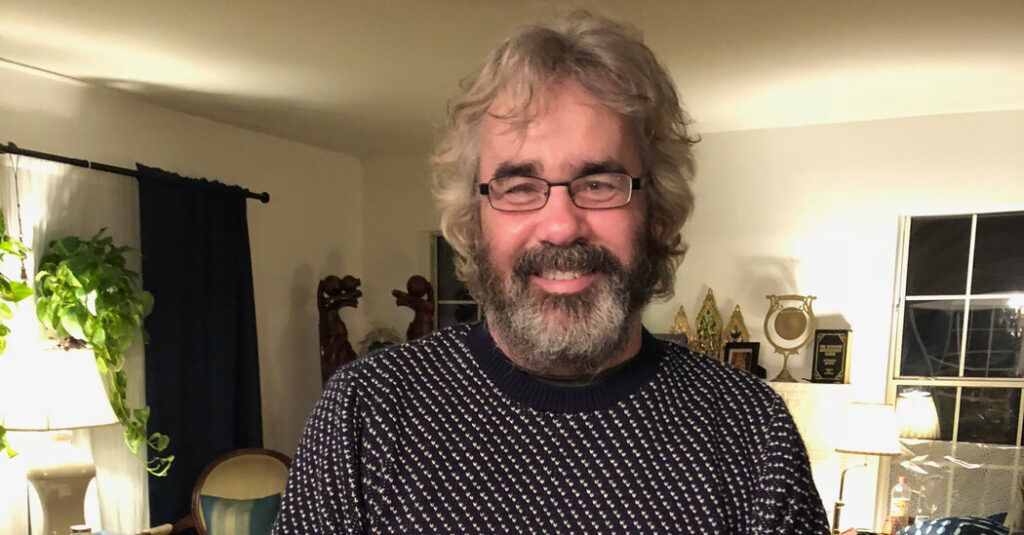
Brian Doherty, a writer who colorfully chronicled the libertarian movement in articles and books, most notably a sweeping history that covered eminent founding figures like the novelist Ayn Rand and the economist Milton Friedman as well as obscure oddballs with an anarchist streak, has died in Sausalito, Calif. He was 57.
Mr. Doherty was found dead on March 13 in Golden Gate National Recreation Area. His brother, Jim, said he fell the night before from a steep overlook of San Francisco Bay during a walk with friends who were scouting a site for an art performance. He had a leg injury and walked with a cane.
Mr. Doherty produced an eclectic body of work that had as a common thread his fascination with how bands of outsiders on the cultural and intellectual fringes infiltrate the mainstream. He was especially interested in movements with no central authority.
Besides libertarianism, he wrote books about 1960s underground comics and the Burning Man hippie-art-tech festival in the Nevada desert. For magazines, he covered seasteading, the notion of dwelling on the high seas beyond any national jurisdiction, and the Free State Project, which seeks to entice libertarians to move to New Hampshire and influence the state’s politics.
“Libertarians talk a lot about freedom and responsibility,” Katherine Mangu-Ward, the editor in chief of Reason, a libertarian magazine where Mr. Doherty worked for decades, recalled in the magazine’s announcement of his death. “Brian embodied both. His weird, colorful life — filled with comics and festivals and music and books — was a model of life lived freely and openly.”
Mr. Doherty called himself a libertarian “movement activist and movement watcher.” His book “Radicals for Capitalism: A Freewheeling History of the Modern American Libertarian Movement” (2007) is regarded as the definitive history of the political philosophy that opposes, in its pure form, nearly all government restrictions on business (taxes, say) and personal lifestyles (including legal heroin).
The book traces the roots of libertarianism in the work of the Austrian-born economists Ludwig von Mises and Friedrich von Hayek, and in Ms. Rand, the author of novels like “The Fountainhead” and “Atlas Shrugged,” who developed a personal cult around her.
Despite what he described as libertarianism’s “occasionally zany radicalism,” Mr. Doherty identified concrete policy wins for the movement in the abolition of the military draft in the 1970s, welfare reform in the 1990s and the rise of school vouchers in the 2000s.
Reviewing the sprawling history in The New York Times Book Review, the journalist David Leonhardt wrote that “libertarian arguments have enjoyed a nice run.” But he bemoaned that “almost everything about ‘Radicals for Capitalism’ is too long,” including rambling sentences of 100 words or more and an overall length of more than 700 pages.
“Evidently, its editor also had libertarian tendencies,” Mr. Leonhardt wrote.
The conservative writer Jonah Goldberg wrote in The National Review that Mr. Doherty at times “lapses into movement stenography” but that, taken as a whole, “Radicals for Capitalism” was “an extraordinary accomplishment.”
In 2012, Mr. Doherty wrote “Ron Paul’s Revolution,” about Representative Ron Paul, the Texas Republican and physician who ran for his party’s presidential nomination in 2008 and 2012 espousing hard-core libertarian views. He attracted a fervent youthful following for his antiwar, anti-government speeches.
“One of his biggest applause lines, to my astonishment, involves getting rid of the Federal Reserve,” Mr. Doherty wrote. “Kids have gathered, not just from Iowa but from Wisconsin and Nebraska, in classic hop-in-the-van college road trips, to hear a 72-year-old gynecologist talk about monetary policy.”
Mr. Paul finished third in the 2012 Iowa Republican caucuses and second in the New Hampshire primary, a high-water mark for a libertarian in American electoral politics.
Some of Mr. Paul’s burn-it-down anti-establishment energy was unleashed in 2016 by Donald Trump, a political figure Mr. Doherty abhorred for his authoritarian tendencies. One of his final pieces for Reason was an assessment of Mr. Trump’s second term under the headline “A Libertarian Nightmare.”
Brian Michael Doherty was born on June 1, 1968, in Queens, the younger of two sons of Francis Doherty Jr. and Helene (Cohen) Doherty, who soon moved their family to Florida. His father worked in the liquor industry, including managing a warehouse.
Mr. Doherty became a libertarian at the University of Florida in the late 1980s, from which he received a bachelor’s degree in journalism. But he traced his political tendencies even earlier, to his reading, as a 12-year-old, of a science fiction trilogy, Robert Shea and Robert Anton Wilson’s “Illuminatus!”
“One of the specific purposes of that work, according to Wilson,” Mr. Doherty later wrote, “was to do to the state what Voltaire did to the church — that is, reduce it to an object of contempt for all thoughtful people.”
Mr. Doherty worked for three years after college as a writer and editor at the Cato Institute, the libertarian think tank in Washington. He became an associate editor at Reason in 1994 — moving to Los Angeles, where the magazine is based — and also became involved with a group of performance artists called the Cacophony Society.
Its members were early participants in Burning Man, the festival in a pop-up locale in the Nevada desert known as Black Rock City. Mr. Doherty first attended in 1995.
“I had heard so much about Black Rock City’s functional anarchy that I had to go — anarchy being one of my primary intellectual interests,” he wrote in his first book, “This is Burning Man: The Rise of a New American Underground” (2004).
Mr. Doherty left Reason in the late 1990s but returned several years later as a senior editor. His predilection for very long sentences was once gently mocked by a colleague who made a T-shirt with a 39-word text he had sent over the magazine’s internal messaging service.
He wrote for other publications, including The Times, The Washington Post and The Wall Street Journal. His other books included “Modern Libertarianism” (2024), a capsule history published by the Cato Institute; and “Dirty Pictures” (2022), about underground comics artists like R. Crumb and others. It carried a Doherty-esque subtitle: “How an Underground Network of Nerds, Feminists, Misfits, Geniuses, Bikers, Potheads, Printers, Intellectuals, and Art School Rebels Revolutionized Art and Invented Comix.”
Mr. Doherty and a partner, Angela Keaton, called themselves husband and wife but, consistent with his disdain for government authority, never legally wed. The relationship ended in a separation around 2012.
He and another partner, Meghan Ralston, bought a home together in Cathedral City, Calif., near Palm Springs, but they also went their separate ways, in 2018, while remaining friends.
Mr. Doherty was living in Cathedral City at the time of his death. Besides his brother, he is survived by his mother.
“He was just passionate about oddballs, mystics, creative types, loners,” Ms. Ralston said in an interview. “People with real exuberances.”
Trip Gabriel is a Times reporter on the Obituaries desk.
The post Brian Doherty, 57, Dies; Chronicled Libertarians and Other Outsiders appeared first on New York Times.