The energy crisis caused by the Iran war is worse than the combined effect of the oil shocks in the 1970s, the leader of the International Energy Agency said on Monday, warning that it would take time to resolve even if the war were to end soon.
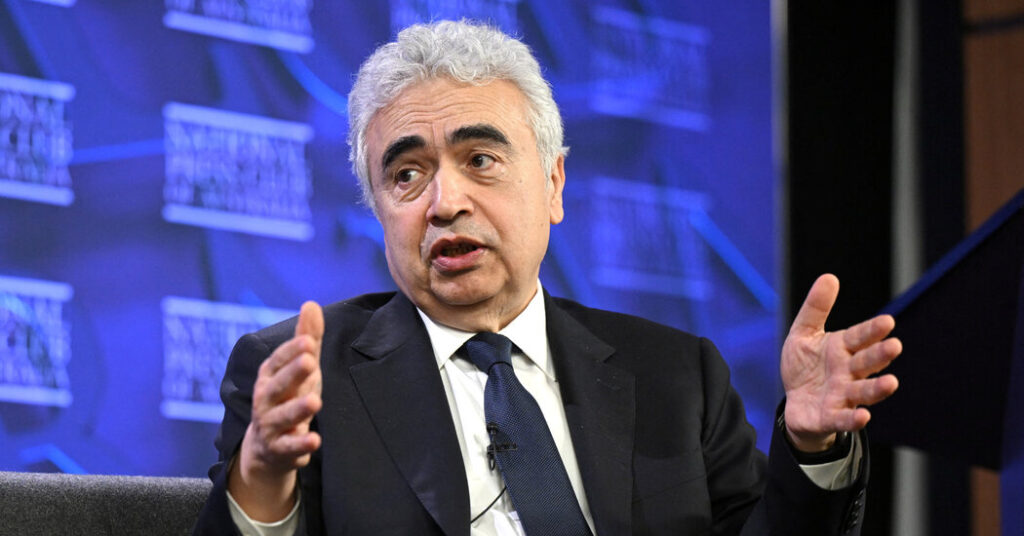
Fatih Birol, the executive director of the I.E.A., accused global decision makers of not appreciating the severity of the crisis. Speaking at an event in Canberra, Australia, he added that his agency, an organization of 32 nations, was in talks with governments in Asia and Europe about releasing more oil from their strategic reserves. Less than two weeks ago, it coordinated the biggest release of stockpiled oil in history.
“If it is necessary, of course, we will do it,” he said.
Mr. Birol cautioned that the severity of the shock meant that even once the fighting ended, the market would not recover quickly. “It will take some time to come back to the normal days we had before the war was started,” he said.
Hours later, international oil prices fell more than 10 percent after President Trump said the United States and Iran had held productive talks on ending the war. But Iran denied that discussions had taken place, and Mr. Trump has made conflicting statements throughout the war, highlighting the uncertainty that still hangs over the conflict and energy markets.
International oil prices spiked again early Monday, with the international benchmark crude topping $114 a barrel and then falling to around $100.
Iran has retaliated against U.S. and Israeli airstrikes by effectively closing the Strait of Hormuz, which accounts for about a fifth of oil transport, and targeting the energy infrastructure of American allies in the Persian Gulf.
Mr. Birol said he had refrained from speaking out publicly for the first three weeks of the war, but he was now ratcheting up his warnings about the lasting effects on oil and gas supplies and prices on the global economy. Last week, he told The Financial Times that the war in Iran was the biggest threat to global energy security in history.
On Monday, he said the war had caused the global oil supply to drop by 11 million barrels a day, more than 10 percent, compared with a loss of 10 million barrels per day from the oil shocks in 1973 and 1979 combined.
Mr. Birol added that the conflict in the Middle East had had a bigger impact on natural gas supplies than Russia’s full-scale invasion of Ukraine.
Iran’s retaliation against Israeli strikes on its energy infrastructure has included targeting the Ras Laffan complex in Qatar, the world’s largest liquefied natural gas processor. Qatar is the world’s third largest exporter of L.N.G. and a major supplier to Europe and Asia. The attacks have knocked out about 17 percent of the country’s L.N.G. export capacity and could take up to five years to restore it, according to Saad al-Kaabi, Qatar’s energy minister.
Mr. Birol made his comments at the start of a global tour that he started in the Asia-Pacific region, which relies heavily on oil and other commodities that are shipped through the Strait of Hormuz.
Ravi Mattu is the managing editor of DealBook, based in London. He joined The New York Times in 2022 from the Financial Times, where he held a number of senior roles in Hong Kong and London.
The post Energy Crisis Will Not Be Resolved Quickly if War Ends, I.E.A. Chief Warns appeared first on New York Times.