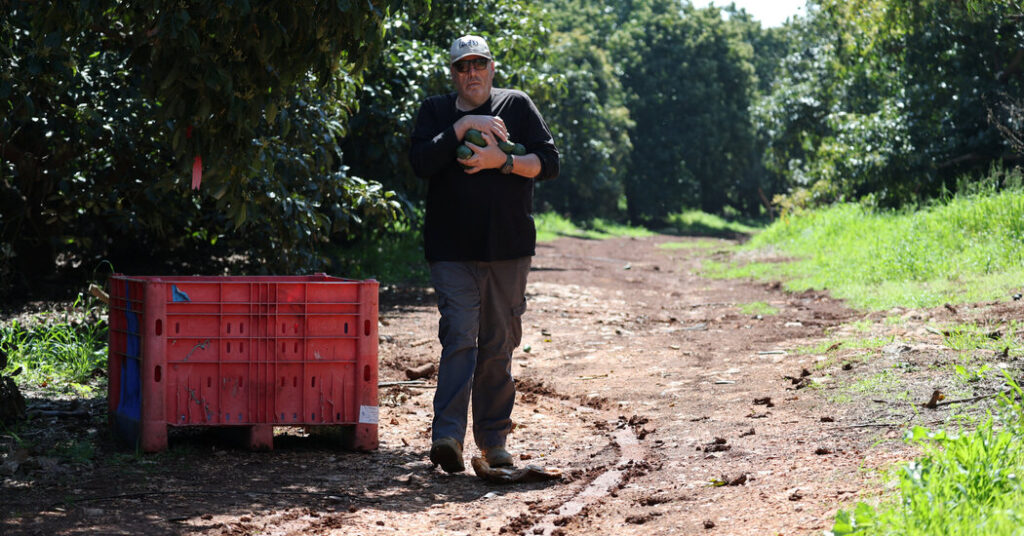
Israel’s military said on Monday that its own errant artillery had killed an Israeli avocado farmer a day earlier near the Lebanese border.
Tributes rolled in for the farmer, Ofer Moskovitz, a colorful raconteur who was killed on Sunday in Misgav Am, a kibbutz on the border with Lebanon. He was buried an hour south by car, in Kibbutz Amiad, near the Sea of Galilee.
Mr. Moskovitz, 60, who was better known as “Poshko,” had been featured in the Israeli news in recent days as a spokesman for Misgav Am, a tiny, 400-person community. He described how Israelis along the border cope with danger and how he could see Hezbollah flags hanging on Lebanese homes.
“A missile or a drone could fall on me at any moment. It’s Russian roulette,” he told a Haifa radio station in an interview on Friday, according to Ynet, an Israeli news site.
Hezbollah announced that it had fired a rocket barrage at Misgav Am at 8 a.m. on Sunday, and the Israeli military initially said that Mr. Moskovitz, who was riding in a car that was blown up, was killed in that attack.
Late Sunday, however, the military said it was investigating the possibility that Mr. Moskovitz had been killed by its own mistaken fire. And on Monday, it said an initial review had shown flaws in the planning and execution of its artillery fire, which was meant to support Israeli troops in southern Lebanon.
Five rounds fired “at an incorrect angle” were aimed at the Misgav Am ridge instead of toward the enemy target, the military said in a statement. It offered an apology to Mr. Moskovitz’s family and to the Misgav Am community.
Reached hours after the funeral on Monday, Mr. Moskovitz’s older brother, Ron Moskovitz, 63, said that the family harbored no animosity toward the soldiers responsible.
“In war, these are things that happen,” he said. “I, as a soldier or an officer — this could have happened to me, too. So I asked: Who are the people who are walking around with feelings of guilt? And we asked to pass on to them, to tell them, that we’re sending them a hug — because they, too, are victims of what happened.”
But Mr. Moskovitz was less forgiving of Israel’s political leadership. “The residents of the North were promised that the threat had been removed,” he noted, recalling a string of similarly triumphant — and, it turned out, false — assurances from the government.
“People want to be told the truth,” he added. “There are nuances, there are complexities. Leaders who are incapable of communicating complexity to their people — they should not be leaders.”
Mr. Moskovitz described his brother as larger than life, with unusual charisma and a wonderful sense of humor. He had arrived in Misgav Am for his military service and stayed afterward, serving as an unofficial spokesman for the Upper Galilee region and especially for its farmers.
He celebrated the birth of his second grandchild only last week.
“It’s an extreme transition from joy to sorrow that you can only understand if you’re Israeli,” Mr. Moskovitz said.
David M. Halbfinger is The Times’s Jerusalem bureau chief, leading coverage of Israel, Gaza and the West Bank. He also held that post from 2017 to 2021. He was the politics editor from 2021 to 2025.
The post Israel Says Its Own Artillery Killed a Farmer, Not a Hezbollah Rocket appeared first on New York Times.