Students at New York University returned from their spring break on Monday morning to find their Manhattan campus in turmoil, as hundreds of members of the private school’s faculty walked off the job over a contract dispute.
A union representing about 950 full-time faculty members who are not on track to earn tenure began their strike at 11 a.m., several minutes after the university’s lawyers responded to the union’s final offer, said Brendan Hogan, a spokesman for the union, the Contract Faculty United-UAW.
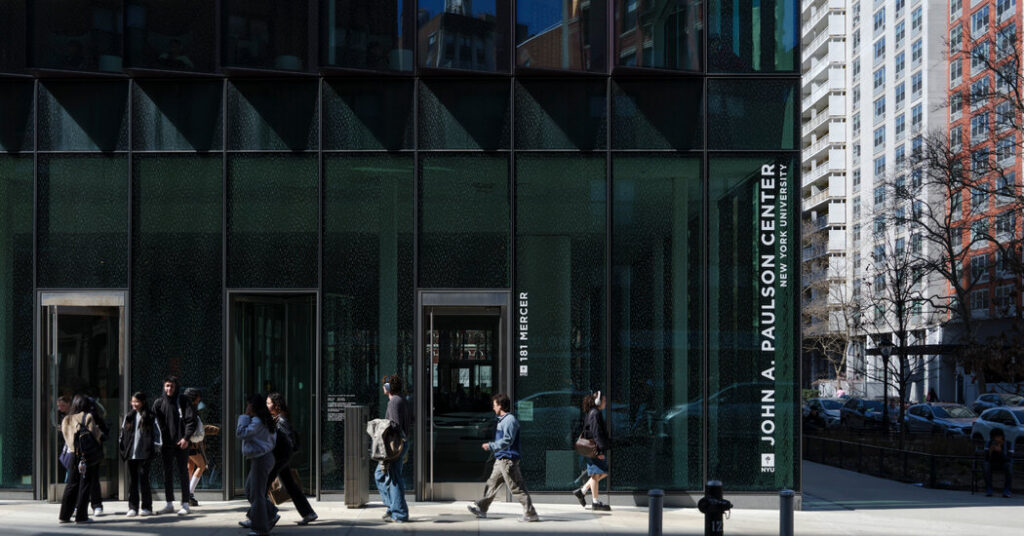
Mr. Hogan said that there was not time to review the latest counteroffer before a revised strike deadline of 11 a.m., so picketing began outside the John A. Paulson Center on Mercer Street. He said that the talks had not broken off and that the strike would continue until the bargaining committee had reached terms that it wanted to present to the members for a ratification vote.
Mr. Hogan said that the current negotiating session had been going on for 26 hours.
“There was a lot of 11th-hour back and forth between the bargaining committee and management,” he said. But “their response to our final proposal came to us at around 10:53 a.m., which did not leave enough time before the deadline for careful consideration.”
The faculty members’ walkout is the first since they formed a union and began bargaining over compensation and work rules in 2024.
Wiley Norvell, a spokesman for N.Y.U., said in a statement that classes would continue on Monday for more than 29,000 undergraduate students, with substitute instructors presiding over some classes, and with alternative plans being developed for others.
“We respect our unionized contract faculty, but this strike is fundamentally unnecessary,” the statement from Mr. Norvell said. “We have a collective responsibility to our students, and the union owed it to them to pursue every option at the negotiating table before disrupting their education. They haven’t.”
He said that the university had presented what he described as “a generous and comprehensive package that would improve the lives of every one of its members, including significant raises.”
The strike was authorized by a vote in February that was approved by 90 percent of the members, the union said.
The union members, who teach classes and advise students, have complained that they are paid far less than their colleagues who are on track for tenure or work under contract. Along with big pay increases and more job protections, they have demanded help offsetting the high cost of housing in New York, a benefit they said their colleagues receive.
“We’re bearing all of the housing costs, but we’re making around 60 percent of what the tenure-track faculty are making,” said Mr. Hogan, who teaches the history of philosophy. He said that the members shouldered 29 percent of the teaching burden at N.Y.U. but received only 2 percent of all the salaries paid to faculty members.
A spokesman for the university said that N.Y.U. had offered pay increases that would lift N.Y.U.’s starting salaries for assistant professors above $90,000 a year, the highest at any private university in the country.
N.Y.U. estimates that the total cost of attendance exceeds $100,000 a year for undergraduate students.
The school’s administrators had been planning for the strike by asking other instructors to cover classes taught by those on strike.
In a message to students last month, N.Y.U.’s president, Linda G. Mills, and its provost, Gigi Dopico, said that they were making careful plans “so your academic progress is not interrupted should a strike occur.”
The message continued: “If there is a strike, all students should plan to go to class. We have plans to cover classes if the instructor stops teaching. You will hear directly from a substitute instructor or will receive information about your affected class by email.”
But Mr. Hogan said it would take “a miracle” for the university to provide the instruction that the students require, especially those expecting to graduate this spring, without the union’s members. He said he had “10 brilliant students writing these amazing senior theses” that were due in mid-April.
“What will the university do to address their needs so they can complete their theses so they can graduate?” he asked.
Kaja Andric contributed reporting.
Patrick McGeehan is a Times reporter who covers the economy of New York City and its airports and other transportation hubs.
The post N.Y.U. Professors Go on Strike, Seeking Better Pay and Job Protections appeared first on New York Times.