This is an edition of The Atlantic Daily, a newsletter that guides you through the biggest stories of the day, helps you discover new ideas, and recommends the best in culture. Sign up for it here.
The American commercial-aviation system is a modern marvel. On any day of the week, a passenger can get to and from nearly any two cities of decent size and to destinations on five other continents, for a relatively affordable price and with exceptional safety.
Or at least all of that was true until recently. Today, the system seems near collapse.
Travelers around the country are facing long security lines: two to three hours at New York airports, three in Atlanta, two in Houston. Checkpoints are staffed by the Transportation Security Administration, which is part of the Department of Homeland Security. DHS has not been paying TSA workers since Valentine’s Day because of a partial government shutdown.
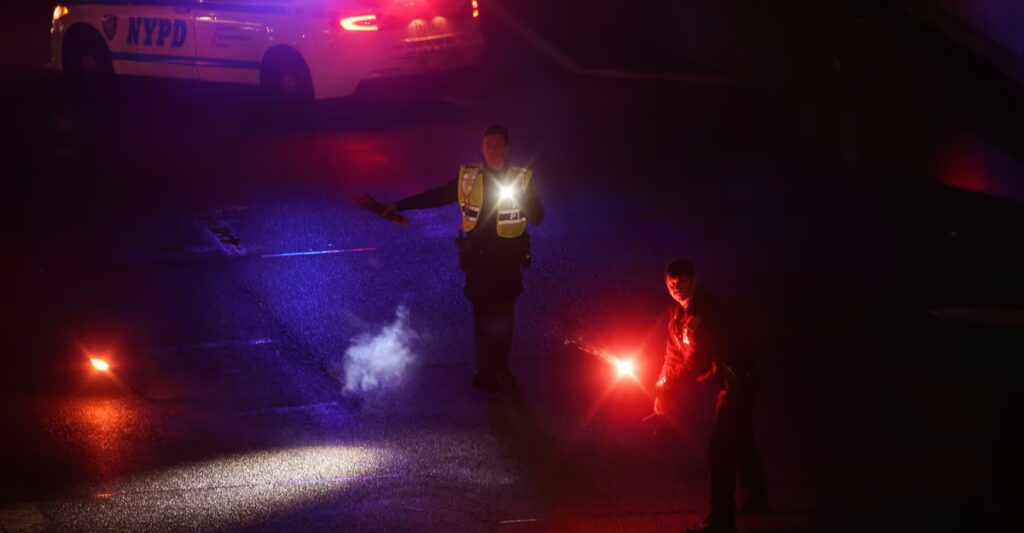
Meanwhile, at New York’s LaGuardia Airport, one of the nation’s busiest, all flights are paused until at least this afternoon after an Air Canada jet collided with an airport fire truck on a runway, killing two pilots and injuring dozens of other people. Nearly 1,000 flights leave from or arrive at LGA every day, and hundreds have been canceled.
A closure at LaGuardia puts pressure on other airports in the area, and they might not be prepared to handle any redirects. This morning, reports of smoke in the air-traffic-control tower at Newark Liberty International Airport, just across the Hudson River from New York City, caused a brief ground stop. Officials determined the problem was a burning smell in an elevator and reopened the tower, but this is only the latest sign of how broken Newark airport is. Last week, an Alaska Airlines plane nearly crashed into a FedEx plane on a runway at Newark, missing by just 300 to 325 feet, after pilots were instructed to avoid a collision. And earlier this month, a Singapore Airlines plane clipped the wing of a Spirit Airlines jet while pushing back from a gate. Last spring, air-traffic controllers lost the ability to track planes at Newark for two brief intervals, causing such stress that some of them took leave.
Each of these situations had its own specific causes, but what unites them is years of disinvestment capped by political dysfunction. Modern air travel was a classic postwar American triumph: a big, complicated system built with lots of money and careful tracking. Deregulation of the airlines in the 1970s made flying cheaper and more widely available. A careful, iterative process of safety regulation culminated in a 16-year period, from 2009 to 2025, when no U.S. airline had a fatal crash.
Yet the system was quietly eroding from within. For many passengers, the most visible sign was the deterioration of airports themselves. In 2014, then–Vice President Biden said that LaGuardia resembled “some third-world country.” Although LGA has since been renovated, other, more essential parts of the system have continued to get worse.
The federal government has been trying to run air-traffic control on the cheap for decades, which has resulted in staffing shortages and badly outdated equipment. Many towers are operating below recommended capacity. After the outages last spring, Transportation Secretary Sean Duffy panned the infrastructure used to keep flyers safe. “We use floppy disks. We use copper wires,” Duffy said. “The system that we’re using is not effective to control the traffic that we have in the airspace today.” Yet despite warnings from airlines and regulators, successive congresses and presidential administrations have failed to fix the problem. The FAA has also seen what’s known as “regulatory capture”: Cozy relationships with Boeing, for example, helped problems with the 737 Max escape notice until a pair of fatal crashes abroad in 2018 and 2019.
More recently, the FAA abruptly closed the El Paso, Texas, airport in a standoff with the Defense Department over laser weaponry. The FAA appears to have made the move as a desperate step after its safety worries weren’t taken seriously. The ploy worked: The FAA drew attention to its concerns and the airport reopened, but in any functional administration, this would have been resolved behind closed doors much earlier.
When an Army helicopter and an American Airlines jet collided near Ronald Reagan Washington National Airport last January, President Trump immediately jumped to blame DEI, a claim as nonsensical as it was repellent. Following multiple investigations, the FAA has changed some rules to prevent a similar incident, but Congress couldn’t agree on an air-safety bill that offered broader fixes.
A different sort of political dysfunction has snarled passenger experiences. TSA is charged with keeping travelers safe not from aviation failures but from threats of violence. While its approach has often been more security theater than essential, as Atlantic editor in chief Jeffrey Goldberg reported in 2008, some screening is necessary. But DHS is unable to pay agents for this work because of the partial shutdown. Following the killings of Renee Good and Alex Pretti in Minneapolis, Democrats have demanded reforms in exchange for funding the department, and neither they nor Trump have been willing to budge. TSA agents, who are not well paid in the first place, have not received paychecks since February, and the situation seems to have hit a breaking point in the past few days. (Some airports have begged people to donate gift cards or food for TSA agents.)
Over the weekend, Trump said that he would “move our brilliant and patriotic ICE Agents to the Airports where they will do Security like no one has ever seen before, including the immediate arrest of all Illegal Immigrants who have come into our Country, with heavy emphasis on those from Somalia.” (DHS has moved funds so that ICE agents, unlike TSA, are being paid.) Administration “border czar” Tom Homan has since said that ICE won’t be doing screening but will take on other, unspecified roles. The administration has insisted that border security is an emergency, so pulling agents off their jobs to do something else seems odd. More broadly, the administration is deploying ICE agents outside of their training in a dubious attempt to ease a political crisis created by ICE agents who had been deployed outside of their standard role in Minnesota. (Trump said today that he would deploy the National Guard to assist if ICE agents could not alleviate wait times.)
The ICE deployment is a particularly extreme example of what the political scientist Steven M. Teles has dubbed “kludgeocracy,” in which the government reaches for short-term, improvised solutions while resisting real reform. “‘Clumsy but temporarily effective,’” Teles has written, “also describes much of American public policy. For any particular problem we have arrived at the most gerry-rigged, opaque and complicated response.” The U.S. aviation system has been held together by such patches for years, but the kludges may finally be failing.
The post American Aviation Is Near Collapse appeared first on The Atlantic.