Much of the global worry over the closed Strait of Hormuz has focused on crude oil and natural gas, yet the waterway is also a channel for other key Gulf-produced commodities like fertilizer and helium. About third of the world’s helium and half of its urea, a vital nitrogen-based fertilizer, passes through the strait.
“Up to 15% of goods passing through the Strait of Hormuz are non-energy materials,” Sugoutam Ghosh, a supply chain management expert from the Singapore University of Social Sciences (SUSS), tells Fortune. “These include critical commodities serving as inputs for multiple industries—and any shortage would have cascading impacts on global agriculture and manufacturing.”
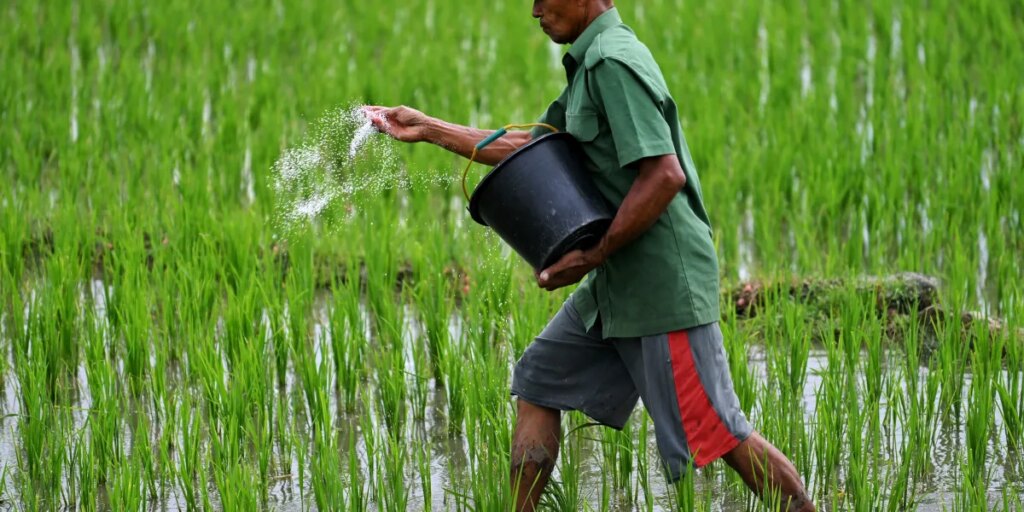
Southeast Asia is particularly vulnerable to an interruption in these supplies. Agriculture is the backbone of many ASEAN economies like Indonesia, Thailand, and Vietnam, where smallholder farms of rice, maize, and oil palm provide employment and food security. Farming contributes about 10% of Southeast Asia’s GDP and a third of its jobs.
“Fertilizer shocks are not just input-market issues. They’re also social and political ones,” warns Imelda Bacudo, an Indonesia-based agri-food systems expert with the UN’s Food and Agriculture Organization (FAO). “The risk is not only lower yields, but also reduced farmer incomes, higher rural vulnerability, and eventually, higher food prices for consumers.”
Many crops grown in Southeast Asia depend on fertilizer, even if the region doesn’t produce that much of it. According to a report by the International Institute for Sustainable Development, a 50% reduction in fertilizer use can reduce palm oil yields by up to 40%.
When it comes to fertilizer, experts think that countries can manage a supply shock in the short-term, whether by tapping stockpiles or turning to alternate products. But a prolonged closure would spell trouble for farms—and, in turn, for consumers.
An extended disruption “will have a negative flow-through effect on the next season’s crops,” warns Paul Teng, a visiting senior fellow at the ISEAS-Yusof Ishak Institute in Singapore. “Some farmers may even reduce their plantings, as they did during the early days of the Ukraine conflict.”
Helium, semiconductors and manufacturing
The supply chain upheaval also extends to helium, a key industrial gas used in cooling and leak detection. In particular, it cools magnets used in chip fabrication and MRI systems.
“A shortage of helium would pose a risk to both the semiconductor and healthcare sectors,” says Ghosh from SUSS, adding that substitutes are “highly challenging” to find.
“Gases such as nitrogen or argon could be used in older fabrication facilities, but they’re unsuitable for high-precision processes in advanced fabs,” he explains.
Older semiconductor fabrication facilities, such as those in Malaysia or Singapore, also lack advanced helium recycling capabilities. They can recycle just half of their helium, whereas high-end plants, like those operated by TSMC or Samsung, can reuse as much as 90%.
Chipmakers have responded by looking for alternate sources of helium, particularly from other large exporters like the U.S. and Russia, yet SUSS professor Tay Hui Ling says these measures simply “mitigate risk without eliminating it.” Actions like building stockpiles don’t address the underlying overreliance on imported helium.
Over the longer term, companies and governments could try to reduce their reliance on supply chains that travel through chokepoints. Industries can also invest in processes that reduce the use of these critical components: Firms that rely on helium can invest in recycling machinery, while the agriculture sector can turn to fertilizer alternatives like green ammonia.
Bacudo, from the FAO, sees a “real opportunity” for multilateral organizations like ASEAN, which can work together to hedge against some of these supply chain disruptions.
Still, Asian industries that rely on inputs from an unstable Middle East will need to manage a volatile commodity market. Even if the Iran war ends soon, shortages are likely to continue for months.
“This crisis looks less like a temporary shock, and more like confirmation of a more fragile era for critical inputs,” Tay, from SUSS, says.
The post The Iran war cripples Asia’s supplies of fertilizer and helium, threatening farms and chipmakers alike appeared first on Fortune.