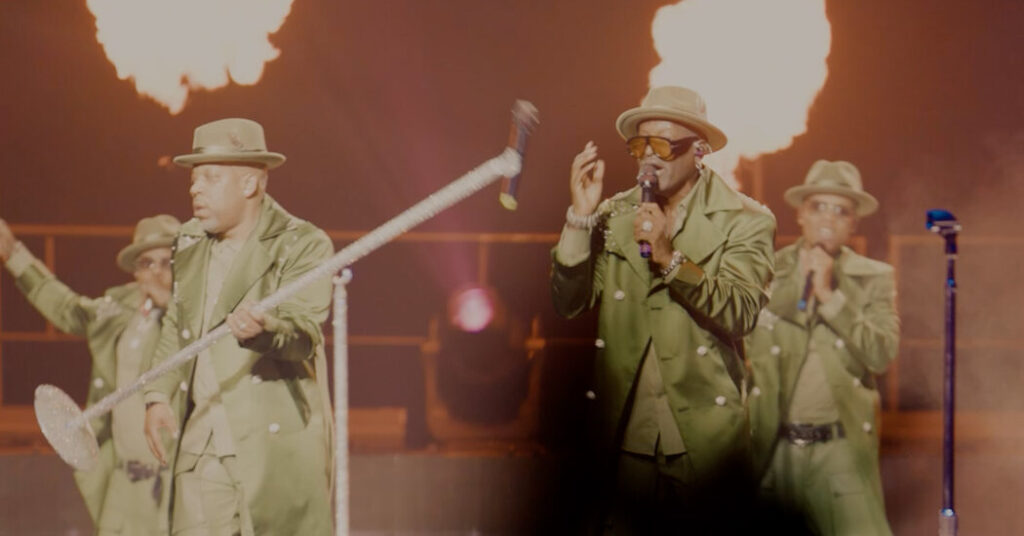
Among the “fame costs” lectures to performers about the pain and sweat required to be the best, the one in New Edition’s video for “If It Isn’t Love” (1988) is up near the top.
“The party’s over,” a man with a thin mustache, in sunglasses, tells the exhausted-looking New Edition members before locking them in a rehearsal room.
“It’s been a long vacation, and your fans are waiting to see you again,” he continues. “And you guys all know, how you look in rehearsal is how you come across onstage. So let’s do it one more time from the top, and let’s get busy.”
The man who delivers that tough love is not a fictional character. He’s Brooke Payne, the group’s choreographer, playing himself.
Payne was with New Edition in the early 1980s in Boston when the band was just starting. He came up with the name. And he’s with the group still, managing, choreographing and directing its current New Edition Way tour, which stopped at Barclays Center in Brooklyn on March 14.
This tour packages the group with its star successors, Boyz II Men, and its contemporary Toni Braxton. That makes the show a bulging catalog of chart-topping songs from the 1980s and ’90s. But it’s also a greatest hits collection of the choreography of Payne. At Barclays Center, those who sang along with all the songs — most of the crowd — also danced along with many of the routines.
Payne was instrumental in establishing how boy bands move. Building on the foundation of Motown groups like the Temptations and the Four Tops, he updated the approach — a “new edition” of those kinds of groups was precisely his idea. He worked out what that might mean on New Edition and its spinoff, Bell Biv DeVoe, and he had an influence on the white copycat act New Kids on the Block. His choreography served as a template for all the boy bands that followed: ’N Sync, Backstreet Boys, and the still-reigning kings of K-pop, BTS.
Payne, 66, had no formal dance training, he said in an interview before the Barclays show. He was a member of a few neighborhood vocal groups and created routines for them. “But the partners I was with just couldn’t stay focused,” he said. “So I started zooming in on the kids at the Boys Club right behind the project I lived in” — in the Roxbury section of Boston. Some of those kids, including his nephew Ronnie DeVoe, became New Edition.
Their routines emerged from the interaction of music and Payne’s imagination. “I see the choreography in my head before I teach it,” he said. “It’s always been a puzzle to the guys how I would teach two of them one thing and three of them something else, and when I put them together, they’re amazed at how they don’t bump into each other.”
Payne’s hero was Cholly Atkins, the tap dancer who became Motown’s chief choreographer in the 1960s, giving teenagers showbiz polish and adapting the basic steps of the Black jazz acts and chorus lines of the 1920s to the ’40s for the R&B of the era. Atkins called what he did “vocal choreography,” designed with a singer’s breathing in mind and continual awareness of microphone stands — when to back off from them for flashier moves and when to step up just in time to add a voice to the harmony.
This is at the heart of what Payne does, too. “That’s the main drive of most of the choreography — when they step up,” he said. “Because that’s the magic.”
The current tour exhibits how many ways Payne has for vocalists to step up — or to the side, squeezing in a spin or letting one slowly unwind. The motor of his choreography is rotary. As one or two members take a more static turn as lead vocalists, the others keep moving, in sync but often in relay or counterpoint, switching positions in daring feats of choreographic juggling.
Payne’s work contains what in K-Pop is now called “point choreography”: memorable, meme-friendly steps. Fans know the New Edition version of the two-step or the lunge that oozes along with the sliding note on the title word of Bell Biv DeVoe’s “Poison.” But it’s remarkable how little repetition there is, across songs and even within each song. In Payne’s choreography, as in Atkins’s most intricate routines, the body frequently registers rhythms different from those of the vocals, making the groove and accents visible.
The obvious model was Motown, and the resemblances between New Edition and the Jackson Five are strong. But Payne’s favorite vocal group was Blue Magic, 1970s purveyors of Philadelphia soul. “Theirs was really the style New Edition was built from,” he said.
The preference is revealing. Blue Magic’s choreography was mathematically musical and dense with steps. It was the group’s dancing, more than its singing, that led the writer Jamaica Kincaid to hail Blue Magic in The New Yorker as “the promise of the Temptations” — “fulfilled.” A signature Payne move — the deep bow at the end of each chorus of “If It Isn’t Love”— was also a go-to move for Blue Magic.
That bow is an expression of the theatrical etiquette that has remained at the core of Payne’s practice. Even as he kept up with the times and matched the hip-hop and new jack swing in New Edition’s R&B with pelvic thrusts, body rolls and party moves of the day, Payne stayed classy.
“Sometimes I’ll get some of the flavor of what the kids are now doing,” he said. “But the key is not to overdo it, not to put something in there where it looks like the guys are trying too hard.”
Now that the guys are all in their late 50s, Payne has to be careful not to overdo it in other ways. “I can’t break them like I used to break them,” Payne said, likening rehearsals to boot camp.
“They all understand I’m not there to burn anybody, but I’m not there for them to cheat, either,” he added, sounding like himself in the “If It Isn’t Love” video. “We drill until it’s right. They get tired, but that ain’t my problem. Nobody asked them to be entertainers.”
At Barclays, only Bobby Brown, who’s had a few heart attacks, really showed his age. The man who popularized the Roger Rabbit in the hoppy video for his 1988 solo hit “Every Little Step” could manage only fitful gestures in the direction of the old moves. “Go Bobby!” his bandmates and fans yelled in encouragement. “If you want to see me dance,” Brown said, “Google me.”
But while the current show is certainly a nostalgia trip — “Can I take y’all back to the ’90s?” Boyz II Men asks rhetorically; “Is it all right to take you back a little further?” New Edition asks later — it isn’t only about the old moves or what Payne called “looking for the thing where the audience is going to scream.” It’s also a demonstration of Payne’s skill in making a complicated production flow with the smoothness achieved by great Broadway choreographer-directors like Jerome Robbins and Michael Bennett.
Much of the boldest choreography in the show is new, created for the mostly female backup dancers who amplify the boy band routines and support the largely stationary Braxton (who has faced major health problems herself). Like Str8 Ahead, the women who backed up Bell Biv DeVoe in their heyday, these performers radiate strength, sass and sex appeal through their robust dancing. And they kill — a display of what Payne can do with professional dancers who don’t have to sing.
In his interview, Payne deflected questions about his legacy, though he admitted to being pleased when Beyoncé (and the choreographer Frank Gatson Jr.) paid tribute to his “If It Isn’t Love” choreography in her 2011 video for “Love on Top.” What matters to him, he said, is seeing audiences at New Edition concerts still doing those moves.
“It makes me feel like when ‘Thriller’ came out and everybody was doing that dance,” he said. “It’s part of the fans’ love for the group. I’m proud of that.”
The post The Man Who Taught Boy Bands How to Move appeared first on New York Times.