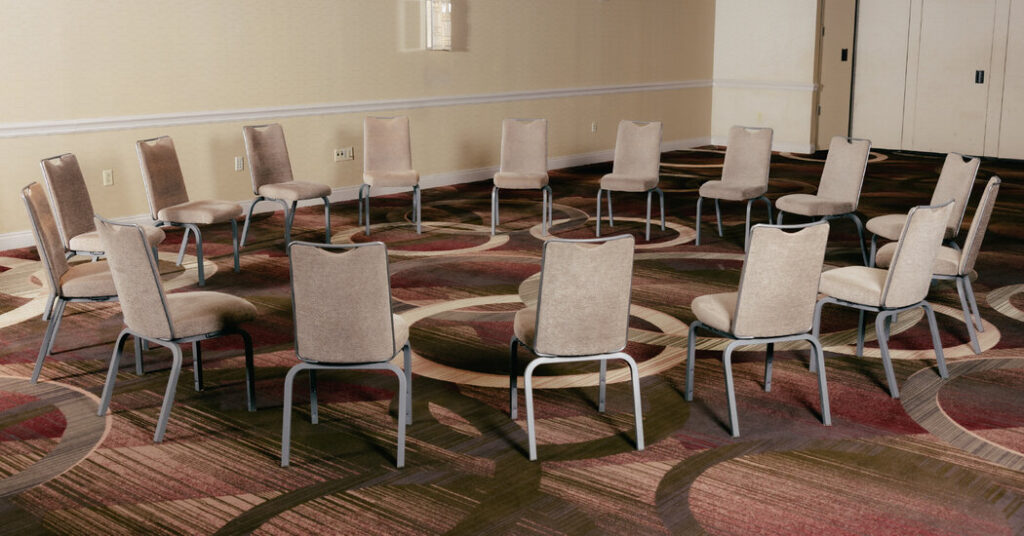
“Group: The Schopenhauer Effect,” a feature film by Alexis Lloyd showing in New York City through March 26, takes place inside a simulation of a Manhattan group therapy room. In this roiling psychodrama, nine actors — eight therapy patients, one analyst — dramatize the practice of group psychoanalysis, a place where characters — or patients — are encouraged to lend voice to their unconscious fantasies and urges. They say things like: “I’m very much in love with you” and “I want to punch you in the face.”
The drama intensifies when a new member appears in the room: a filmmaker named Alexis (the S is silent), played by the actor Thomas Sadoski.
In the film, where life imitates art imitating life, Alexis reveals that he wants to make a television series about group therapy, and cast the group’s analyst. The film mirrors the director’s experience with a group he joined in 2017.
I recently met Mr. Lloyd, 64, in his West Village apartment, where we sat in the living room he’d used for the film’s therapy set. In making “Group,” Mr. Lloyd had created a therapeutic ouroboros in which actors became patients, patients became characters, his psychoanalyst became a star, and a whole extended transferential family was formed, one defined by a narrative power struggle between the filmmaker and his 78-year-old therapist. When a director and a psychoanalyst make a movie about therapy, who is really leading the group?
How Fathers Figure
Mr. Lloyd’s story begins, as so many analytic sessions do, with his father. Alexander Lloyd, who worked as an analyst in Paris, once advised his son to join a therapy group to develop his interpersonal skills. “My father told me, ‘You’re going to need this in life because you’re an only child,’” he said.
Alexis never joined a group. But a few years after his father died in 2011, he sought to adapt “The Schopenhauer Cure,” a novel about group therapy by the analyst Irvin Yalom, for TV. It gave him the sensation of “transgressing” into his father’s world, he said, and led him back into the language of the unconscious that had marked his childhood.
In 2017, on the advice of his analyst neighbor, Mr. Lloyd attended an American Group Psychotherapy Association conference. The press pass dangling from his neck helped him catch the attention of Elliot Zeisel, a leader of the group therapy movement who had been running groups in New York City since 1973. Mr. Lloyd told him he had been struggling to write dialogue that mirrored the freewheeling dynamism of a real group session. Dr. Zeisel suggested that he join a group, and invited him to a session.
When Mr. Lloyd showed up for his first session, he told the group about his TV show idea, which was met with skepticism, hostility and envy. “I just kept coming, and they sort of accepted and resented it,” he said. He assured them he was interested only in learning the language and rhythm of group psychoanalysis. But “there was a lingering anxiety that fragments of their real lives would be recycled,” he said.
Their anxiety was exacerbated by Mr. Lloyd’s announcement that he wanted to cast Dr. Zeisel as the group therapist. “The reaction was very defensive,” Mr. Lloyd said. “You’re taking our group leader away from us. He’s going to go to Hollywood. He’s going to forget about us.”
“Group” debuted as a web series on YouTube in 2020. Mr. Lloyd gave the actors back stories, plot points and emotional beats and asked them to improvise for uninterrupted 90-minute takes — the length of a typical group session. Dr. Zeisel’s job was to run the room as if the characters were his patients. As the actors reacted in real time, they drew on their own histories and triggers, blurring the line between therapy and performance.
This month, Mr. Lloyd released “Group: The Schopenhauer Effect,” a feature-length film that expands the story of his fictional therapy group by introducing the autofictional Alexis character to the room.
When Dr. Zeisel urged Mr. Lloyd to join the group, he had given the filmmaker a chance to consummate his father’s desire. “Elliot told me that it wouldn’t work if I just came to be a fly on the wall,” Mr. Lloyd said. And he warned Mr. Lloyd that he would inevitably project his experience with his father onto the analyst. “The group leader is a father figure for the group,” Mr. Lloyd said. “And my actual father and Dr. Zeisel, they shared a lot in common.”
But when Mr. Lloyd started directing the “Group” series, he needed to shift the gears of their relationship. “My role now is to be the group leader of the film,” he told the analyst. As the filmmaker converted his apartment into a fictional therapy group, he terminated his treatment with the real group.
Group Within a Group
In 2017, Dr. Zeisel knew inviting Mr. Lloyd would provoke a strong reaction in the group. “Individual treatment is like being alone in a room with your mother,” he said. “Group is like being at the dinner table with your father and your siblings.” When a new member enters a group, Dr. Zeisel said, “it’s a little bit like a birth in the family. Whatever reaction you had when your sibling arrived, you’re going to have in the room.”
Mr. Lloyd was, in psychoanalytic terms, the new baby. “Pretty quickly, people wanted to be in the movie,” Dr. Zeisel said. “They wanted to be consulted about the movie. They wanted ownership.”
Dr. Zeisel wasn’t sure what he wanted. He weighed whether playing an analyst would be a distraction from the work of being an analyst. Eventually he saw his participation as a way of “walking the walk.” He said, “If I can take the risk to do this kind of work, it means they can take risks and do things in their lives that they might be frightened of doing.”
As Mr. Lloyd auditioned actors, Dr. Zeisel interviewed them about their histories and hang-ups, just as he does with potential group members. “We wanted to make sure they could tolerate it,” Dr. Zeisel said. More than one actor failed to make the cut. Dr. Zeisel recommended two of his longtime group patients for roles, one of whom, Gabriela Kohen, is also an analyst.
“My character was created to bring out stuff from the other actors,” said Ms. Kohen, whose character, Karina, is reactive, miserable and emotionally unstable. Since the series was released, she’s been confronted by colleagues and patients who recognize her as her “quite insufferable” character. Ms. Kohen has been working with her clients to process their feelings about watching her in the role. “As we say in the psychoanalytic world, it’s grist for the mill,” she said.
News of Mr. Lloyd’s developing series eventually spread to several of Dr. Zeisel’s 10 groups, which began unpacking the impact of the film as a part of their therapeutic process. “Here I was doing something outside of group with the group leader,” Ms. Kohen said. “There were many, many discussions about what this would mean.”
Meanwhile, the actors in the fictional group started to regard Dr. Zeisel less as a fellow cast member than as a transference figure. “He was my shrink,” said Teresa Avia Lim, who plays the group member Rebecca, in a recent Q&A after a screening at the Quad Cinema. “Not really, though. It was more like he was my dad.”
Another actress, Cara Ronzetti, said that her own emotional communication skills had evolved through the film’s therapeutic process, so much so that she said: “Watching the film, I’m cringing at myself. I’m like, Oh my god, why are you getting so upset right now?”
Dr. Zeisel insisted he had no trouble adjusting to the shifting power dynamic when Mr. Lloyd became the leader of the film project. “I gave myself over to his direction,” the analyst said. But when the cameras rolled, “it was my group. I was doing my work, and the pacing was my pacing.” The filmmaker would sit at a monitor in his kitchen, watching a fictional version of himself undergoing group therapy as Dr. Zeisel ran the group in Mr. Lloyd’s converted living room.
Mr. Lloyd’s experience in the real group had now been rerouted into a simulation under his control. Both the web series and the film were designed to be shot as super-long takes. But after Mr. Sadoski joined the cast as Alexis, Mr. Lloyd once disrupted the improvisational flow, breaching the living room to administer notes — like a group therapist interrupting the conversation to urge it in a new direction.
The actors dealt with the incident by having a “group within a group” moment to repair the rift, a process led by Dr. Zeisel. “I’ve actually dreamt about having a group process to process the ‘Group’ process,” Ms. Ronzetti said.
Blurred Lines
This month, Dr. Zeisel came to the American Group Psychotherapy Association conference, the very same place he had met Mr. Lloyd in 2017, to screen the film for an audience of more than 60 mental health professionals. He offered them an extended cut, including several scenes that had been shaved from Mr. Lloyd’s version. He then presented a two-day “learning lab,” in which the participants joined breakout group sessions to unpack Dr. Zeisel’s analytic work in the film.
I met Dr. Zeisel after the conference, and we took a cab downtown to have dinner with his wife, Mary Sussillo, a psychoanalyst. I asked Dr. Zeisel about what I had come to understand as two central rules of group therapy: Its members don’t talk about what happens in group, and they don’t see one another outside the group. It struck me that the film and its ever-expanding world of groups had required a near-constant transgression of those boundaries.
“We call this an ‘extra-analytic context,’” Dr. Zeisel said. “As long as I respect the boundaries of the relationship — I don’t go to dinner with you, I don’t go to bed with you, I don’t go to the movies with you — and we maintain the analytic nature of our work, within a certain framework, we can do things like that.”
After dinner, we went to the movies. In a special screening of “Group: The Schopenhauer Effect” attended by 30 members of the A.G.P.A. board, I counted five current or former group patients of Dr. Zeisel’s in the audience. I asked them, in one way or another, whether they felt Dr. Zeisel’s choices seemed in any way to bend the rules of group therapy — and soon received an email from Dr. Zeisel defending himself, which read in part: “While the parameters of individual therapy and psychoanalysis create a necessary insulation from the world outside, group treatment by definition creates a blur in its boundary between the inside and outside worlds.”
In our cab ride between the therapy conference and the therapy movie, I raised with Dr. Zeisel a fact about his biography that I had recently learned: that before he studied to become an analyst, he had been rejected by New York University’s film school. I asked whether his true motivation to join Mr. Lloyd’s project was to fulfill his own thwarted dream. “Yes, I had self-interest,” he admitted. “And yes, I have an undying devotion to seeing the field become better understood.”
After the screening, I met Dr. Zeisel’s adult son, David, and asked him what he thought of the film. As a child, David lived in an apartment two floors up from his parents’ offices and made every effort to avoid running into patients, or overhearing their conversations, out of respect for their privacy.
“To watch this goes against every instinct I have,” he said. “Something deep-rooted in me says: This is inappropriate. You shouldn’t be doing this.”
He added: “But obviously, it’s a movie. It’s not real.”
Amanda Hess is a writer at large for The Times.
The post When Group Therapy Went Heavy Meta appeared first on New York Times.