DARKOLOGY: Blackface and the American Way of Entertainment, by Rhae Lynn Barnes
When it comes to tracking down material related to amateur minstrel shows in America, the historian Rhae Lynn Barnes writes, you can often smell the evidence before you see it.
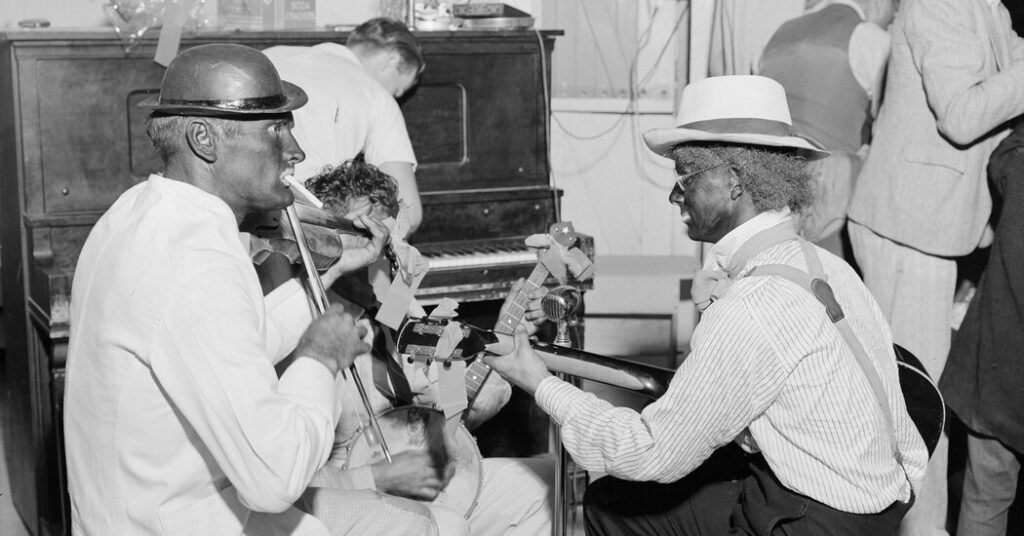
Barnes, who teaches at Princeton, has spent two decades rummaging in closets, basements, schools, churches, attics and estate sales — under the eaves of the American psyche — for the remnants of this egregious ephemera. It’s all evidence of a practice once so beloved that until the 1970s, rowdy, high-stepping, “comic” blackface shows were seen by most white citizens to be as American, as harmless and as appetizing as apple pie.
Libraries and archives were rarely helpful to Barnes: So much of this evidence (programs, photographs, songbooks, cans of burnt-cork makeup) has been lost, either concealed or purged. When Barnes was close, though, the smells of blackface theater — “cigarettes, liquor, greasepaint, aftershave, hair spray” — would charge the air.
Most Americans over a certain age, those who were paying attention, know this material is out there. Maybe you are old enough to remember newspaper ads for amateur blackface performances, which were held well into the second half of the 20th century. Maybe you glimpsed a souvenir matchbook. Maybe your great-uncle was in an Elks Lodge minstrel show.
Maybe you’ve read books about minstrelsy, like Eric Lott’s influential “Love and Theft” (Bob Dylan borrowed Lott’s title for his 2001 album), or journalism on the subject. But with her meticulous, cleareyed and pulverizing new volume, “Darkology: Blackface and the American Way of Entertainment,” Barnes is here to say that we do not know the half of it. She has scraped together everything that’s known and plastered new receipt after new receipt after new receipt to the walls of the historical record.
Because professional minstrelsy declined after the Civil War, Barnes writes, scholars mistakenly came to believe that it was in retreat across the culture. Instead, it went underground: Amateur shows more than picked up the slack. What seemed to be over was just beginning.
Nearly everyone who wasn’t the butt of the joke was in on it. “This is not a tale of fragmented, strange, isolated events, the work of backwoods fanatics or marginalized racists whose blacked-up faces leer from grainy yearbook photos,” she writes. “Amateur minstrelsy was no sideshow. It was at the dark and ever-present center of modern American life.”
The author is often at her best when detailing what blackface performances left in their shadow. They were crucial in perpetuating the stereotypes of Black people as lazy, criminal, lewd and illiterate. They generated “the cultural capital needed to justify racial inequality.” This was a white problem labeled the Black problem.
Barnes is an American aquarium drinker, with a nose for the dregs at the bottom of the tank. You can open up “Darkology” almost anywhere and find the squirming details. Emily Dickinson collected blackface sheet music; Elvis Presley, before his Sun recordings, played his music at a minstrel show in Memphis organized by his homeroom teacher; Doris Day, Gene Autry, Bing Crosby, Shirley Temple, Bob Newhart, Lou Gehrig and Frank Sinatra “blacked up” (as did a number of Black stars); Babe Ruth and presidents, including Abraham Lincoln, were fans of the shows.
The annual Gridiron dinners in Washington — the precursors to the White House Correspondents Dinner — regularly featured minstrel performances. John Lennon learned to play music on a banjo owned by his grandfather, who’d used it in minstrel shows. Looney Tunes sprang from minstrelsy’s DNA.
These things, some of them known, if not at the level of detail Barnes provides, are the tip of this book’s iceberg. In the years after World War II, she writes, “blackface was the national zeitgeist.” Her tone is rarely scolding. She does not advertise her moral purity. She is here to dispassionately collect the forensic evidence.
This book takes extended aim at the Elks, a social club founded by professional minstrel performers. The organization amassed political power (Supreme Court justices, military generals and presidents were members) and “normalized blackface as a charitable, positive, civic duty and intergenerational family tradition.”
If you grew up in a small town that had a seemingly innocuous welcome sign with fraternal emblems on it, this indicated, through the 1970s, the likelihood that one could see a minstrel show. To Black people and other minorities, the message was: Keep out.
Barnes investigates the publishers who issued blackface plays and guidebooks, for use in classrooms and churches, with advice on how to tailor the material for local audiences. One of the largest, T.S. Denison & Company, mailed 350,000 catalogs to customers in 1947. Three years later, in 1950, it shipped 5,000 minstrel wigs.
The author laments the paucity of hard information about these publishers. She wonders what their whites-only editorial meetings were like. “Did they discuss character names in plays for schoolchildren like ‘Hannah Rentfree,’ ‘Alabama Screwluce: A Chicken Raiser,’ or the blunt ‘Useless’?” One of Denison’s plays instructed performers to punctuate their lines with exaggerated blinks and to open their mouths very widely at the start of important sentences.
Barnes documents in scarifying detail how, under the progressive New Deal, including the Federal Writers’ Project and the Federal Theater Project, this material was both financed and distributed by the U.S. government. During World War II, kits were sent to soldiers to put on their own minstrel shows. Among the contents: burnt cork, wigs, tambourines, makeup advice, Stephen Foster sheet music and “tips for safely using spotlights without attracting enemy fire.”
There is a long, complicated section about how popular minstrelsy was among the Japanese Americans who were forced into detention centers during World War II. Another long section details Franklin D. Roosevelt’s obsession with blackface. On the day he died, in Warm Springs, Ga., he was scheduled to attend a minstrel show he’d commissioned and helped write. The show went on: White polio patients in blackface were among the performers.
Barnes also focuses on Gerald Ford’s long association with minstrelsy, information that his nearly 500-page autobiography does not mention.
The University of Vermont, and the town of Burlington, is placed under the microscope over the school’s popular and long-running Kake Walks. These lasted until 1969, and racist ice sculptures filled the town. Barnes profiles a Black student who was instrumental in bringing them to an end. She was almost injured in a riot that erupted.
Some long books you must feel your way into. Others smack you awake from their first pages. “Darkology” is among the latter. It opens with a 33-page introduction that is so vivid and shot through with annihilating detail that you wonder if she has anywhere left to go. She does. This book, I suspect, will detonate over certain corners in America.
If Barnes’s book has a fault, it’s an occasional lack of nuance, not in the unambiguously insidious use of blackface but around the subject of popular music and the slippery push and pull, and attraction and repulsion, inherent in what we now often generalize as cultural appropriation. A small section that’s critical of the Creedence Clearwater Revival frontman John Fogerty, for his early embrace of Foster’s minstrel music and for his faux-Southerness, for example, reads as if she has never listened to him.
“Darkology” is a major and thrilling work of American history. It deals out uncomfortable truth after uncomfortable truth. James Baldwin understood its subject implicitly. “It comes as a great shock around the age of 5, 6, 7,” he said, “to discover that the flag to which you have pledged allegiance … has not pledged allegiance to you.”
DARKOLOGY: Blackface and the American Way of Entertainment | By Rhae Lynn Barnes | Norton | 501 pp. | $39.99
Dwight Garner has been a book critic for The Times since 2008, and before that was an editor at the Book Review for a decade.
The post Blackface: A Shameful History as American as Apple Pie appeared first on New York Times.