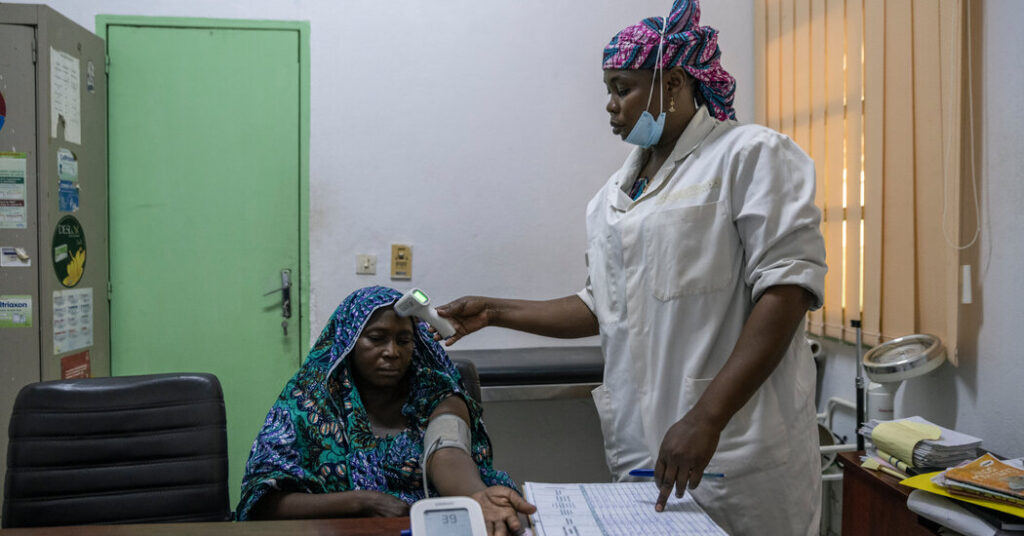
The sun has not quite risen when Dr. Paulette Djeugoue arrives at her diabetes clinic in northern Cameroon. The wooden benches outside are already full with patients, some of whom have spent the night there, waiting.
Dr. Djeugoue is the only diabetes specialist for thousands of miles, and her patients come from villages scattered across the north; some have crossed borders from Nigeria or Chad. She unlocks the door and settles in, with a nurse by her side to translate the half-dozen languages her patients speak. She won’t leave until the sun has set.
Even with the throng of patients at her one-woman clinic, Dr. Djeugoue knows she is seeing just a tiny fraction of those who need care. An estimated 75 percent of people with diabetes in Cameroon have no idea they have the disease; the portion is even higher in the poorer and more rural parts of the country, like this one.
There is a striking epidemiological shift underway here in Cameroon and across much of Africa: People now face as much risk of dying from a noncommunicable disease such as diabetes as they do an infectious one, such as malaria.
Historically, health systems here have been structured and funded to focus on infectious threats, which pass from person to person, and they have made progress in bringing down death rates for H.I.V. and tuberculosis.
Only now are steps being taken to try to bring the resources and personnel essential to address diabetes, a disease that is estimated to afflict some 54 million people in Africa and that can cause blindness, amputations and death. One of the aims now is to screen and treat diabetes as part of primary care.
The push comes as there is growing recognition that the disease has a different, insidious form in places like this, where it has long been misunderstood and overlooked. Last year, the International Diabetes Federation recognized a new form of diabetes, called “Type 5,” that afflicts undernourished people, such as many of the patients Dr. Djeugoue sees.
When Dr. Djeugoue opened her clinic six years ago, she found patients who had been hospitalized a half-dozen times without anyone testing their blood sugar levels. “They were so focused on malaria and typhoid,” she said of her colleagues.
Now, the hospital screens blood sugar for every patient.
Dr. Djeugoue did a radio and TV blitz not long after she arrived from the capital, Yaoundé. She explained the basic symptoms of diabetes, including extreme thirst, frequent urination and blurry vision, and how to ask a health facility to test for the disease. That brought many new patients to her clinic.
But that only solved a first problem: Patients might scrape together the 2,000 francs, about $4, for a consultation with her. She would prescribe medications and tell them to return in a few weeks. But many did not return, when they could not gather the money for transportation or the hospital fee. She might not see them again for three years, until they turned up in the emergency ward with lost vision or damaged kidneys.
Of the fraction of people with diabetes who know they have the disease in Cameroon, just a third are taking medication to control it, according to Dr. Eugene Sobngwi, a diabetes specialist and director at the Ministry of Public Health. One reason is cost: While national H.I.V. and malaria programs offer treatment and care for free, with support from international funding, there is no such program for diabetes.
Insulin is free for children, but adults must pay, and a month’s dose costs the same as a basic laborer’s monthly wage. Many patients ration doses, taking half or less of what they should to stretch through a month.
A blood glucose test to screen for the disease costs 500 francs, about a dollar. “Can most patients pay that? No,” said Dr. Jean Claude Mbanya, who, when he trained as a diabetes specialist 40 years ago, was the only one in the country.
Innovations such as continuous glucose monitors, in wide use in high-income countries, are not available at all here. The companies that make them don’t even bother to register them for import, said Dr. Sobngwi, most likely because they assume the market won’t be big enough to justify the effort. He hopes that a growing drug industry in Cameroon will start to produce both insulin and other drugs and supplies, and that the growing domestic market will help bring down prices.
Aminatou Mana, 53, cycled in and out of hospitals in Maroua for seven years before she was diagnosed with diabetes last year and sent to see Dr. Djeugoue. The doctor prescribed her a daily dose of metformin, a medication to increase insulin sensitivity, that was made by a company in India. But most months, she runs out of money to buy it by about the third week, she said, and then she feels weak and dizzy.
“I cried and cried when I was diagnosed,” she said. “When they told me I had it, they said it was forever and I’d never be cured.”
Her consultations with Dr. Djeugoue, and the tests she needs beforehand, can cost $40 or $50, far more than her family earns in a month. She has had to abandon her own job selling baked goods because diabetes has caused her vision problems.
Her neighbors scoff when she heads to clinic appointments, she said. They tell her a traditional healer could cure her, while the hospital is a scam.
Ms. Mana knew little about diabetes when she was diagnosed. “People say it’s a disease of the rich — so how can it be that I’m so poor and I’ve got this?” she asked. “The rich eat well and eat sweet things.”
The two forms of diabetes common in industrialized countries are Type 1, an autoimmune condition where the pancreas stops producing insulin, which often starts in youth, and Type 2, a metabolic disorder where cells don’t use insulin properly, which is often associated with obesity. Type 5, the newly identified form resembles Type 2, but it’s found in lean people who may be underweight, like Ms. Mana.
“It’s not what we are trained to expect,” Dr. Djeugoue said, gesturing at the waiting area full of tall, lanky patients.
Researchers believe this form of diabetes is caused by early-life or chronic malnutrition, rather than genetics or the lifestyle factors associated with Type 2. Lack of food keeps a person’s pancreas from developing normally. Unlike with people who have Type 1, the body does not attack its own pancreas, and unlike with Type 2, the body’s cells remain sensitive to insulin; they just don’t have enough of it.
Dr. Sobngwi estimated that a third of diabetic patients in Cameroon are lean or underweight. But the disease is even less likely to be accurately diagnosed in patients with those body types, he said. When these are diagnosed as diabetic, they can be at risk from improper treatment because clinicians don’t realize their body processes insulin differently — they don’t need heavy doses of insulin, weight-loss drugs or high-carbohydrate diets. Research is just beginning on the best treatment options, and clinicians are testing a diet full of legumes and the use of medications that support the body’s insulin production.
Dr. Djeugoue said she and the handful of other endocrinologists in Cameroon needed to study the phenomenon, but there are few resources for research and even less time. She is training a doctor and a nurse in each district in the far north in how to manage diabetes, and setting up a phone line so they can call her about complicated cases. A few of the other endocrinologists in the country have agreed to help take calls as well. (Last year, the national medical training program sent eight doctors to Europe to train in endocrinology; only one returned to work in Cameroon.)
In Yaoundé, the national reference hospital has a diabetes center. Tucked way at the back, behind the morgue, are beds for patients who need critical care, and beds for those who have the infected foot and leg wounds common in people with poorly managed diabetes. Dr. Martine Etoa Etoga, who directs the center, said her goal is to keep patients out of it: With some front-loaded investment in prevention and screening, the health system may be able to spend less money treating people with complex complications — such as kidney dialysis — and more on basic education, prevention and screening.
But there is progress. Starting this year, 6,000 of the community health workers who deliver most primary care in Cameroon will be equipped with blood glucose meters and blood pressure machines. Dr. Sobngwi said he hopes six million people will be screened, achieving the first step of identifying patients, even if medications and testing remain a challenge.
On a recent morning, Dr. Etoa Etoga prepared to discharge Jean Abologo, a 61-year-old house painter who had arrived with a gangrenous leg wound. He’d been given a host of misdiagnoses before he landed in her clinic, with none of the other classic symptoms of diabetes. He was worried about his hospital bills but keen to go home. His leg was healing, and Dr. Etoa Etoga had managed to avoid amputation and prescribed the medications he would need each day.
“I have to find the money because I have a chance at a new life,” he said.
Stephanie Nolen is a global health reporter for The Times.
The post Diabetes, Overlooked and Unchecked, Poses New Risks in Africa appeared first on New York Times.