In March 2006, Bravo aired the first episode of “The Real Housewives of Orange County,” ushering in an era of reality television that’s become inescapable — even if you don’t watch the shows.
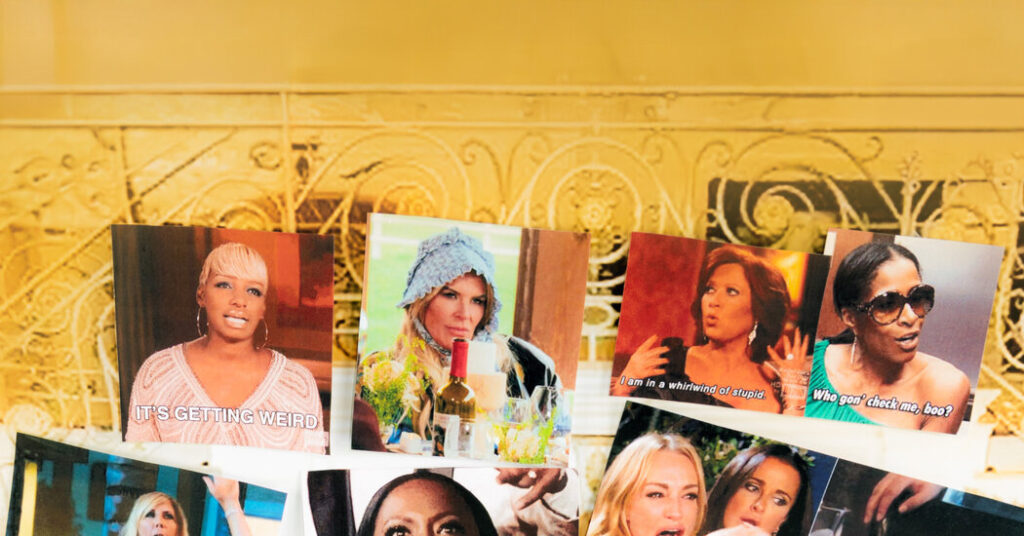
That’s because the “Real Housewives” franchises (they now include New York City, Atlanta, Dallas and Dubai, with another, “The Real Housewives of Rhode Island,” on the way), and the tendency of their cast members to tease, yell and flip tables when they get together, are irresistible to anyone who knows how to make a meme. Traded on social media, in emails and texts, they are a way of communicating for those who speak their coded language.
Often the clips show just a few seconds taken from one episode, and they don’t always make sense stripped of their context. How do they become memes with staying power? When a cast member’s “veneer falls and their vulnerability and humanity comes through,” said Sherri Williams, an associate professor in race, media and communication at American University. “That, along with the amplification of social media, creates a moment of truth and a meme.”
Those moments, which Tanya Horeck, a professor of film and feminist media studies at Anglia Ruskin University, defines as “little bundles of affect,” thrive on the internet. “People who haven’t even watched the show can understand those memes,” she said. “They can use them because of how legible they make certain emotions.”
These are some that, over the past 20 years, seem to have taken on lives of their own.
‘Real Housewives of New Jersey’
The table flip.
Circa: 2009
Origin story: An enraged Teresa Giudice upended a dinner table at LuNello, an upscale Italian restaurant turned reality TV landmark in Cedar Grove, N.J., during a heated group argument over a book written about Danielle Staub. The table flip, which sent red wine and food flying, put an end to the back and forth and brought this franchise’s first season to a dramatic end.
Proper usage: When you need to convey frustration. When you’re not being believed or heard. A top contender for the “Housewives” meme hall of fame, this particular scene, said Sherri Williams, the American University professor, “embodies the franchise.”
‘Real Housewives of Atlanta’
‘The lies. The lies. The lies.’
Circa: 2017
Origin story: The truth. The truth. The truth. Nobody hunts for it like a “Real Housewives” cast member. It is a running theme on every iteration of the shows. Kandi Burruss blurted out this phrase during the show’s Season 9 reunion after learning that a false rumor — that she wanted to sexually assault Porsha Williams — was spread by fellow cast member Phaedra Parks.
Proper usage: When you’ve had it with someone’s dishonesty. According to Sherri Williams (no relation), a variety of memes from the show are used in group chats to “punctuate our feelings and our experiences.”
‘Real Housewives of Beverly Hills’
The cat meme.
Circa: 2011
Origin story: This one takes some explaining, but first off, there was no cat in the “Housewives” episode. In Season 2, Taylor Armstrong struggles with forgiving Camille Grammer for airing details of abuse by her then-husband. Tensions later rise at a party where Grammer’s friend attempts to defend her behavior, leading Armstrong to shout in anger. A meme maker later swapped out Grammer’s friend for a white cat named Smudge. Why? Nobody knows.
Proper usage: When you need to comment on a bewildering conflict. This meme began circulating widely in 2019 and soon appeared on everything from clothing to paintings, Armstrong told BuzzFeed in 2022, adding that she was not bothered by its popularity, despite its dark origins. “I’ve come so far since then that I find the meme hysterical,” she said.
‘Real Housewives of Orange County’
‘That’s my opinion!’
Circa: 2014
Origin story: Who among us hasn’t told a friend that her boyfriend doesn’t seem to be a good guy — and gotten our head bitten off as a result? During the Season 9 reunion, a shouting match between Tamra Judge and Vicki Gunvalson over the quality of Gunvalson’s boyfriend at the time culminated in this response from Judge, delivered at earsplitting volume.
Proper usage: When you need to express an unwanted viewpoint to a friend, or maybe frenemy. Williams said such angry retorts often become a cast member’s defining moment because audiences see it as “real, raw, unfiltered emotion.”
‘Real Housewives of Potomac’
‘But still, I rise.’
Circa: 2025
Origin story: Maya Angelou was one of the best-known writers in U.S. history and the author of “Still I Rise,” in which she wrote “You may trod me in the very dirt / But still, like dust, I’ll rise.” In a moment of considerable poetic license, Stacey Rusch recites this line at the show’s Season 9 reunion after defending herself from accusations that she may have faked her relationship with an ex-boyfriend.
Proper usage: When you’re feeling lyrical but confident amid life’s trials and tribulations. Rusch’s show of resilience quickly went viral on TikTok in 2025, with fans of the show parodying the moment.
‘Real Housewives of Salt Lake City’
‘High body count hair.’
Circa: 2024
Origin story: In an argument at a bat mitzvah during the show’s fifth season, Angie Katsanevas (above left) tells Britani Bateman (not pictured) that her teased hair, dress and shoes make her look sexually promiscuous or like a porn actress.
Proper usage: When you’re throwing shade. Tanya Horeck, the Anglia Ruskin University professor, said that memes like this feed into a wider “culture of nastiness,” adding they are appealing because of their mean spirit. Slut-shaming, she said, was one of several problematic themes that run throughout the franchises.
‘Real Housewives of New York’
‘Clip! Clip! Clip!’
Circa: 2017
Origin story: At a boozy lunch during the show’s ninth season, Dorinda Medley denies wanting to be a part of Tipsy Girl, a brand of wine started by Sonja Morgan. In an effort to silence Morgan, Medley yells “Clip! Clip! Clip!” clamping her thumb and four fingers together.
Proper usage: When you need to quiet a hater. “I have no idea where that comes from,” Medley wrote in a Bravo blog in 2017. “I just couldn’t figure out a away [sic] to stop Sonja from saying more lies!” Horeck said that the cast of “Real Housewives of New York” was excellent at knowing what to deliver for audiences. “Performance is absolutely key to the memes,” she said, adding that Medley’s animated behavior was made for TV. (Perhaps proving her point, Medley has since appeared on two consecutive seasons of “The Traitors.”)
‘Real Housewives of Atlanta’
‘Whew, child, the ghetto!’
Circa: 2013
Origin story: NeNe Leakes delivers this infamous line in Season 6 when she visits Kenya Moore, a fellow cast member with whom she has often clashed, who was staying in a hotel located in a less affluent area. (Leakes’s other comment about the hotel’s white refrigerator from the same episode is another frequent pop culture reference.)
Proper usage: When someone wants to (condescendingly) signal substandard or low-quality conditions. Wealth is a major component of the “Housewives” shows — whether it is real or manufactured, Williams said. The scene stoked conversations about money and class among viewers.
‘Real Housewives of New Jersey’
Gia Giudice’s Song
Circa: 2011
Origin story: Rifts between family members and close friends are common plot points on the “Housewives” series, particularly the New Jersey franchise, where one cast member memorably describes her family as “thick as thieves.” When Gia Giudice, the eldest daughter of Joe and Teresa Giudice, performs a song that she wrote about her family’s drama in the show’s third season, it is an emotional wake-up call.
Proper usage: When you’re comically referencing struggle, like a rocky week at work or a tough semester at school. This meme is an example of how moments from the shows lose their original message when they go viral (see Will Smith using it to describe the regret of making a St. Patrick’s Day video in his hotel room). “Some reality TV is contrived and manufactured,” Williams said. “The real emotional moments aren’t and when they translate into memes, the real heartfelt emotion that was originally expressed ends up getting lost in translation.”
Derrick Bryson Taylor is a Times reporter covering breaking news in culture and the arts.
The post ‘Real Housewives’ Changed the Way We Argue. Blame the Memes. appeared first on New York Times.