The game has changed.
From the moment the United States and Israel attacked Iran, the nightmare scenario for the global economy that most people talked about was the closing of the Strait of Hormuz, the most important choke point for oil on the planet.
But a different and more disturbing nightmare began to unfold with direct attacks on the backbone of the Persian Gulf region’s energy production: the prospect of millions of dollars’ worth of long-term damage to facilities that supply a critical portion of the world’s natural gas.
Now, instead of wondering if the war would last for days or weeks, officials and economists are speculating about effects that could last for months and years.
“We have moved from stopping transit, which is a temporary measure, to attacking infrastructure, which has long-term effects,” said David Goldwyn, a former U.S. diplomat and Energy Department official.
This new phase of the war began Wednesday, when Iran carried out a retaliatory missile strike on Ras Laffan, Qatar’s vast energy complex. That target produces roughly a fifth of the world’s liquefied natural gas, a transportable fuel used to heat homes, cook food, power factories and generate electricity throughout Asia and Europe.
Iran hit other refineries and gas facilities in Kuwait, Qatar and Saudi Arabia on Thursday. The strikes followed an Israeli attack on Iran’s South Pars natural gas field.
Officials and workers are still picking through the rubble, and the full extent of the damage has not been assessed. Even so, Saad Sherida al-Kaabi, Qatar’s energy minister, said Thursday that it would take up to five years to repair and would reduce the country’s export capacity 17 percent.
The attacks showed that despite Iran’s relative weaknesses, the country is exerting enormous leverage over the global economy. By using small-scale, low-cost weapons to counter highly sophisticated and expensive missile systems, Mr. Goldwyn said, the Iranians “have demonstrated a long-term threat to be able to attack infrastructure throughout the Gulf.”
A lot remains uncertain. And circumstances on the ground — and behind political leaders’ closed doors — change at a dizzying pace. Will the attacks escalate, with more on critical energy infrastructure? How long will the strait be closed? How long will the war last? What happens after the fighting stops?
At the moment, although many energy facilities in the Persian Gulf have suspended operations, most are intact.
“We’re still in a place where if the strait were to open tomorrow, most energy production in the region could come back online reasonably quickly,” taking a couple of months, said Jason Bordoff, founding director of the Center on Global Energy Policy at Columbia University.
But the situation could change at any moment if attacks continue, he added.
What is clear is that the damage from this pressure on the world’s energy supply and shipping industry has the potential to put the global economy on a different and more dangerous trajectory.
“This is by far the largest disruption of crude oil and refined products that we’ve ever seen in history,” said Jason Miller, a professor in supply chain management at Michigan State University. “Petroleum goes into everything,” he said, so the inflationary impact could be enormous.
Analysts at the energy consulting firm Wood Mackenzie have already warned that $200 a barrel is not outside the realm of possibility in 2026, up from about $73 before the war.
“I couldn’t fathom we would not start seeing economies fall into a recession with energy prices at that point,” Mr. Miller said.
Higher energy prices tend to slow economic growth, increase unemployment and speed inflation.
It is also important to note that the price of diesel and jet fuel — which are processed differently — generally rise faster than the gasoline that drivers buy at the pump. And that has a disproportionate effect on moving goods around the globe, whether by plane, ship or truck.
Those elevated energy prices could eventually increase the price of practically every avocado, automobile, pair of sneakers, cellphone and drug that is bought and sold around the world.
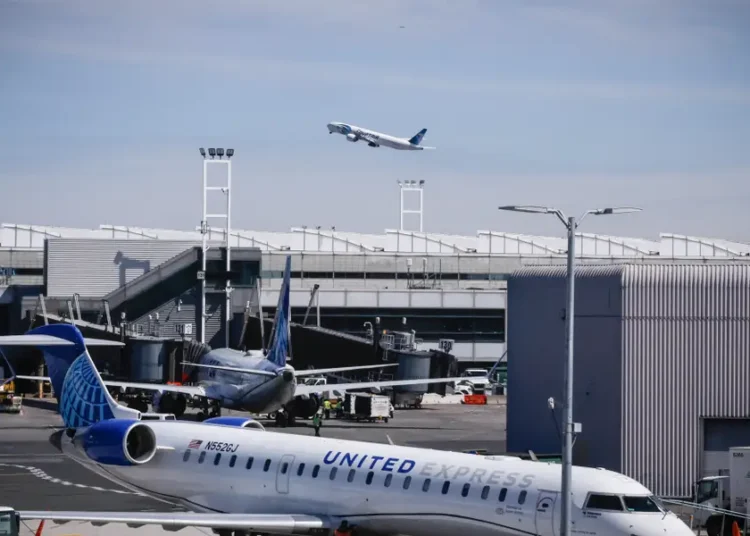
Shippers in some regions also have to contend with soaring freight prices, closed routes, stranded ships, long detours and high-risk insurance rates.
Thousands of vessels are backed up in the Persian Gulf. And shippers like Maersk and CMA CGM have told clients that they reserve the right to dump their containers at the nearest available port. Customers would be left to pick up the additional charges.
Though oil tends to grab headlines, the supply of natural gas in many ways is at the heart of the economic fallout from the intensified fighting in the Gulf this past week.
The facilities for processing liquefied natural gas, or L.N.G., are far less numerous than oil plants. Qatar’s, the world’s biggest, has not been operating for weeks, and is damaged. That also affects the price and availability of critical materials like fertilizer and helium, a byproduct of natural gas that is used to make semiconductor chips.
Jan-Eric Fahnrich, a senior analyst at Rystad Energy, said the impact went beyond the damage to gas fields. Critical Gulf energy infrastructure that was presumed to be safe is now seen as vulnerable, he said. A precedent has been set.
“Buyers will price that risk for longer than the initial outage itself,” Mr. Fahnrich wrote in an analysis.
Countries in Asia and Europe, which depend on L.N.G., are likely to face more expensive gas prices long after the Strait of Hormuz reopens.
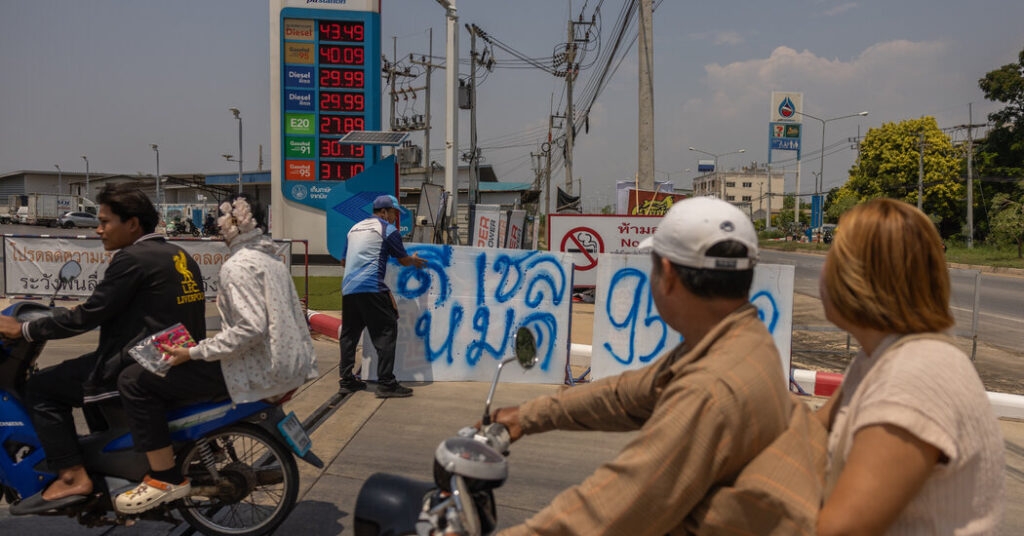
Governments around the globe are working to blunt the impact of soaring oil and gas prices. Austria, Brazil, Italy, Portugal and Turkey cut or suspended fuel taxes, according to the International Energy Agency. France, Hungary Japan, South Korea, Mexico and Thailand capped some fuel prices.
In Bangladesh, universities were closed, and Pakistan closed schools for two weeks. Sri Lanka rationed fuel.
“Many consumers around the world are still bruised from past price increases during the global energy crisis of 2021-23,” the agency noted.
Yet after years being whipsawed by a global pandemic, supply chain breakdowns and painful inflation, governments are limited — by depleted budgets and daunting debt loads — in their ability to respond to another crisis.
Patricia Cohen writes about global economics for The Times and is based in London.
The post War’s Attacks on Energy Could Turn Economic Shock Into Long-Term Damage appeared first on New York Times.