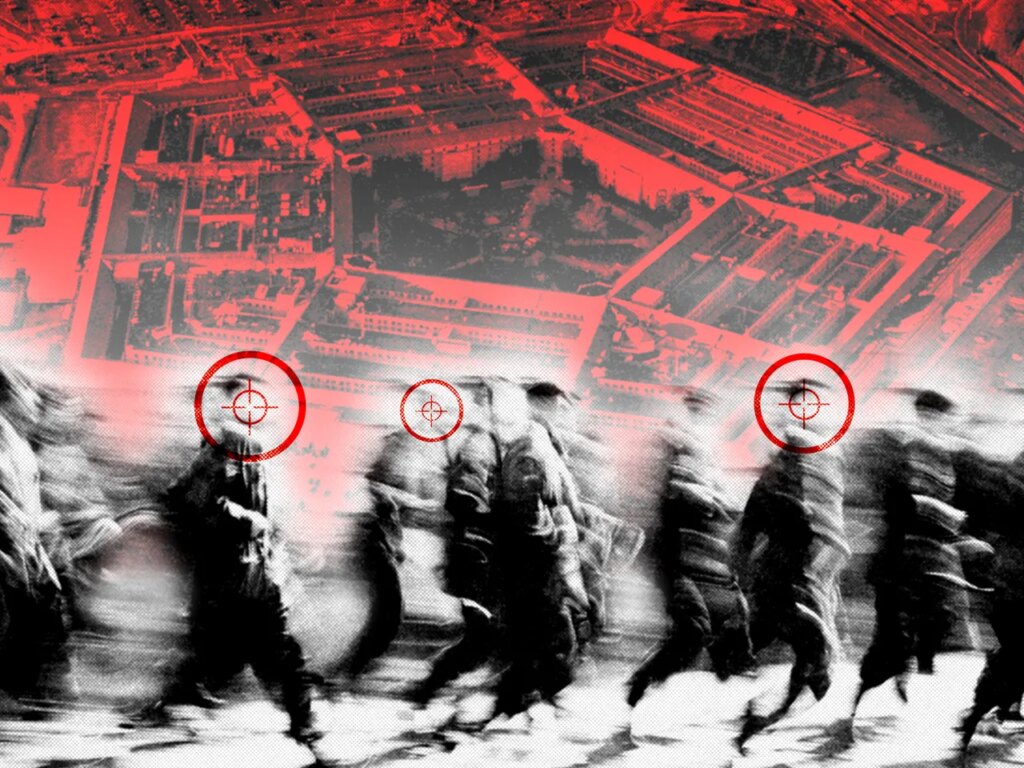
The rise of AI warfare speaks to the biggest moral and practical question there is: Who—or what—gets to decide to take a human life? And who bears that cost? In 2018, more than 3,000 Google workers protested the company’s involvement in “the business of war” after finding out the company was part of Project Maven, then a nascent Pentagon effort to use computer vision to rifle through copious video footage taken in America’s overseas drone wars. They feared Project Maven’s AI could one day be used for lethal targeting.
In my yearslong effort to uncover the full story of Project Maven for my book, Project Maven: A Marine Colonel, His Team, and the Dawn of AI Warfare, I learned that is exactly what happened, and that the undertaking was just as controversial inside the Pentagon. But that didn’t slow its forward march. Today, the tool known as Maven Smart System is being used in US operations against Iran. How the US military’s top brass moved from skepticism about the use of AI in war to true believers has a lot to do with a Marine colonel named Drew Cukor.
In early September 2024, during the cocktail hour at a private retreat for tech investors and defense leaders, Vice Admiral Frank “Trey” Whitworth found his way to Drew Cukor. Now Project Maven’s founding leader and his skeptical successor were standing face-to-face.
Three years earlier, Whitworth had been the Pentagon’s top military official for intelligence, advising the chairman of the Joint Chiefs of Staff and running one of the most sensitive and potentially lethal parts of any military process: targeting. Colonel Cukor, an intense Marine intelligence officer described to me by one of his seniors as “a one-man wrecking ball” who took on military orthodoxy, defense bureaucracy and the pursuit of AI warfare to his own cost, was wrapping up his five years as Project Maven’s chief.
Buy This Book At:
If you buy something using links in our stories, we may earn a commission. This helps support our journalism. Learn more.
In a meeting so tense some present had squirmed, I learned that Whitworth—an exacting former SEAL Team 6 intelligence director who sat on the military targeting committee for nearly two decades—had drilled Cukor about whether Maven and its use of AI was skipping crucial steps in the targeting process, moving too fast and bending rules.
“Tell me about what happens after the bad drop when we go through a congressional [hearing] and we’re getting hard questions?” Whitworth demanded.
He worried about record-keeping and accountability when it came to involving AI in targeting, and he expressed strong doubt that Project Maven was worth the billion dollars Congress had already spent on it, much of which had gone to Silicon Valley’s controversial upstart darling: Palantir.
When Whitworth took charge of the National Geospatial-Intelligence Agency in June 2022 and became responsible for the future of Project Maven following Cukor’s departure, he still worried that Project Maven was overpriced, overhyped, and incautious about the targeting principles he most cared about. Whitworth could have shut the program down in a heartbeat. The future of Cukor’s baby looked increasingly in doubt. “We were all very concerned,” Cukor told me in one of our weekly afternoon talks over the course of more than a year. “Trey was not a friend.”
I would come to see Cukor as a leading historical figure in a war that hasn’t happened yet. That seemed to be what almost everyone to do with Project Maven thought, whether they feted or hated him. Alex Karp, Palantir’s chief executive, referred approvingly to Cukor as “crazy Cukor” and called him “the founding father of AI targeting.” After his showdown with Whitworth, Cukor told others: “I will either be famous or live in infamy.”
But now, more than two years into leading the NGA and more than two years into Russia’s war against Ukraine, rather than abandoning Maven, Whitworth praised the program. “Drew, this is important work,” he assured Cukor at the September 2024 event. Maven Smart System—the software platform built by Palantir that brought together disparate battlefield and other data on a digital map and displayed AI detections that could be deployed in targeting—was adaptable. It could integrate with any system and become new with each software update. It could do what people wanted.
Cukor described the vice admiral as methodical, saying that Whitworth had just reasoned his way to endorsing Maven. Cukor thought Whitworth had come to understand why the US needed to bring AI into the targeting cycle. (The portion of Maven’s $250 million annual budget that went to NGA may also have helped, he thought.) “It speaks to his character, honestly,” said Cukor. “It wasn’t an apology as much as a formal recognition. We didn’t hug, but it was an important conversation.”
Under Whitworth, Maven would have its coming-out party, emerging from years of secrecy tightly maintained under Cukor in the wake of the Google protests. Six months earlier, deciding to shoot comprised the shortest element of the targeting cycle. Now every other part of the cycle was so close to being automated, and so compressed in time, that deciding to shoot was the lengthiest part. Internal documentation referred to Maven ATR: automatic target recognition. In public, Whitworth started describing Maven as his agency’s “marquee targeting program of record.”
A few days after he spoke with Cukor, Whitworth stepped onto a stage for a livestreamed Palantir customer event. He could hardly have cut a stronger contrast with the Palo Alto crowd: His service dress blues came with gold buttons, gold threads round his sleeves, and bright ribbons. In his high-shine formal black shoes, he stood in front of a cabinet displaying colorful Nike sneakers. His talk on Maven Smart System followed directly after two other Palantir customers, one who leased railcars and another who supplied automotive seating. War was now just another business process, sandwiched between sales and health care.
Amit Kukreja, a prominent Palantir commentator, investor, and fan of the company’s “merch,” was narrating the event live off to the side. He described it as a “new and special” moment for Palantir’s retail investors to learn about the company’s government work. Even Karp appeared taken aback. “I didn’t even know we were allowed to talk about this stuff,” he said, after laying claim to the “most elite and interesting” government clients in the world. Palantir had already won an Army contract with a $480 million ceiling for Maven Smart System that spring, and later would win another to supply the system to all military services in September for up to $100 million. In spring 2025, the Pentagon’s contract ceiling for Maven Smart System was raised to $1.3 billion, due to run until 2029. And NATO said it would become a customer for Maven Smart System too. Ten NATO customers were thinking about buying the system for their own country. The UK would reportedly sign a £750 million (roughly $1 billion) deal for Palantir’s military AI tools during a high-profile state visit from Donald Trump in September 2025.
Up on the Palantir stage, Whitworth talked through AI targeting as a screen beside him played a demonstration. An icon flashed up alerting the audience to “Possible Enemy Activity.” A cursor click revealed a group of tanks over a “notional” demonstration map of Kherson in Ukraine. The tanks were four clicks from evisceration. Palantir’s Target Workbench popped up. Two more clicks established the tank group’s height, latitude, and longitude; and then paired the target with an “effector” (in this case an F-22A fighter jet 82 miles away). One more click and a green tick flashed up: “Target destroyed.”
Nearly a year later, on a hot day in the high summer of 2025, I stepped into NGA’s headquarters at the Fort Belvoir Army Base in northern Virginia. It was my second visit to the spy agency HQ, and I wanted to find out why Whitworth had changed his mind, how much Maven had spread, and how Maven’s new backers saw the risks and rewards of mainstreaming AI into military workflows.
By then, Whitworth had become so ardent a fan of AI that his agency was pumping out machine-produced intelligence reports for US decisionmakers that “no human hands” had touched. And the NGA had launched a $708 million contract for data labeling in support of Maven’s computer vision models, the largest such appeal in US history, that would ultimately go not to self-made billionaire Alexandr Wang’s Scale AI but to Enabled Intelligence, a startup focused on hiring people on the autism spectrum expert in pattern recognition and comfortable with repetitive work.
My visit required the rigmarole of any meeting at a spy agency. Courteous background checks and vetting; no phone, laptop, or smartwatch allowed; and one step more curious: writing down not only the make and model, but also the serial number inscribed on my tape recorder, which I resolved never to use again for any interview after the visit.
The building was a temple to geospatial intelligence, or GEOINT, the pursuit of insightful analysis tied to locations on a map. A mesh of reflective glass encased by nearly 2,000 concrete triangles covered the blast-resistant facade, as if each one were attempting to triangulate a different location. More than 8,500 personnel worked at headquarters, but I was there to meet four particular NGA officials. Each, in their own way, was deeply involved in the development, standards, and spread of Maven. It was, I was told, unprecedented for them to gather all in one room to brief a journalist on Maven, and I was eager to hear what was at stake for them.
“This is our reputation on the line,” Whitworth told me in the interview. After he saw how easy it was to integrate the system into combat scenarios, it didn’t take long for him to change his mind: “I started really believing in it.” Far from being sheepish about ushering in a new age of AI warfare, its midwives wanted their names stamped over it. Some had become quite “ornery” in pursuit of credit, one NGA official said. I wondered if NGA wanted its fair share, mindful that some advising the second Trump administration wanted to wrest control of Maven and AI away from NGA and back into the Pentagon. “There’s no one person who can claim credit for this thing. It’s too big.”
The NGA officials walked me through Maven’s developments since the agency took over most of it two years before. Five of eight Maven initiatives, including analyzing drone feeds and satellite imagery, ended up with NGA. Whitworth wanted to expand the scope and capabilities of his agency in line with the expansion of ubiquitous global sensors. AI relied on data, and that required global surveillance to deliver it. While NSA could listen in to the world, NGA could watch it. Whitworth made clear he wanted to do that in minute, constant detail—surveilling the entire globe, at all times. NGA previously gave me a demonstration showing how AI could flag military construction in China—such as the arrival of a new rail depot at a missile base. NGA kept track of all movement at 49,000 airfields around the world. Whitworth even wanted to put GPS, or a similar navigation system, on the moon. And if GPS got jammed or hacked, he wanted other ways to map space too: NGA was fashioning digital maps drawing on magnetics, gravity, remote sensing, celestial navigation, and elevation. “From seabed to space,” went the new mantra he unveiled in 2023. The US war horse wanted omniscience, omnipresence, and omnipotence.
Nearly two years into its work in support of Ukraine, Maven became a “program of record” at the beginning of November 2023. That was Pentagon-speak for a fully funded line of effort with backing from Congress. It came with the expectation of a consistent budget for the coming years. The lines were still blurred: The Pentagon’s successor to the JAIC, the Chief Digital and Artificial Intelligence Office, paid the licenses for Maven Smart System and managed the text-based parts of Maven such as “reading” captured enemy material, while NGA produced the computer vision models that showed up on Maven Smart System screens.
Throughout 2024, Whitworth drummed up new users for the platform. He rang combatant commanders in every region to tell them what NGA was adding, shopping Maven’s latest features. Addressing criticism I’d come across, he insisted that Maven was useful not only in Europe, but also in the Indo-Pacific, and for moving targets as well as static targets.
Maven Smart System had particularly taken off in the Middle East. General Erik Kurilla had started using the platform “extensively” in support of US weapon strikes, once he took over US Central Command in April 2022. He hired former Google AI expert Andrew Moore, and spent much of 2023 practicing how to get through a thousand targets a day, cooperating with the UK and others in a series of experimental 90-day sprints.
In early 2024, I learned that the command had made “a pretty seamless shift” from experimenting with the platform in exercises to doing all this in combat. Here would be the first real US test of AI at war on a large scale.
“October 7th everything changed,” Schuyler Moore, the chief technical officer at CENTCOM, told me, referring to the deadly 2023 Hamas attack on Israel that international rights groups said constituted war crimes and crimes against humanity. “We immediately shifted into high gear and a much higher operational tempo than we had previously,” she said.
Brigadier General John Cogbill, CENTCOM’s deputy director of operations—who served under Kurilla, including at the 75th Ranger Regiment—put it this way: “It’s just been off to the races ever since.”
In February 2024, the command used Maven Smart System to locate rocket launchers in Yemen and unmanned surface vessels in the Red Sea. Moore told me Maven’s AI helped narrow down more than 85 targets that US bombers and fighter aircraft subsequently struck in Iraq and Syria, in reprisal for the death of three US service members in Jordan the month before. It was public confirmation that the US military was using AI to identify enemy systems for its own weapons to strike. “We were using these tools in a way that we’d never used them,” Cogbill told a podcast the following month, saying the command became “hyper-focused” on Israel.
By 2024, the command had 179 different live data feeds from land, sea, air, space, and cyber pouring into Maven Smart System. CENTCOM is using it most, Whitworth told me. That region alone had 13,000 accounts, with 2,500 people counting as regular users who log in “at least a few times a week,” said Rear Admiral Liam Hulin, a former commander of SEAL Team 3, who was now deputy director of operations at CENTCOM. Maven could also discern the nearest available weapons, the most suitable ones for the task, flying time, weapons loading details, and the whereabouts of personnel and partners.
Operators would click through Maven’s Target Workbench, approve or disapprove targets, sequence them according to priorities, and send a message directly to weapons systems. “Shortening kill chains is universally good,” Cogbill said on an April 2024 podcast.
Kurilla himself could keep track of all this from a plane: He watched real-time Maven feeds showing the latest in Iraq and the location of ships mapped over the Red Sea. He also kept an eye on data sent over Link 16, a jam-resistant digital channel on a tactical military radio system used by NATO and US allies to enable aircraft, ships, and ground forces to communicate in real time. Soon he’d be picking Maven Smart System as his topic of choice for his lecture at Capstone, the military’s in-house “charm school” at the National Defense University, to guide newly promoted generals.
What they’d been able to do, Kurilla would later confide to others, was “eye-watering.”
But there were major concerns as well. Cogbill gave Maven Smart System a “C+” grade during remarks at an August 2024 conference. AI was getting better all the time, but it was tricky, he said, because of hallucinations, “all kinds of AI ethics,” and the chance that the data inputs or the algorithm could lead military operators “to the wrong conclusion.”
Alex Miller, the Army’s serving chief technology officer during the second Trump administration who was described to me as an early Maven “frenemy,” told me in late 2025 that Maven Smart System itself uses up too much bandwidth to be used below the division level, and risked exposing US frontline forces to being found through hastily established satellite connections and other electronic footprints. But he had also come to admire Maven Smart System as a “phenomenal” platform at the theater level, and wanted AI to help run the entire fire control system.
In line with a growing cohort inspired by Maven, Miller wanted AI in every weapon and throughout the tactical level. Systems that deliver weapon fire needed to be digital-first and automated, and AI targeting would have to be imbued at every level of the military down to the battery or company, he said. AI mattered to Miller because of the “superhuman” speed and scale it could bring to combat operations. “It doesn’t matter how many people you throw at the problem; we are never going to solve the challenges of war without technology like AI.”
Kurilla told Congress in June 2025 that feedback was improving the command’s software suite. I learned that the US used Maven during the 12-day Iran-Israel war that occurred just five days later. Maven wasn’t favored as an intelligence platform but was regularly being used for operations. A single targeting cell could now go from sensing a target to shooting it within minutes, down from hours before. Maven could also detect and track ballistic missile launches headed toward Israel. Mavenites stayed up overnight working on the digital infrastructure for Maven when Iran sent 200 missiles toward Israel in October 2024.
NGA officials told me that Maven was accelerating operations and “enabling lethality” at combat headquarters around the world. At least 32 different companies were working on Maven, and close to 25,000 US personnel were using it. NGA officials boasted that usage had more than doubled since January. The agency had accumulated 1 billion AI detections in its computer vision data store, one official later informed me. Maven was detecting objects nearly five times as fast now too.
When I asked how many of the users were actually using the AI computer vision detections, as opposed to relying on the fancy Maven Smart System data fusion platform and display for the broader overview it gave of battle, NGA officials were quick to defend Maven’s AI. The models were improving during 2025 “by leaps and bounds,” Whitworth told me. “All the serious people are using the AI, because they go straight to the hardest thing, which is target development.”
Many of those serious people were commanders, the ones who would run deadly operations rather than oversee the collection of intelligence that powered them. “Every commander is using the AI, bottom line,” insisted Joe O’Callaghan, NGA’s director of AI mission who previously spent several years developing Maven for AI targeting at the 18th Airborne Corps prior to his military retirement. Commanders were using AI to characterize the environment, just to understand what was going on, and for targeting, he said. “You’ll hear some people push back, but when you ask them what they’re looking at on screen, it’s the AI.”
I learned separately, from nonpublic documents I reviewed, that in the two years to 2025, Maven found its way into 141 exercises and experiments. It was in more than 130 sites, Australia, Bahrain, Cambodia, Uzbekistan, Vietnam, and Yemen among them. It was at two sites in the UK. It was analyzing data collected over China and North Korea, Kazakhstan and Myanmar, Pakistan and Russia. For a time during 2025, Maven had people based permanently in Japan, Germany, and Qatar, and would rotate people through Jordan, Djibouti, the Republic of Korea, and Poland. A team assisted with all six military services, supporting more than 20 units on four continents and with seven combatant commands. These dealt with Europe, Africa, the Indo-Pacific, the Middle East, Special Operations Command, and Space Command. Cukor’s dream was coming true, and NGA was now urging on the users. The code could be changed in a day. “That is the secret sauce of bringing in the operational community in a very, very big way,” Whitworth told me. “Ride that wave,” he encouraged.
Maven was not operational at the two domestic commands responsible for tracking the Chinese spy balloon that in early 2023 stoked alarm when it flew into US airspace (and which the US eventually shot down over the eastern seaboard after it passed across the entire country). But in 2024, NORTHCOM, the command for homeland defense, and NORAD, the military command run jointly with Canada to watch for incoming air and sea threats, both adopted Maven.
James Rizzo, chief data officer for both commands, told me that they started using Maven in July 2024. By the time Whitworth and Cukor were eyeballing each other over canapés, the adoption was complete. Maven Smart System helped display and track movements by Russian and Chinese military, and other aircraft coming near the US. By 2025, the two commands had 2,000 daily users, Rizzo told me.
But operating Maven required a certain knack; you had to learn to filter out the noise. The day Rizzo spoke to me, Maven had made 850 million computer vision detections when he logged in that morning. “I thought wow, that’s a big number. I don’t know what to do with that,” Rizzo told me. “I’m trying to sort hornets from honeybees.”
As national security policy shifted under the second Trump administration in 2025, so did the uses of Maven. It became a tool for detecting border crossings and was potentially relevant for the “armed conflict” that Trump told Congress he was unleashing on alleged narco-terrorists in the Caribbean. Maven could detect and flag just about anything—drug runners, hobbyist balloons, military vessels, people. It was detecting people trying to cross the southern border, Rizzo told me. In September 2025, an NGA official told me Maven was helping with Customs and Border Protection and with the US Coast Guard. That was the same month that US Southern Command (SOUTHCOM) started carrying out lethal strikes against Venezuelan vessels, alleging that the targets they obliterated were smuggling drugs—and prompting criticism that the US was executing people without trial and risking war crimes. (“I don’t give a shit what you call it,” Vice President JD Vance retorted in a social media post.) By early December, the US would strike 23 boats, killing 87 people, including two shipwrecked survivors.
It wasn’t acknowledged whether Maven was being used in these strikes, but I learned SOUTHCOM had been using Maven for years. The command previously used it to identify a drug-running vessel that was subsequently boarded, according to Cameron Stanley, science and technology adviser at SOUTHCOM during 2020 who later took over from Joe Larson as chief of Maven in mid-2022. (Stanley now leads the Pentagon’s Chief Digital and Artificial Intelligence Office.) Since then the practice had only increased. An NGA official told me that Maven assisted “in the detection, classification, and ultimate interdiction of more than three dozen vessels suspected of engaging in illicit or clandestine activity.” The official declined to give a timeline or describe the vessels or interdictions further. The official did say, though, that NGA could identify the vessels three times as fast as humans.
Maven was now coming closer to home as a prodigious border control and drug policing tool. (NGA can only use Maven domestically during a federally declared emergency, at the request of the lead federal agency. NGA has previously undertaken such a role in support of the National Guard in stemming wildfires, but not through NGA Maven, according to the NGA official.) Nevertheless, some thought the move was a quintessential example of imperial boomerang, the theory developed by 1950s intellectual Aimé Césaire that a colonial power using oppressive techniques overseas would eventually bring them home. The US could end up with a well-equipped military “optimized for domestic warfare,” argued one commentator worried by the deployment of hi-tech troops to US streets.
Rizzo was more focused on how incredible it was to have a machine spit out summary reports at speed to brief commanders. He marveled at what a future end state could be. Maven had quickly become all-encompassing. It was now how NORAD “talked” to other commands all over the globe, knitting up the same view of the world with INDOPACOM and EUCOM. That was extremely useful for communication and speed, but there was also a chance that relying so much on Maven for a common view of America—and the world—could go very wrong, he warned. “We’ll never get anything done if we wait for perfection, so we take a little bit of risk,” he told me.
“But we’re not building the WOPR,” he laughed, referring to the fictional supercomputer in WarGames, the 1983 movie in which Matthew Broderick plays a computer hacker who nearly triggers World War III when he accesses a newly automated NORAD system that can launch nuclear strikes against the Soviet Union.
Many officials said some version of “We’re not building WOPR,” and routinely dampen worries about integrating AI into warfare. In Unit X, two former defense officials who helped stand up and run the Pentagon’s Defense Innovation Unit (DIU) argued that Project Maven had nothing to do with weapons. And Palantir officials scoffed when I asked if Maven Smart System was a weapons system. Even though a single click could send coordinates through a tactical data link to a specific weapons platform so that it could fire at the target, they pushed back: The click on Maven Smart Screen didn’t release the munition, they told me. (One defense expert I consulted about this argument described this as a distinction without a difference.)
And when I asked General Christopher Donahue, an army commander who returned to Europe at the end of 2024 with his fourth star, if Maven was a weapons system, he was clear-cut: “Oh, absolutely,” he told me in an interview. And he expected more: “Ultimately all this stuff will become automated.”
When I visited NGA headquarters in June 2025, one of the four officials I met asserted that there were still humans in the loop. But General Donahue’s point about the direction of travel was well founded: The Defense Department’s policy on autonomy has nothing to say about having a human involved. It states only that “appropriate levels of human judgment over the use of force” are required.
Emelia Probasco, a former Navy lieutenant, concurred with General Donahue’s view: “I think Maven is a weapons system,” she told me. Probasco advocates for scaling up the use of Maven throughout the US military, but wants the Defense Department to take training more seriously. “I think if you’re going to be making lethal decisions through engagement,” she said, then “soldiers should be trained as if it were a weapons system.”
As a fire control officer stationed on a Navy destroyer in San Diego in 2006, Probasco says she was less interested in the medals she was awarded than in the letter she kept from her captain giving her the authority to shoot the AEGIS weapons system, a centralized, automated total weapon system designed to go “from detection to kill.” In 1988, a US Navy warship deployed the AEGIS system and erroneously shot down an international passenger plane on its way to Dubai, killing all 290 civilians on board. AEGIS registered it as an enemy fighter jet, even though its route and radio signature matched with a civilian airliner. Years later, a similar job fell to Probasco to determine whether or not her ship would send out lethal Tomahawk cruise missiles. That kind of responsibility weighed heavily on her. She wants those using Maven and the AI it relies on to understand the responsibility they have too. “Nobody wants to be the guy that shot down the Iranian civilian aircraft.”
Back then, she spent a month in a defense schoolhouse learning how to use the AEGIS system, when to use it, and under what circumstances it will go wrong. Those using Maven—more than five years after Maven Smart System was rolled out—undergo no such training, despite the multiple ways and circumstances under which AI fails. That’s not OK, in her view. Lots of people are playing with the system now, but all in different ways. Maven’s Target Workbench has grown to encompass weapons pairing, and prioritization is already underway. The arrival of autonomous AI agents (also known as agentic AI)—which go much further than chatbots by carrying out tasks unsupervised—as well as the improvement of reasoning models—which break complex problems down into smaller steps and have extensive data access inside a specific system to carry out tasks independently in pursuit of a goal—will only make that process go faster. Maven, she said, has run into what she calls “AI adulting problems.”
Plenty of targeting experts argued to me that Maven shouldn’t be considered a targeting tool, never mind a weapon. It’s a helpful guide to develop targets that must be corroborated with other more precise locational detail, they argued. Even so, these targeting experts conceded that Maven has unofficially been used for targeting.
That’s one reason Probasco argues that Maven needs a concept of operations, a standard operating procedure, guidance on how often to update and rectify the system—it needs doctrine. Right now the US is funding tech, but not the development of the ideas or training for how to use it. “We need to fund the adulting tasks,” she says, arguing that task is made all the more urgent as Maven expands and people introduce more AI into the targeting workflow. AI agents based on large language models (LLMs) could start to generate orders, undertake battle damage assessments, and strip out highly classified information so the remainder could be shared with allies. “All these choices are upon us now,” she says.
Maven’s AI had already sped up the pace of war. An NGA official told me that with the help of Maven’s computer vision the US went from being able to hit under a hundred targets a day to being able to hit a thousand. Now, as LLMs were integrated into the Maven platform, the official told me processes were speeding up and that number had risen fivefold to 5,000 targets a day.
Whitworth knew clever enemies would try to trick and hack the data that powered AI, the models, and the systems they sat inside. He knew AI targeting would succeed or fail based on keeping careful records about model development, and who supervised model development. Under his watch, NGA started allocating each AI model an assessment card to indicate what it might be good at and where it might fail, depending on the level of autonomy and secrecy of the mission. By the time of Whitworth’s retirement in mid-November 2025, his agency had accredited two AI models, one used by Maven and one by another (unidentified) intelligence agency. In January 2026, the second Trump administration announced its new military AI strategy focused on becoming an “‘AI-First’ warfighting force,” eager to enlist and accelerate AI agents for campaign planning, kill chains, and more. In March 2026, the US Army started integrating Maven Smart System into its training regimens. That same month, a Pentagon memo noted Maven Smart System would become a program of record by the end of September.
I thought back to something Joe O’Callaghan had told me, underlining just how far things had shifted since the early days of internal Pentagon skepticism about Maven’s development of AI targeting.
“Maven is a movement,” he’d said. “We’ve drunk the Kool-Aid.”
O’Callaghan meant of course that NGA was encouraging widespread adoption of Maven and AI targeting. But the phrase he used, “drinking the Kool-Aid,” has a grim origin: It refers to the imitation fruit drink laced with cyanide, Valium, and several other drugs that an American cult leader mixed up in a vat and gave to his followers in Guyana in 1978. Everyone who drank it died.
Excerpted from Project Maven: A Marine Colonel, His Team, and the Dawn of AI Warfare, by Katrina Manson. Copyright 2026 by Katrina Manson. Reprinted by permission.
The post Meet the Gods of AI Warfare appeared first on Wired.