D.C.’s mayoral race was ramping up, with a democratic socialist potentially taking charge of the nation’s capital, when Paul Dougherty sent a blast email to a network of friends and business associates bemoaning the ravaging effects of federal layoffs, high unemployment and the city’s “damaged national reputation.”
Choosing the wrong mayor, wrote Dougherty, a longtime developer, invoking the specter of historically troubled cities like Detroit, risks propelling D.C. into “a period of instability, rising crime, and weakened governance.”
Dougherty’s warning reflects the unease percolating within Washington’s business class as the city — only months from choosing its first new mayor in a dozen years — faces a potential leftward shift in its policies while it struggles to recalibrate in the aftermath of the coronavirus pandemic and the Trump administration’s cutting of thousands of federal jobs.
With downtown still hobbled by office vacancies and plummeting land values, the mayoral race is unfolding at a moment when Washington is searching to replace what generations of past D.C. leaders could count on — a robust federal workforce driving the local economy.
A main focus of executives’ worry is the candidacy of D.C. Council member Janeese Lewis George (D-Ward 4), a democratic socialist whose platform features potentially costly promises such as publicly financed social housing and expanded government-funded child care.
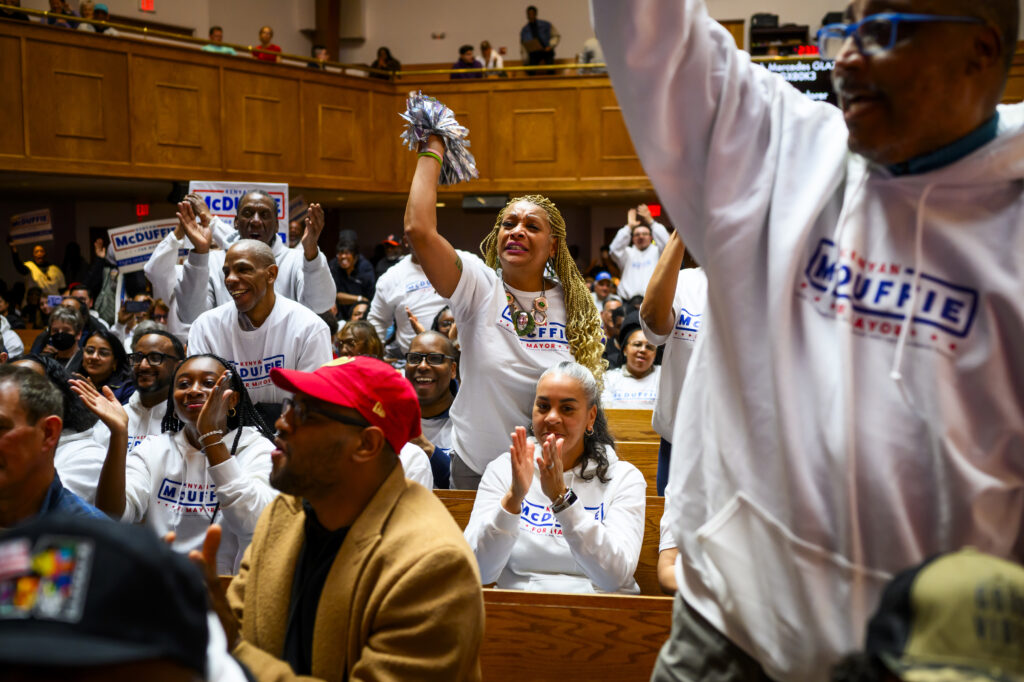
Their worry is compounded by the fear that Lewis George’s campaign, which has drawn large and enthusiastic crowds, appears to have the muscle to defeat their preferred choice, former council member Kenyan R. McDuffie, in the June Democratic primary.
Exacerbating those concerns is the success of the country’s best known democratic socialist, Zohran Mamdani, who won New York’s mayoral race last year despite Wall Street’s overwhelming support for former governor Andrew M. Cuomo.
“We are going into the unknown, and that’s what has the business community a little nervous,” said Jim Abdo, a developer who has contributed $200 to McDuffie. “Everyone wants to know what their vision and approach is going to be and how they will pay for it.”
Business leaders viewed the outgoing mayor, Muriel E. Bowser (D), as a reliable ally who “may not have been perfect but she provided certainty and stability, and so there were guard rails,” Abdo said. “The one thing the business community thrives on is certainty.”
Pragmatism vs. ‘a change agent’
McDuffie’s alliance with the Chamber of Commerce crowd is rooted in his more than 13 years on the council, including nine as chair of the business and economic development committee. Bowser has signaled her support for McDuffie, though she has not yet formally endorsed him.
The tangible benefit of McDuffie’s business ties is evident in his list of campaign donors, including dozens of developers, executives and business owners who have helped him raise $1.5 million. Both candidates are participating in the city’s Fair Elections Program, which caps individual donations at $200, bars business contributions and provides campaigns with a 5-to-1 match for every dollar from a D.C. resident.
“Kenyan has been around for a while and a lot of the business community has a level of comfort with him,” said Ron Lester, a pollster whose clients have included former mayors Marion Barry and Vincent C. Gray. “They can disagree with him, but they know they can do business with him.”
Yet, as Mamdani demonstrated, business support is not required to capture City Hall. Mayoral candidates in D.C. — Anthony Williams in 1998, Adrian Fenty in 2006 and Gray in 2010 — all won first terms without overwhelming financial help from developers and CEOs.
Lewis George, who has raised $1.6 million, much of it in small donations, is backed by labor unions and grassroots groups such as Free DC, which have been mobilizing volunteers to canvass neighborhoods. Her supporters laud her for advocating for affordable housing, tenants’ rights and eradicating health care disparities. After George Floyd’s murder in Minneapolis, she voiced support for “divesting” from the police, a position from which she later retreated.
Tom Lindenfeld, a political strategist who advised Williams, Fenty and Bowser, said Lewis George is casting herself as a change agent at a time when voters nationwide are gravitating to new faces like Mamdani, and Senate candidates like Graham Platner, the Maine Democrat, and James Talarico, the Democrat from Texas.
“The problem for Kenyan is that he’s the establishment candidate in a year when that’s not so easy,” Lindenfeld said. “Right now, voters want change, not only in D.C. but across the country.”
It was two weeks after Lewis George launched her campaign in January at a spirited rally at the Howard Theater that Dougherty emailed 30 friends and associates, urging them to donate to McDuffie and claiming that D.C. “is at serious risk if Janeese Lewis George, a self-described social democrat, is elected.”
Dougherty, in an interview, said he felt compelled to send the email because he fears Lewis George’s promise of expanded child care and other initiatives would strain the city’s already depleted budget and lead to tax hikes that could drive corporations and residents from the city. “Anything that costs a dollar is a dollar we don’t have,” he said.
He included in his email a warning that Lewis George — he misidentified her as “Janeese Lewis Brown” before correcting himself in a second message — “would fundamentally shift the city’s direction.”
“Washington could quickly resemble cities like Portland, with declining public safety, reduced accountability and diminished economic confidence,” he wrote. McDuffie, he added, “brings logic, pragmatism, and experience” and won’t cater to “ideological national donors or far left special interest groups.”
Asked about the email, Tommy Wells, Lewis George’s campaign chair, said Dougherty’s message “is out of touch with reality. He’s speaking for himself. I don’t think he’s speaking for the business community.”
Wells said Lewis George has met with business leaders, such as members of the Greater Washington Partnership, Ted Leonsis, and the Capitol Hill Association of Merchants and Professionals, sharing her ideas for economic development and hearing their concerns.
Although she’s “not antibusiness,” Wells acknowledged that Lewis George “does not support the status quo, and business generally supports the status quo. We know there will be discomfort.”
‘I want the city to win’
D.C. developers know the benefits of working with mayors who are aligned with their vision.
In the early 2000s, after years of fiscal dysfunction, the city embarked on what would be an astonishing economic renaissance, a period that spanned the Williams, Fenty, Gray and Bowser administrations. From the Southwest Waterfront to Columbia Heights to Union Market, developers remade neighborhoods, building apartment towers surrounded by new restaurants and shopping. While other cities struggled during the 2008 recession, D.C. escaped relatively unscathed, in no small part because of the steady presence of the federal workforce.
D.C.’s economic footing, like that of cities nationwide, slipped in 2020 with the onset of the pandemic. Unlike other metropolitan areas, though, D.C.’s pandemic recovery has been slowed, not only because of the growing popularity of remote work, but also because of President Donald Trump’s gutting of 22,000 local federal jobs.
The city’s struggle is evident in the vacant storefronts still pocking downtown. More than 20 percent of office space remains empty. The total value of downtown real estate — a driver of commercial tax revenue that funds services — has shrunk by an estimated 30 percent. Across the city, 102 restaurants closed last year, more than double that shuttered four years ago.
Even the number of births has declined, from 9,854 in 2016 to 7,898 in 2023, according to a recent D.C. Policy Center report. “We’re losing babies, which is a strong indicator of whether families choose to stay in the city or not,” said Yesim Sayin, the center’s executive director. “There’s no demand for the city. Workers are not coming, businesses are not starting. Our private sector is not functioning.”
Oliver Carr, a developer whose firm owns several downtown office buildings, said whoever succeeds Bowser needs to “start playing offense to attract businesses” and shake free of Washington’s longtime reliance on “the golden goose, the federal government.”
“We need to evolve,” Carr said. “It’s time for the city to reinvent itself and move away from government dependence.”
He declined to reveal who he is backing for mayor, saying only that he’s “very nervous about leadership that’s not about growth.”
An added problem is that D.C.’s image suffered in recent years because of chaotic moments like the 2020 protests following the murder of George Floyd, the Jan. 6, 2021, assault on the U.S. Capitol, and the shootings of two National Guard members in broad daylight last year. Although crime has subsided since, the rise in homicides in 2023 revived decades-old memories of when D.C. was known as the nation’s “murder capital.”
There was also Trump’s federal takeover of the city last year and scenes of immigration enforcement agents swooping into neighborhoods. Trump, as well as certain congressional Republicans, have made belittling the nation’s capital a staple of their reign.
“It chills the experience and feeling of being here and the pride of being here,” said Richard Lake, a developer whose company built 2,000 units of housing in the city over the past two decades. “It’s a vibe shift, and when that vibe is negative, it filters down to where people want to live.”
Like many of his peers in the development sector, Lake contributed to McDuffie’s campaign, saying he knows him “extremely well” and describing him as “diligent.” If Lewis George wins, he said, he will “make myself available” to help.
“I pick sides, but I’m not into the political fight,” Lake said. “I’m a big fan of the city, and I want the city to win.”
Seeking to draw more attention
Bo Blair, a prominent restaurateur in D.C., is planning to throw a fundraiser for McDuffie this spring because he’s “a solid guy” who is a “safer choice.” Lewis George strikes him as “too extreme,” though he acknowledges not knowing a lot about her.
Although McDuffie has become more aggressive in recent days, Blair said he’s worried that his campaign, which hasn’t attracted the crowds that have fueled Lewis George’s appearances, isn’t doing enough to “get the message out on who he is and what he stands for.”
“There are so many people who have no idea,” he said. “Everyone I talk to doesn’t know anything except one candidate is moderate and the other is left leaning. It’s almost like the election isn’t happening.”
On Thursday, Opportunity DC, an independent expenditure committee funded by business leaders, did its part to draw attention to McDuffie. The group announced via email that he was its choice for mayor because of his “proven leadership and commitment to delivering economic opportunity.”
The endorsement was expected, given that the organization had, in a mass mailing two years ago, cast Lewis George as weak on crime when she ran for reelection to the D.C. Council.
At the moment Opportunity DC sent out its endorsement announcement, Lewis George stood before reporters where the Washington Commanders’ new stadium is being built. She was flanked by a handful of organizers from several labor unions who endorsed her.
Lewis George spoke of starting a downtown development authority to revitalize the city’s core, of using city-owned properties to house retail pop-ups, of turning the neighborhood into a place where Washingtonians want to live.
“I am running as a change candidate,” she said.
That same day came the news that an association representing builders and contractors endorsed McDuffie.
The post As mayoral election looms, D.C.’s business class worries about what’s next appeared first on Washington Post.