While the United States wades deeper into war in the Middle East, Taiwan is in the middle of a political fight over how to counter China’s growing strength. And big choices facing Taiwan rest heavily on the direction taken by its main opposition group, the Nationalist Party, which is increasingly fractured between politicians who lean more toward Washington and a party leader who envisions a new era of harmony with Beijing.
One likely Nationalist Party contender for the presidency, Lu Shiow-yen, recently completed an 11-day visit to the United States, promoting herself as a solid partner of Washington. By contrast, Cheng Li-wun, the chairwoman of the party, hopes to visit China in the next few months to meet President Xi Jinping, an event that she has said could ease enmity with Beijing, which claims Taiwan as its lost territory.
“I also believe that the other side hopes to resolve cross-strait issues peacefully,” she said at a news conference in Taipei on Monday, referring to the government in Beijing. “We hope to expand peaceful exchanges across the Taiwan Strait on this basis, instead of bringing up past grievances every day to settle old scores.”
The Nationalist Party, together with a smaller opposition party, holds the majority in Taiwan’s legislature, giving them the power to approve or block the government’s initiatives, including President Lai Ching-te’s proposal for $40 billion of extra defense funds over eight years, on top of the regular annual spending. The Nationalists are also desperate to win the next presidential election in early 2028 after a decade out of power.
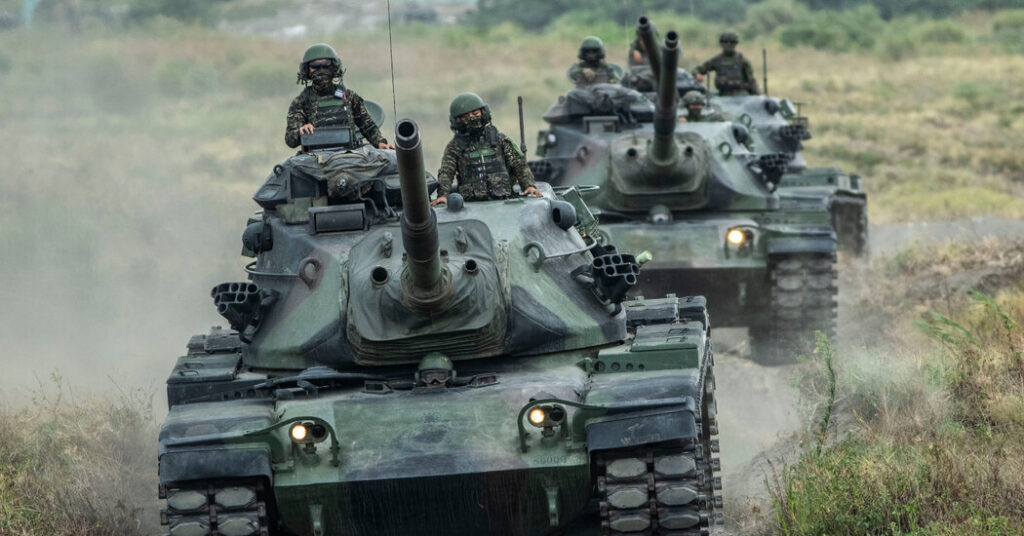
Taiwanese lawmakers will start formal negotiations over Mr. Lai’s military spending plan this week, alongside rival plans from the two opposition parties. Those parties both propose more modest additions to military spending, with the option of later increases to buy U.S. weapons. The Nationalists have proposed an initial sum of about $12 billion for an arms package already approved by the Trump administration.
Legislators from all of Taiwan’s parties are under pressure from Washington to raise military spending. But accumulated rancor and policy disagreements could slow or even derail a deal, which could dent the Trump administration’s willingness to back Taiwan.
“A failure to get the budget through would be taken as a sign that Taiwan is simply too politically fractured, and too strategically complacent, to be a full-fledged participant in its own defense,” said Hal Brands, a professor of global affairs at Johns Hopkins University who has been following Taiwan’s defense budget debate. “There’s not much appetite in Trump’s Washington for helping allies and partners of that sort.”
Months of political deadlock in Taiwan have already exposed polarization, including in attitudes toward the United States and China. The tensions are surfacing in the Nationalist Party, also called the Kuomintang or K.M.T., which long promoted itself as the party that can stay on good terms with both Washington and Beijing.
Centrists see keeping warm ties with Washington as a priority, even while they also want more contact with Beijing. Ms. Lu, the potential presidential contender, sought to underline that message during her visit to the United States, said Dennis Lu-Chung Weng, who advised her on the trip.
“I think the major signal Mayor Lu tried to send through her visit was that the K.M.T. remains, at its core, a traditionally pro–U. S. party,” said Mr. Weng, who is a professor at Sam Houston State University in Texas.
Ms. Lu, the mayor of Taiwan’s second-largest city, Taichung, emphasized in Washington that she supported an approach to defense that “should not disappoint our friends in Washington,” Mr. Weng said.
Ms. Cheng, the party chairwoman, said that she would also help secure Taiwan’s safety by visiting Beijing and meeting Mr. Xi, and then visiting Washington. Ms. Cheng said she also wants good ties with the United States, including through continued arms purchases, and she said that the Nationalist Party was united. But for some experts, Ms. Cheng’s focus on Mr. Xi amounts to keeping the United States at a distance.
“There is a clear contrast here between the kind of politician whose first visit would be to the United States, and those who believe it’s more important to engage Beijing first,” said David Sacks, a fellow for Asia studies at the Council on Foreign Relations in New York, who hosted Ms. Lu for a meeting during her U.S. trip. The contrast, he said, showed “the differences within the party regarding how Taiwan should balance these relationships.”
Ms. Cheng has argued that her approach to Beijing will attract more voters, especially if she can bring back assurances from a meeting with Mr. Xi. China’s leaders have not confirmed that a meeting is on the cards. Ms. Cheng has not visited Beijing since 2023, when she said she went there as a tourist.
“My hope is that Taiwan can play a pivotal role in fostering peace along the First Island Chain,” Ms. Cheng said, referring to the clusters of islands, including Japan’s, that face China’s eastern coast.
Chris Buckley, the chief China correspondent for The Times, reports on China and Taiwan from Taipei, focused on politics, social change and security and military issues.
The post Taiwan Debates Military Spending as Choices Over U.S. and China Loom appeared first on New York Times.