It was anything but an average U.S. history lesson.
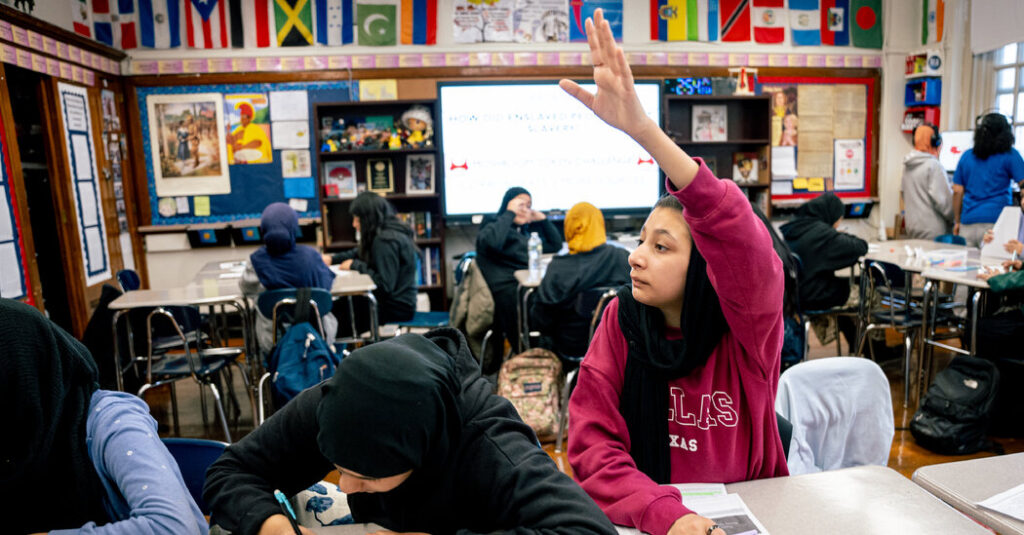
In Room 406 of an all-girls public school in Brooklyn, seventh graders learned about enslaved women and their resistance, hearing familiar names such as Ona Judge, who escaped George Washington’s Philadelphia mansion in 1796 and evaded his efforts to recapture her.
Then, their teacher turned to a more obscure duo who were held by Washington at Mount Vernon — but have rarely appeared in American textbooks: a mother and daughter known as “the Fatimas.”
It ignited a discussion about the widespread capture of Muslims from West Africa during the trans-Atlantic slave trade — and how their faith shaped their enslavement.
“How did Islam allow them to resist?” the teacher, Manjot Khehra, at the Urban Assembly School for Leadership and Empowerment, asked one recent afternoon during Ramadan.
“They were praying,” one student replied.
“But they had to keep it a secret,” another chimed in.
The exercise was a window into a fresh set of lessons on Muslim and Jewish American history rolling out across New York City — the nation’s largest public school system — at a time when U.S. cities are struggling to quash a rise in hateful harassment, vandalism and rhetoric.
The United States has witnessed a surge in antisemitic episodes in recent years. More than half of all reported hate crimes in New York City in 2025 were against Jewish people. And the ascension of Mayor Zohran Mamdani as the country’s most prominent Muslim elected official has cast a spotlight on longstanding and growing Islamophobia.
The city’s new endeavor asks whether schools might hold the answer to changing course.
Mr. Khehra’s class is part of a project that emerged as districts grappled with high-profile episodes of antisemitism while the war in Gaza raged. Some families worried that too many children were learning about history from TikTok and social media feeds than from behind their school desks.
For millions of students, Jews and Muslims will never become a focal point of classroom discussions beyond World War II and basic Venn diagrams comparing the three major world religions.
As districts were criticized for failing to meet the moment, many turned to trainings and workshops. Maryland started mandatory antibias education for school employees. Chicago sent staff members to mediate conversations with students at schools where tensions arose.
The effort in New York City stands out as a novel approach, rooted in the idea that exposing children to a broader view of the contributions of Jews and Muslims to society will offer a more complete picture of the American story — and serve as a potent way to root out intolerance.
“I don’t know of any other large district in America doing something like this,” said Mark Treyger, the chief executive of the Jewish Community Relations Council of New York, which partnered with the school system to develop the lessons.
At least 33 schools signed up for a pilot program this year, and the coursework is expected to roll out more broadly next fall. It is not mandatory or part of a new elective, but rather provides materials that teachers can occasionally introduce into social studies periods throughout the year.
It remains an open question whether the lessons will be taught widely — or simply collect dust on bookshelves.
Natalia Mehlman Petrzela, who was the lead scholar helping to develop the Jewish American history materials, said that too often “the only place kids in secular schools will encounter Jews is either in education about the Holocaust or training after an antisemitic incident.”
“Those are very important interventions,” Dr. Mehlman Petrzela, a professor at the New School, said. “But this is fundamentally different.”
At Edward R. Murrow High School in Brooklyn, teenagers recently spent social studies class diving into the legacy of Rose Schneiderman, the labor organizer who helped set the stage for the biggest U.S. strike of women workers at the time.
Most of the students were not Jewish. They analyzed Ms. Schneiderman’s legacy as a Polish Jewish immigrant in small groups — and assessed the consequences of World War I for women on the American home front.
“It allowed women to contribute,” one student said. “But at what cost?”
“What’s the point of giving them opportunities if they’re not treated the same as men?” another interjected.
As fourth period wound down, their teacher, William Bochbot, shouted, “Wrap it up! Wrap it up!”
He had to wait about four seconds for students to stop talking about the lesson. After class, he said that many had appeared to engage in a way they had not when history was “taught in such a narrow-minded way.”
Other lessons examine American society through a broad lens. During a class on immigration, fourth graders in the Bronx might study Emma Lazarus, who spoke out about the plight of Jewish refugees who were fleeing pogroms in Eastern Europe. She wrote a poem that is inscribed inside the Statue of Liberty.
In a unit on Reconstruction, eighth graders in Harlem might discuss Ernestine Rose, the reformer known at times as the “first Jewish feminist,” who lost her faith in Judaism.
And when learning about race in early America, teenagers on Staten Island might read about Abdul Rahman Ibrahima ibn Sori, an African prince enslaved in Mississippi whose Muslim identity shaped his quest for freedom.
Edward E. Curtis, who led development of the Muslim American history materials, said that while public conversations about Muslims play an outsize role in shaping policies and culture, they “are almost always devoid of any sense of history.”
The new lessons introduce pupils to “important Americans who also happen to” share the same faith. “That’s a different focus than always seeing Muslims through the prism of their religion,” said Dr. Curtis, the director of the Arabic and Islamic Studies Program at Indiana University.
Back at the Urban Assembly school, Mr. Khehra said that he had regularly fielded questions about why his class had failed to learn about Muslim and Arab historical figures more often; a number of his students practice Islam.
One student, a relatively recent arrival to the United States, is typically less outspoken than her classmates during discussions. But she perked up during the lesson on the Fatimas, calling her teacher over. She had eagerly pointed out a connection: Her name was the same as the women from more than 250 years ago.
Mr. Khehra knelt down beside her.
“What does that tell you about your mom?” he asked quietly. “How much does she believe in her religion if she picked that name for you?”
She smiled as he walked away from her desk.
Troy Closson is a Times education reporter focusing on K-12 schools.
The post Jewish and Muslim People Face a Wave of Hate. Can Schools Turn the Tide? appeared first on New York Times.