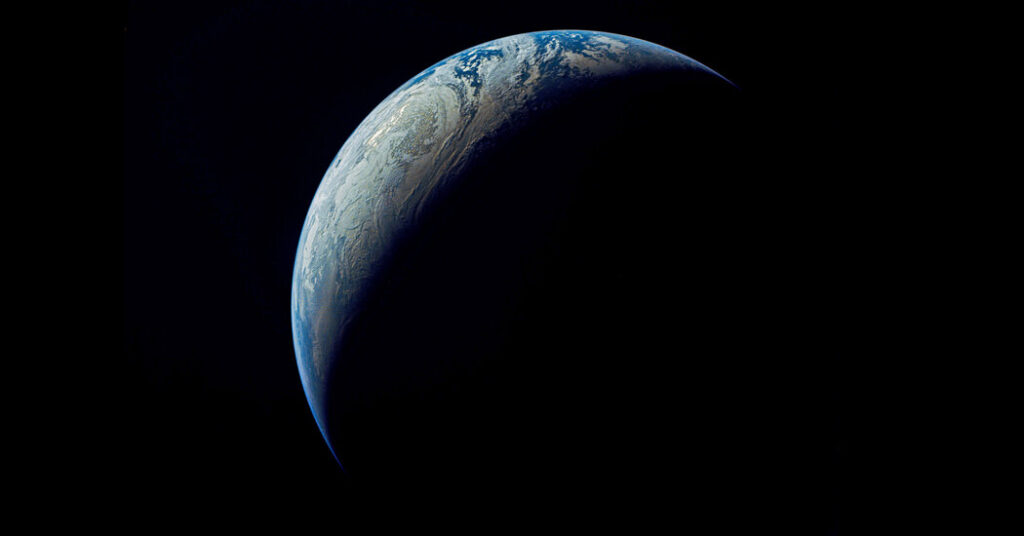
The Earth is out of balance.
That’s the message from a United Nations report released late Sunday that looked at how much energy from the sun is absorbed by the Earth or reflected back into space.
Researchers found the gap between the two is the biggest since measurements began in 1960, meaning more of the sun’s heat energy is now staying on Earth. And that energy imbalance is heating up the oceans, atmosphere, and frozen regions of the world, according to the World Meteorological Organization’s State of the Global Climate report.2
Ashkay Deoras, a research scientist at Britain’s National Center for Atmospheric Science at the University of Reading, likened the planet to a heated room with the windows closed.
“If you open the window, naturally, you will allow the hot air to escape,” said Dr. Deoras, who was not associated with the report. “But now what is happening is that, because of all these greenhouse gases, they are just trapping more and more heat. The planet is just not getting a chance to cool down.”
In previous reports, the U.N.-based meteorological organization documented changes in each element of the Earth’s system, such as surface temperatures, ocean heat, melting glaciers and sea level rise. This year, the authors, who include climate scientists and meteorologists, examined shifts on a wider scale.
“The energy imbalance gives you the full picture,” Karina Von Schuckmann, an author of the report and senior adviser at Mercator Ocean International, a French scientific oceanographic organization, said at a news briefing.
Under a stable climate, about the same amount of energy comes in from the sun as is reflected back. Now, however, emissions of heat-trapping greenhouse gases — carbon dioxide, methane and nitrous oxide — have surged to their highest level in at least 800,000 years and have upset this equilibrium, the researchers found.
The past 11 years have been the hottest since record-keeping began. Last year was either the second- or third-hottest on record, depending on which record is used, with global average temperatures 1.43 degrees Celsius (2.5 degrees Fahrenheit) higher than preindustrial levels. The year 2024 was the hottest year, at 1.55 degrees Celsius above the preindustrial average.
The world’s oceans continue to warm as they absorb carbon dioxide from the atmosphere. The extent of sea ice in the Arctic region is at or near a record low, while Antarctic sea ice extent was the third lowest on record, according to the report.
Describing the energy imbalance allows scientists to assess the rate of global warming because it encompasses all the components of the climate system.
“Sometimes independent graphs are not explaining the full narrative,” said Ko Barrett, deputy secretary-general of the W.M.O. and a former U.S. climate official during the Biden administration.
The surplus energy that the Earth retains gets moved around from ocean to atmosphere to land. The increase in heat within the climate system raises the likelihood and intensity of extreme weather events such as powerful storms, heat waves, droughts and extreme rainfall.
About 91 percent of the Earth’s surplus heat energy is stored in the oceans; 5 percent is stored in land, 3 percent in ice sheets, and 1 percent is stored in the atmosphere near the Earth’s surface — where it affects the temperatures that humans feel, the report said.
The amount of heat stored in the oceans reached a record high in 2025. The rate of ocean warming more than doubled from the period between 1960 and 2005 to the period between 2005 and 2025, the report stated.
One worrying result is that scientists are detecting more heat deeper in the ocean, rather than just at the surface, according to Dr. Von Schuckmann.
Below 2,000 meters, oceans store and hold heat longer than at the surface layer, which releases it to the atmosphere. That means that the effects of climate change will continue for a long time, she said.
“The more we have heat kept away from communication with the atmosphere,” Dr. Von Schuckmann said, “the more we are moving to time scales of committed climate change of 400 to 1,000 years.”
The post The Balance That Keeps Climate Stable Is Out of Whack, U.N. Report Finds appeared first on New York Times.