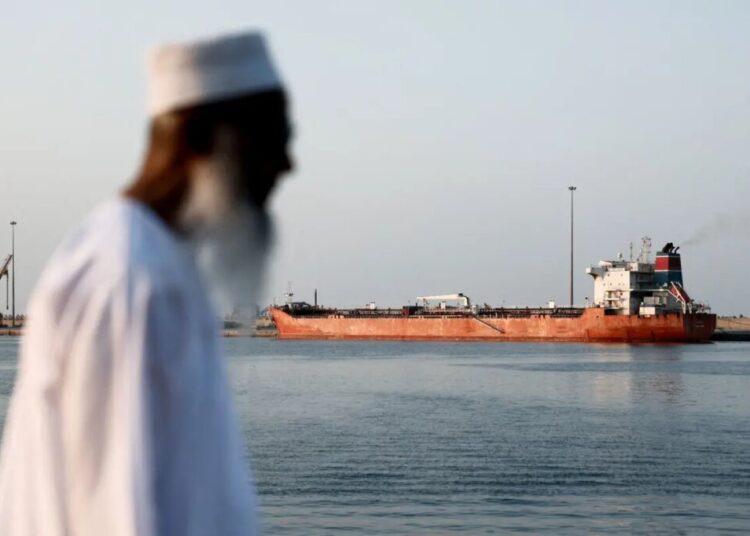
Wall Street is bracing for a Monday deadline that President Donald Trump set for Iran to reopen the Strait of Hormuz while the global economy reels from an energy crisis that shows little signs of abating.
Futures tied to the Dow Jones industrial average fell 30 points, or 0.07%. S&P 500 futures were down 0.15%, and Nasdaq futures lost 0.18%.
U.S. oil futures dipped 0.6% to at $97.64 a barrel. The national average gasoline price reached $3.94 a gallon on Sunday, up more than $1 over the past month, according to AAA.
The yield on the 10-year Treasury ticked down less than 1 basis point to 4.386%. The U.S. dollar was up 0.09% against the euro and was down 0.04% against the yen.
On Saturday evening in the U.S., Trump gave Tehran 48 hours to comply with his demand or else face the destruction of power plants, potentially escalating his war to civilian infrastructure.
Iran responded to the ultimatum by warning that such an attack would result in its forces similarly targeting vital infrastructure, including desalination plants that provide much of the region’s fresh water.
Trump’s AI and crypto czar, David Sacks, raised alarms earlier this month about this exact path of escalation as he called on the president to declare victory and “get out” of Iran.
“If you see that type of destruction continue, you could literally render the Gulf almost uninhabitable,” he said in an episode of the All-In podcast on March 13. “I mean you’re not going to have enough water for 100 million people, and human beings just cannot survive very long without water. So that would be a truly catastrophic scenario, and we’re talking about destroying the Gulf states economically and then also from a humanitarian perspective.”
Both sides showed no signs of backing down and further upped the ante militarily. Trump is sending three more amphibious assault ships and 2,500 additional Marines to the Mideast, joining a separate Marine Expeditionary Unit already headed there. There are already more than 50,000 U.S. troops in the region.
Meanwhile, Iran launched ballistic missiles at a U.S.-U.K. base 2,500 miles away on the island of Diego Garcia in the Indian Ocean. The attack was unsuccessful, but it demonstrated that Iran’s missiles have much longer range than previously known and could theoretically reach most of Europe.
On Sunday, NATO Secretary General Mark Rutte backed the Iran war and predicted the alliance would eventually come around to support it too, after several members rebuffed Trump’s demand that they provide naval escorts.
“If Iran would have the nuclear capability, including, together with the missile capability, it will be a direct threat, a existential threat, to Israel, to the region, to Europe, to the stability in the world,” Rutte told CBS News. “So the president doing this is crucial, and I’ve seen the polling, but I really hope the American people will be with him, because he is doing this to make the whole world safer.”
In addition to NATO, Trump got more signs of support from the United Arab Emirates, which has suffered from a barrage of Iranian missiles and drones.
Anwar Gargash, a senior UAE diplomat, suggested an increasingly hardened stance toward Iran that aligns more closely with the U.S. and Israeli stance.
“Our thinking does not stop at a ceasefire, but rather turns toward solutions that ensure lasting security in the Arabian Gulf, curbing the nuclear threat, missiles, drones, and the bullying of the straits,” he wrote on X. “It is inconceivable that this aggression should turn into a permanent state of threat.”
With no evidence of any talks aimed at halting the conflict, the thousands of Marines headed to the Mideast could be involved in a climactic battle to reopen the Strait of Hormuz and crush Iran’s ability to weaponize it again.
Still, some have called for a less dangerous option, namely a naval blockade of Iran’s oil exports meant to pressure the regime to open the strait.
“The US can implode Iran’s economy by shutting down its oil exports,” Robin Brooks, senior fellow at the Brookings Institution, wrote in a Substack on March 13. “That might open up the Strait of Hormuz a lot faster than anything else. Time to implode Iran’s economy and give the Ayatollahs a taste of their own medicine.”
The post Markets wait for Trump and Iran to follow through on Hormuz threats that carry potentially catastrophic results appeared first on Fortune.