Times Insider explains who we are and what we do and delivers behind-the-scenes insights into how our journalism comes together.
When the photographer Gail Albert Halaban first moved to New York from Los Angeles in 2004, she and her newborn daughter, Zoë, liked to look into apartment windows and imagine what the lives of the city’s residents were like.
“We’d make up stories about what was happening,” Ms. Albert Halaban said in a recent video call from her apartment in Chelsea. The tradition continued with her son, Jonah.
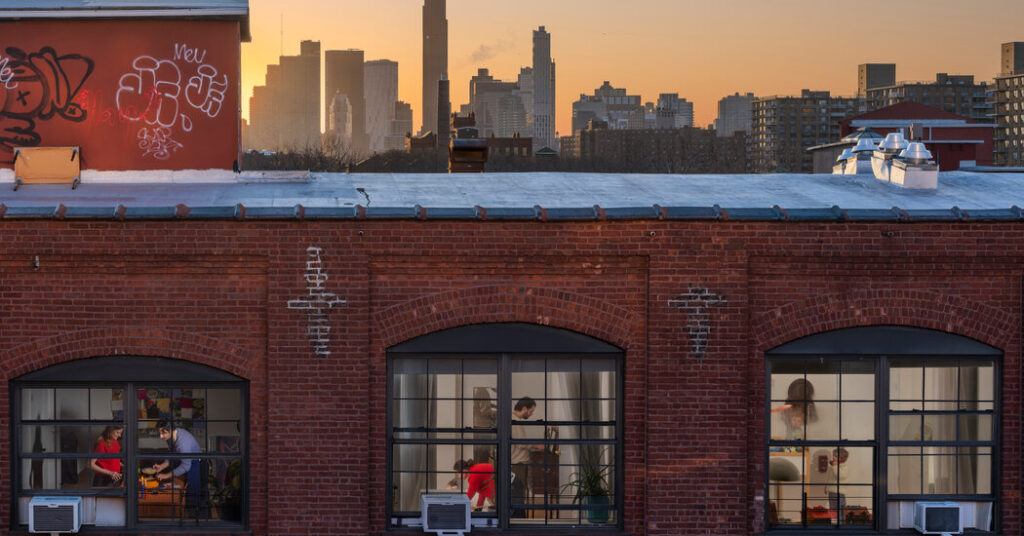
That spirit endures in an ongoing photography project, “Out My Window,” which Ms. Albert Halaban has now been working on for more than 20 years. The idea for the project, which has come to span more than 25 cities on five continents, is to reveal the lives of city dwellers from an apartment window across the street, creating Edward Hopper-esque landscapes of city life with the collaboration of a neighbor.
“The goal is always to see everybody engaged, for it to be about community,” she said. “It’s not really about the picture. The picture is almost the bonus of a friendship or relationship made.”
For Sunday’s issue of The New York Times Magazine, she spent a month photographing New Yorkers inside 10 apartment buildings across four boroughs to illustrate an article about the tension between tenants and landlords in New York City, and how Mayor Zohran Mamdani plans to confront the affordable housing crisis.
In a recent video call, Ms. Albert Halaban and Allison Pasek, the deputy photo editor for The Times Magazine, shared how they found the people they featured, what they wanted to capture about city life and what they learned from the experience. These are edited excerpts from the conversation.
Gail, how did you get the idea for the project that became “Out My Window”?
GAIL ALBERT HALABAN My daughter, who’s about to turn 22, was having her first birthday party: We had balloons and cake, and my parents came, and it was this big scene in our window. Right across the street from me was a flower shop called Starbright. The owner saw that we were having a birthday party, and he sent balloons and flowers with a note saying, “It’s been great watching your daughter grow up.”
At first, I was kind of spooked — if someone did that to you in L.A., it’d be weird, but in New York, it was such a friendly thing. So I was curious, who else had that relationship of watching their neighbors from across the street? I started photographing people in their apartments all over New York, and then I was invited to Paris, Italy, Istanbul and Buenos Aires. And it just kept going.
Allison, why did you think of Gail for this story?
ALLISON PASEK Gail’s work has always been about more than just real estate; it’s about community and the feeling of home. We thought it was an inventive and artful way to illustrate this story.
How did you find the people you photographed for The Times Magazine?
ALBERT HALABAN We reached out to our friends, or people we knew — I have a lot of Instagram followers who have offered their windows to me. We asked people if they would be willing to go meet the neighbors they saw out their windows. In the Bronx, the doorman of a building where I took a picture knew the project, was into it and was willing to help. He coordinated with his friend who’s lived in his building 43 years, who knew the person across the way. It really is about relationships much more than locations.
PASEK We talked to renters in about 80 apartments. I reached out to different rental organizations and community groups. The trick with Gail’s work, though, is you have to find that companion window.
ALBERT HALABAN I’ve always thought of it like dating — we’re finding the two windows that are the perfect match with the perfect personalities of people who are willing to do this.
How do people generally respond?
PASEK I was pleasantly surprised by how many people were willing to open their doors to this. It felt like a strange thing to ask people: Can a photographer come to your apartment and photograph out your window for about three hours? But people were willing to look at Gail’s work, and to be part of it, and got energized by that.
What does your setup look like?
ALBERT HALABAN I go to the apartment I’ll be photographing first, see what it looks like, get to know people. We decide what we’re going to photograph. Then I go to the other apartment to set up the camera. I put a transmitter that communicates with my lights across the way, and then I set up a Zoom call so that we’re all sharing the screen. So as I take the pictures, the people across the way can see what I’m photographing of them. And I don’t zoom in, they’re all taken with a normal lens — it’s what your eye would see if you looked out the window.
If a window in the photograph is dark, does that mean someone hasn’t agreed to be photographed?
ALBERT HALABAN In all my pictures, I’m lighting the windows where I’m shooting, so the exposure will be so much lower in the ones that aren’t participating. Nobody will be revealed if they don’t want to. But usually, if one neighbor does it, they can get the other neighbors on board.
What were some of your biggest challenges?
ALBERT HALABAN We were shooting this in probably the worst month of weather I’ve ever seen in New York. I did one on the night of the blizzard in Bedford-Stuyvesant, and I really wanted to shoot it in the snow, but I hadn’t planned ahead. So we literally knocked on every door on the block, and the only person who answered is the only person who’s in it.
How do you decide what subjects will do in the photos?
ALBERT HALABAN I like to make it totally collaborative. So I ask the people whose apartment I’m shooting in what they’ve seen their neighbor doing in the window, or what they imagine the neighbor is like, assuming they don’t know each other very well. And then I also ask the person I’m photographing, Who do you think the neighbor sees when they look through the window? And then we try to stage the photograph in a way where everybody’s imagination comes together.
I love that. And I’m sure it’s sometimes surprising what people want to be pictured doing.
ALBERT HALABAN In one of the photos, there’s a boy on a landline phone. And I was like, Why does a 6-year-old boy have a landline? Well, it turns out it goes directly to his grandma. And the couple in the middle, they’re eating pasta because they had invited all the neighbors over after the shoot for a pasta dinner.
People were really friendly, and we’d often stay for a cup of tea afterward. For a shoot in Bedford-Stuyvesant, the woman had just moved to the United States from Ukraine, and as I’m shooting on that freezing cold night, she made us some borscht after so we could sit and talk.
What did you both take away from the experience? Did it change how you think about housing in the city?
PASEK It renewed my love of New York and of being a renter. A lot of people wanted to be involved, so it felt like the community that Gail has talked about.
ALBERT HALABAN I took away that the fanciest neighborhood and the fanciest apartment aren’t necessarily the best places to live. The place you’re going to be happiest living is where you have an opportunity to get to know and meet your neighbors. I really want to move to certain buildings now, because the neighbors were so friendly. In the Bronx, the neighbors helped me carry the lights up five flights of stairs. They didn’t have to do that, but they wanted to.
Sarah Bahr writes about culture and style for The Times.
The post A Window Into the Lives of New York City Renters appeared first on New York Times.