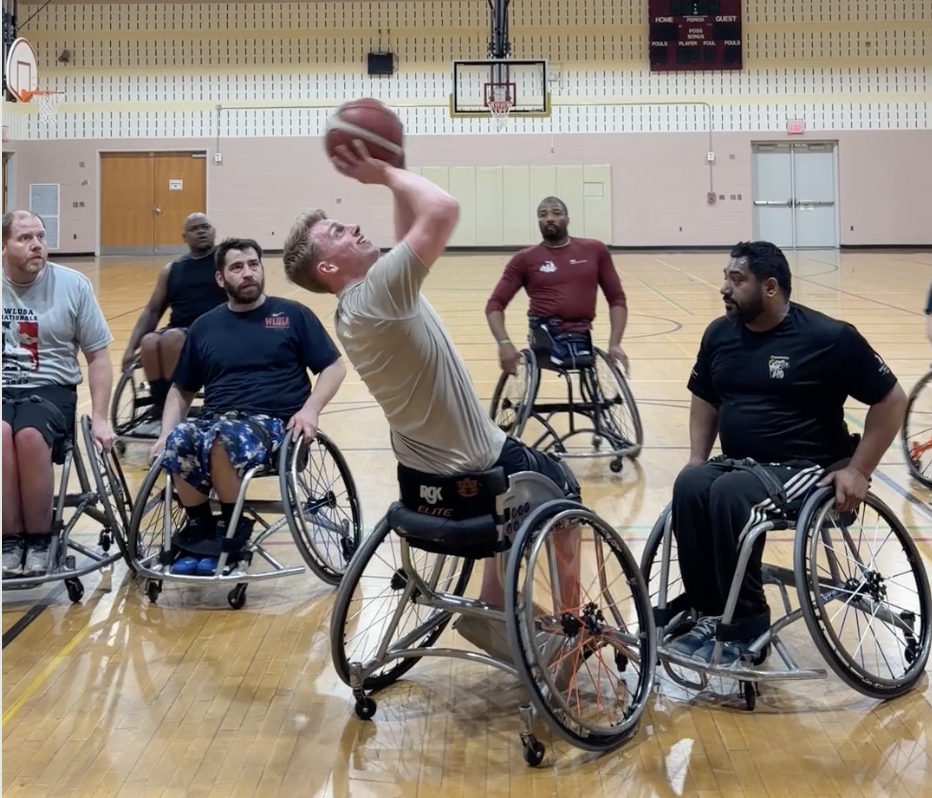
Shawn Sloan spun his body around and sped down the basketball court. He stopped the player beside him from attacking the basket and knocked the ball out of bounds.
“Good D, Shawn,” his coach yelled during a recent scrimmage inside a recreation center in Silver Spring.
Sloan, a 24-year-old with cerebral palsy, has been playing wheelchair basketball since he was 10 and joined the MedStar National Rehabilitation Hospital’s Punishers team this season.
The Punishers are among the top Division I teams for the National Wheelchair Basketball Association. Later this week, they will represent D.C. as the fifth seed at the association’s national tournament, which kicks off Thursday in Louisiana. Two years ago, the Punishers made it to the title game, coming in second.
For Sloan, a Chicago native who now lives and works in Baltimore for the city government, it will be his first time competing at that level.
“Playing against the best is all that I’ve ever dreamed of,” he said. “Because I want to be the best.”
The Punishers are among nine adaptive sports and activities, including wheelchair rugby, tennis and cycling, offered by MedStar’s National Rehabilitation Hospital. The program, which debuted in the 1980s, is funded solely through philanthropy, including a 5-kilometer run, walk and wheel each September to kick off the season.
The hospital’s recreation therapy team educates patients about the sports and other adaptive options, which they said can offer outlets for socialization, teach players more life skills and help combat how they and others might view their disabilities.
“In the very initial stages of anyone’s recovery process, they’re not ready to engage in all of those activities because they’re just going through their own grief process,” said Harsh Thakkar, 40, who directs the adaptive sports program. “Whenever you’re ready for this to be a part of your life, you reach out to us and we’ll get you connected with the right person.”
Thakkar, who first played basketball as a youth, sustained a spinal cord injury in a shooting more than 20 years ago. But his passion to play sports never wavered: He’s now an assistant coach and team manager for the Punishers — helping lead practice in the same Montgomery County gym he played in when he was younger.
On a recent weeknight, the Punishers met for one of their final practices before the national tournament.
As the 6:30 p.m. start time approached, athletes wheeled into the gym, fist-bumping one another and saying hello. Some filled their tires with air while others strapped themselves securely into the seats of their wheelchairs.
The specialized sports chairs have wheels that are slanted out to create a wider turning radius for athletes and prevent them from running into each other’s hands, Thakkar said. The chairs also have tipper bars to prevent players from falling backward as easily, and a front bumper protects their feet.
To participate in the sport, players must have a permanent impairment in their lower body, which can range from a spinal cord injury to an amputation. Many on the Punishers’ team also competed previously in college or internationally.
Avery Moore, 49, a native Washingtonian, donned a blue and gray Punishers uniform and a gray headband as he got seated for practice. A double amputee, both above and below the knee, Moore was injured in a fire at age 3. He said he started wheelchair track before getting into basketball around 13 years old.
He’s been with the Punishers for more than a decade.
“We all love each other, we all pick each other up, we support each other,” Moore said. “That’s what a real team is about.” That means from business and entrepreneurship to everything in between, he said.
The National Wheelchair Basketball Association has around 225 teams and offers multiple divisions, including some that are coed. There are also women’s, military and collegiate divisions.
The competitive season runs from September until the national tournament in the spring, Thakkar said.
There aren’t weekly games, but the Punishers participate in a handful of tournaments across the country during the season as many teams are spread out. Thakkar said the team also tries to host at least one in the D.C. area.
The Punisher’s recent practice began with teammates getting into position for layup lines, or what they call “four corners,” said Coach Trevon Jenifer, a three-time Paralympic gold medalist from Maryland whose been with the Punishers for eight years. He also serves as team captain.
Pushing themselves in a continuous circle around one of the hoops, players took turns shooting the ball before rebounding and passing it off to a teammate.
“It’s something that implements all aspects of the game: pushing, passing and shooting,” Jenifer, 37, said.
They soon transitioned to practicing outside shots. Then, it was time for the scrimmage to begin. The team huddled.
Jenifer, who was born without legs, gave the players three keys to focus on: effort, energy and communication.
“I want these next two hours that we’ll have here to kind of relay what we’re going to try to do and mimic in that title game,” Jenifer said.
As the five-on-five scrimmage got underway, the sounds in the gym swelled increasingly louder — from shouts of names of who’s guarding who to directives of certain moves like “pass” and “shot.”
Wheelchair basketball mostly operates under a combination of rules for international basketball and college basketball. A lot of the rules come from NCAA rule formatting, Thakkar said.
The three-point and free throw lines are in the same place and the rims are still at 10 feet. The length of the court is regulation, too.
But there are some variations. There’s no double-dribble violation, Thakkar said, but players can be called for traveling if they push their wheelchair more than two times without dribbling.
The sports chair is also considered a part of the player’s body. If someone rams into an opponent’s chair, that’s a foul, Thakkar said.
As the scrimmage went on, Luke Robinson, 24, dribbled the ball down the court and passed it to teammate Mike Looney.
Born with a genetic degenerative neuromuscular condition, Robinson, from Mill Creek, Washington, said he grew up playing able-bodied basketball before transitioning to wheelchair basketball in high school. He earned an athletic scholarship to play at Auburn University and competed on the under-23 national team.
Since moving to Virginia to work in software, Robinson says the Punishers have been an integral part of his life the past two seasons as he transitioned from college to adulthood.
“To still have that … anchor in wheelchair basketball and have this community of teammates and athletes to compete and train with, and also call brothers, has been a huge thing for me,” he said.
Looney, 47, of Severna Park, can relate. “It’s taken me to places I never in my life would have ever imagined. It brought me to college, to graduate school,” Looney said.
After catching Robinson’s pass, Looney hit a clean, outside shot, and then another again and again during the scrimmage.
“I just have a shooter’s mentality,” he said with a smile. “There’s not really a shot that I don’t like and I just try to make sure that I make all of them.”
Looney has played with the Punishers for about a decade. He’s been in a wheelchair more than twice that time, after a rock climbing accident resulted in a spinal cord injury.
“I look at it as my therapy,” Looney said about the sport. “It’s something that has kept me going in life.” He runs a wheelchair lacrosse team that is also based in Maryland.
On the other side of the basketball court, a handful of newer players on the Punisher’s Division III team got some practice in, too. Thakkar said the team, currently unranked, started about 2½ years ago.
Troy Anderson Jr., 35, traveled two hours by bus and train from Rockville to make it to the Division III practice. A recreational basketball player before being injured in a 2013 shooting, Anderson said learning to maneuver his chair and dribble at the same time was an adjustment. But finding the team last year has given him an “outlet to have fun and endure life in a wheelchair,” he said.
“I’ve found a place I can call home now,” Anderson said.
The entry-level team hopes to grow and register for more local tournaments next season, said Evelyn Sweeney, the team’s manager and a full-time inpatient recreation therapist. They’re also looking for a coach.
By 8:15 p.m., as the Division III players wrapped up their practice, the Division I squad transitioned to a full-court scrimmage.
“Next bucket wins game,” Jenifer said.
A burning scent emitted in the air from the constant friction of the wheelchairs’ hand rims rubbing against others on the court, and players’ hands were coated in dirt from more than two hours of pushing.
As the practice wound down, Sloan was covered in sweat. His motivation to play draws from his past, he said, having lived through an umbilical cord wrapped around his neck six times at birth (causing the cerebral palsy) and growing up amid Chicago’s violence.
“Being in the disability community has allowed me to see that not only am I someone that’s normal, but everybody around me is normal,” Sloan said. “I just see us just trying to get one common goal figured out … a championship.”
For Moore, the upcoming tournament is also special. Playing has allowed him to travel across the world, including to Paris, his favorite visit so far. But this year’s trip to nationals could be one of his last.
Moore turns 50 in December and may retire from playing. But he won’t leave the game. He wants to coach.
“I’m about inspiring others, pushing others to their limits,” Moore said. “I always tell people, ‘don’t doubt yourself’ because you never know what you’re capable of doing until you actually put the effort in.”
The post This D.C. basketball team is one of the nation’s best and shooting for more appeared first on Washington Post.