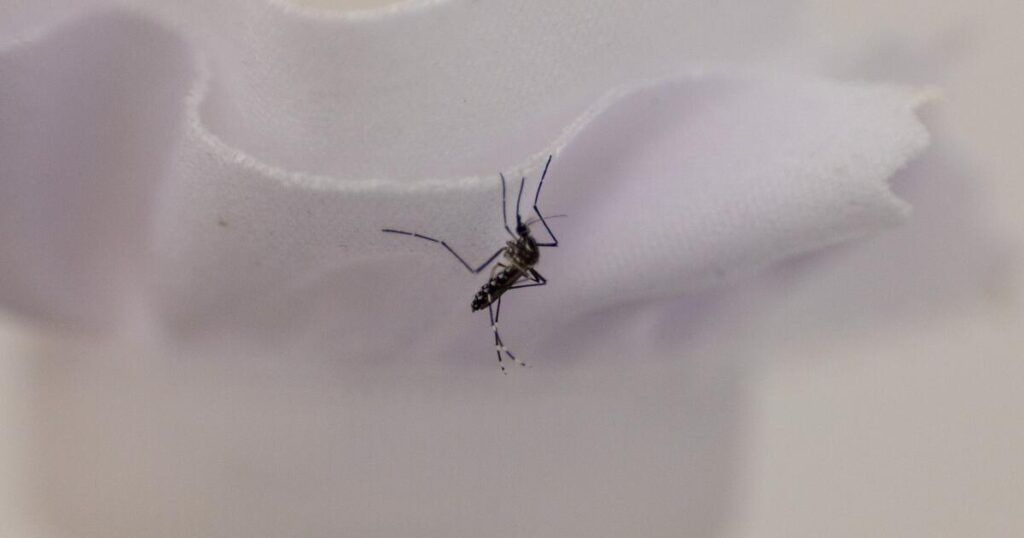
Residents were supposed to get a respite from the ankle-nipping mosquitoes that fueled a recent surge in dengue fever in Los Angeles County.
Typically, the invasive mosquitoes — called Aedes aegypti — essentially disappear from winter until early May in the region.
Instead, complaints to local agencies tasked with controlling the pests spiked recently.
“We have not seen them go away altogether like they have in previous years,” said Susanne Kluh, general manager for the Greater Los Angeles County Vector Control District.
Their unusual presence adds to the urgency of work going on in a 40-foot shipping container tucked away in Pacoima. It’s about to transform into a bustling nursery for tens of thousands of mosquitoes.
This May, the district is set for the third year in a row to release legions of sterilized male mosquitoes — which don’t bite — into parts of Sunland-Tujunga.
The last two years were promising, with the female population in two treated neighborhoods plunging by an average of more than 80%.
Yet business owners have signaled they’re not willing to pay to expand it.
That’s thrown uncertainty into officials’ goal of eventually bringing the approach to their whole service area, spanning 36 cities and unincorporated communities.
“Unfortunately, that’s going to be a rather expensive endeavor,” said Steve Vetrone, an assistant general manager for the district. “I can tell you right now that’s not something that we can do with our current operating budget.”
A need, an ask and a disappointing answer
Aedes aegypti are a new-ish local fixture. Native to Africa, the black-and-white striped mosquitoes were first detected in California in 2013 and landed in L.A. County the following year.
“Despite our best efforts, they’ve been able to just outpace us, and they’re now in every city and community within our district,” and all of Southern California, Vetrone said. In fact, the low-flying, day-biting mosquitoes are present in nearly half of California’s counties, including Shasta in the far north.
Desperate to find a solution, many are trying the so-called sterile insect technique — including vector control districts serving Orange and San Bernardino counties, as well as the San Gabriel Valley — and “we kind of all hope that this is going to be our silver bullet,” Kluh said.
The idea is fairly simple: unleash sterile males so that they far outnumber wild ones — say, 10 to 1 or even 100 to 1. The goal is for the altered males to mate with females, producing eggs that don’t hatch.
Kluh’s district uses X-rays to sterilize males but there are other methods, such as using genetically modified insects or ones infected with bacteria.
The technique, while promising, requires time and money.
In California, property owners foot the bill for local mosquito (and other pest) control, with some paying an annual fee called a benefit assessment.
Levying a new fee requires approval from home, apartment and business owners, in accordance with Proposition 218.
To unleash sterile male mosquitoes in a broader swath of the Greater L.A. district, officials are seeking up to $20 a year per single family home. That would be on top of $18.97 that homeowners now pay for the agency’s services.
Last April, the district sent out 50,000 sample ballots to property owners, asking if they’d support the increase.
Only 47% of those returned were in favor.
“Data showed that single family homeowners were pretty supportive, but fewer business owners with larger parcels and potentially higher dues did not see the benefit in the additional expense,” Kluh said in an email.
Business owners might not live in the area, but their vote — if their property spans several acres — is weighted more heavily.
Times readers, commenting on a story from last year about the proposal, responded favorably.
“I hate mosquitos because they love me so much,” one reader said. “I would happily spend $20 to reduce their populations! I probably spend more [than] that on repellent.”
Officials haven’t given up, and plan to send out another round of sample ballots next year.
Kluh already has talking points for businesses in her back pocket: Restaurant owners should have an interest in making outdoor dining more pleasant, while apartment owners could lose revenue if their renters are sickened by an outbreak of Zika, chikungunya or yellow fever — all diseases transmitted by Aedes aegypti, she said.
Making mosquitoes that can’t reproduce
On a recent tour of the Pacoima insectary, Nicolas Tremblay, a senior vector ecologist with the district, whipped out a small container filled with a handful of what looked like vitamins.
But the clear pill cases were filled with about 6,500 mosquito eggs and bovine liver powder.
The pills are dropped into trays of water, where the eggs hatch and the larvae feed on the powder. It takes about nine days to go from egg to buzzing adult.
The males are then chauffeured to Garden Grove, where they’re zapped with X-rays. Then they’re driven back and set free the next day.
“It’s crazier around August, September, is when we’ll probably reach our peak production” of up to 72,000 mosquitoes a week, he said. “All these [trays] would be full of water and mosquitoes.”
In 2024, the district launched its pilot, releasing nearly 600,000 sterilized males in two Sunland-Tujunga neighborhoods over about five months.
The population of Aedes aegypti females dropped by an average of 82% compared with a control area.
The stakes became clear that year, when California reported 18 locally acquired dengue cases — a sharp rise from the first-ever cases confirmed the year before.
Last year, the pilot saw similar success, though there was also a natural drop in activity districtwide.
On the recent visit to the insectary, several hundred mosquitoes flew around in white mesh cages, serving as participants in a study to see which blood they prefer — pig or cow.
“We haven’t completed the trials yet, but it seems like they didn’t care,” he said.
One thing scientists already know: Aedes aegypti love biting people.
A highly adaptive foe
The invasive mosquitoes can lay their eggs in tiny amounts of water. A bottle cap or crease in a potato chip bag is fair game.
What’s more, mosquitoes in the Greater L.A. district are resistant to a lot of pesticides.
Now, there might be a new concern. Typically, the invasive mosquitoes go into a type of hibernation every year.
Kluh said it appeared that they may have mutated in a way that allows them to stay active through the winter.
A warming climate has already expanded their season and allowed them to move into formerly inhospitable regions.
Releasing sterilized males involves no pesticides, and also leverages the insect’s biology: Males in lust are adept at finding females.
Many residents are thrilled by the promising tool, but others bristle at the idea of manipulating nature.
“There’s folks that are in favor and then there are folks that are just absolutely opposed because it’s like, ‘You’re playing God,’” Vetrone said.
The post As mosquitoes go year-round in L.A., a promising fix hits a snag appeared first on Los Angeles Times.