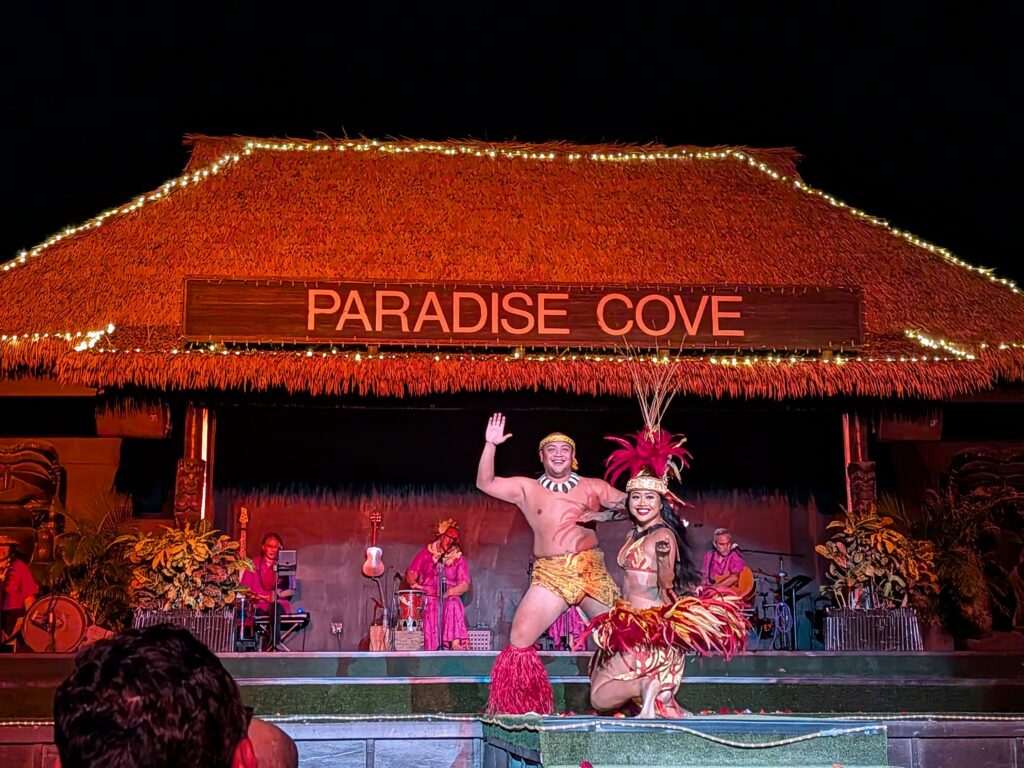
KAPOLEI, Hawaii — Less than an hour remained in the final luau at Paradise Cove. At midnight, 167 employees would be out of work.
On Jan. 1, 2026, the lease would officially end, clearing the way for an upscale destination for shopping, restaurants and entertainment with an estimated price tagof $135 million.
But it was still New Year’s Eve. The party wasn’t over yet.
“I need my O.G. dancers and my boys!” shouted Summer “U’ilani” Barros, 64, into the microphone. The crowd cheered. The luau’s lead emcee was on her third costume change of the evening. Behind her stood four male dancers in sarongs who had just finished a dance number. “One more time, we’re gonna do it!” Barros bellowed.
From the audience, five men in street clothes — khaki shorts, Hawaiian shirts, flip-flops — ran onstage, greeting the shirtless dancers with handshakes, hugs and backslaps. A table full of former Paradise Cove employees cheered, screamed, chee-hoo’d and wept.
When the band started, all nine men snapped into their routine, stomping, squatting and twirling in sync. No one missed a beat.
“No rehearsal, all these generations of dancers,” said Keith Horita, 64, Paradise Cove’s owner, as he recorded the show on his phone from the front row. “They just nailed it.”
Horita’s neck was stacked with leis from employees past and present. There were too many for him to wear all at once. A pile of leis sat on his table, amid a bevy of drinks that were brought by a stream of well wishers.
“There were times I was trying to fight back the tears,” Horita said. It was a fight he would lose several times that night.
For 47 years, Paradise Cove was a major employer for locals on the west side of Oahu. It was not uncommon for two or three generations to work at the luau, sometimes at the same time.
But today, fewer visitors are coming to Hawaii. More luaus have opened, diluting the market. The James Campbell Company, which owns the land, stands to make many millions of dollars more from the restaurants and shops in its new plan for the area, which will be renamed Waianiani at the Cove.
When it opened, Paradise Cove was an anomaly, a tourist attraction surrounded by country roads and rural land. When it closed, its neighbors included a condominium development, a Four Seasons hotel and the Disney-owned Aulani resort. Paradise Cove helped whet an appetite for tourism and growth in the area. But now, a different kind of tourism has emerged — one that is aimed at attracting more luxury-oriented visitors.
Paradise Cove sits on a 41,000-acre parcel of land that was purchased by industrialist James Campbell in 1877. Campbell drilled the first artesian well in Hawaii, which made way for the island’s sugar plantations, which brought both profit and exploitation to the labor market.
During the 1980s, when the sugar industry was in decline, Keith Horita’s father, Herbert K. Horita, and his business partners began a push to develop 640 acres of that land in the city of Kapolei into Ko Olina, a real estate development that remains a popular shopping and dining destination today.
Keith began working for his father in 1985. He remembers watching the building of the man-made lagoons that would become a fixture of the Ko Olina development. Keith also remembers people shouting anti-Japanese slurs at his father on work sites.
“I would ask him: ‘Why do you want to do this? They hate you,’” Keith recalled. “He said: ‘One day, they’re going to thank me. Maybe not these people, but their children and grandchildren.’”
In Hawaii, tourism and real estate are deeply thorny issues. The Ko Olina development was opposed by a variety of preservationists. But according to Keith, his father never wavered in his conviction that developing the west side was the right thing to do.
“I wasn’t excited, I was sad,” said Barros, 64, who has lived on the west side of Oahu since age 7. She remembers riding her bike with her brothers on dirt roads cut through 15-foot-tall fields of sugar cane, of fishing and diving on empty beaches.
But Barros also recalls local interest in the potential new jobs tourism could bring. When Roy Tokujo and Irving Weled opened Paradise Cove in 1978, Barros was in the 10th grade. She spoke Japanese, which helped her land a job teaching tourists from Japan how to weave coconut leaves.
Barros worked many jobs at Paradise Cove, eventually joining the cast as a dancer and being promoted to lead emcee. She started using the stage name “U’liani.” “It means ‘heavenly beauty,’” she said with a laugh. “So corny.”
Corny, maybe. But also rewarding. “It was the perfect job,” Barros said. She’d work at a hospital in the mornings, take a break, then head to Paradise Cove for her 4 p.m. call time. “I bought my first luxury car when I was 22,” Barros said. “I earned more at my job at Paradise Cove than I did at my hospital job.”
Herbert Horita purchased Paradise Cove from Tokujo and Weled in 1991. By the late 1990s, he was in dire financial straits. He had ceded many of his assets to avoid bankruptcy but still owned the Paradise Cove business. Keith remembers his father shuffling money from different accounts every month to stay afloat.
Keith proposed buying Paradise Cove. His father reluctantly agreed. In 2001, Keith became the official owner.
He had no experience in hospitality or entertainment, but he threw himself into the business with gusto.
“Keith was there every night, wanting to learn every single aspect of the Cove,” Barros said.
“If I could sing or dance, I would have done that, too,” Keith said.
Paradise Cove was never the biggest or most successful luau in Hawaii. But there was something special about it. Before each live show, it offered arts and crafts, dance lessons, canoe rides and games, a practice other luaus eventually adopted. Waikiki had a few beachside luaus, but none had the wide vista or the western-facing sunset views offered at Paradise Cove.
“The Polynesian Cultural Center was always the 800-pound gorilla in our market,” Keith said. That luau has been running continuously since 1963. “Nobody can top them. Shucks, they were even in an Elvis movie,” he said, referring to the 1966 film “Paradise, Hawaiian Style.”
Liu Taufa, a musician who worked at Paradise Cove for more than 30 years, remembers the first time she visited.
“I was just awed [by] the property,” Taufa said. She had grown up in the densely populated Waikiki neighborhood of Honolulu. Performing outdoors on 13 acres of oceanfront property was a nice change of pace from the nightclubs where she usually performed.
In recent years, Native Hawaiians have been creating luaus that more accurately reflect their culture and traditions. Last year, in The Washington Post, Sarah Kehaulani Goo described such a show: “There were no fast hip-shaking Tahitian dancers. No men spewed fire from their mouths. No tourists were asked to come onstage to wear a coconut bra.” The last luau at Paradise Cove featured all three.
But Taufa appreciated Paradise Cove’s pan-Pacific approach. The late entertainment director O’Brian Eselu created a live show that incorporated traditions from Tonga, Tahiti, Samoa, the Cook Islands and Hawaii. “The culture was strong, so strong,” Taufa said. At the final luau, she performed “Ua Hiti te Marama,” the same Tahitian wedding song she had sung at her audition 35 years ago.
The starting hourly wage at Paradise Cove was most recently around $19 — several dollars more than the state’s $16 minimum wage.
Employees would help friends and family land jobs.
“My brother was a security guard here, my grandma works here, so it’s like a whole family thing,” said Ela Alaga, 27, during her last shift as a photographer. “My sister works here, they all work here.”
Former Paradise Cove workers still speak fondly of the lavish holiday parties Keith used to throw, the gifts he would give and his decision to add 401(k) accounts to their benefits packages. That was when the luau could regularly bring in up to 1,000 guests a night.
But that was years ago. In 2025, it wasn’t unusual for the luau to host only a few hundred guests. Paradise Cove was also contending with rising costs for food and supplies and some bad press after a man who was not a guest of the luau drowned nearby.
The James Campbell Company had been interested in developing the land at Paradise Cove for more than 10 years. Since 2019, Keith had managed to extend his lease on the property six times. At one point, he attempted to open negotiations to buy the property. But ultimately, Keith and the landowners couldn’t come to an agreement. He would close the business and the land would return to the same family his father had purchased Ko Olina from more than 40 years before.
By the time the second act started, the sun had set. Christmas lights, wrapped around the trunks of palm and banyan trees glowed. In the distance, you could hear the first booms of fireworks that would eventually crescendo into a dazzling Hawaiian New Year’s cacophony. Fire dancers took to the stage and walked into the crowd, illuminating faces with their flames.
“Cousins, our warriors are just warming up,” Barros shouted to the audience. She was wearing her fifth and final costume of the night. “Do you want to see more?” They did.
When the show ended, the staff lingered. There were hugs and tears and promises to keep in touch. Backstage, a piece of paper listing each performer’s last day was still taped to a mirror while the cast collected their makeup, costumes and personal effects.
On New Year’s Day, Keith went to the cemetery carrying the stack of leis he had collected the night before. It’s a Hawaiian tradition to leave leis at the graves of loved ones, often near holidays or special occasions.
He left some at the grave of his first wife who died of cancer in 2012.
He left the rest at the grave of his father.
“I told him, ‘Sadly your dream is ending with me,’” Keith said.
The post A luau’s last night shows Hawaii’s changing tourist tastes appeared first on Washington Post.