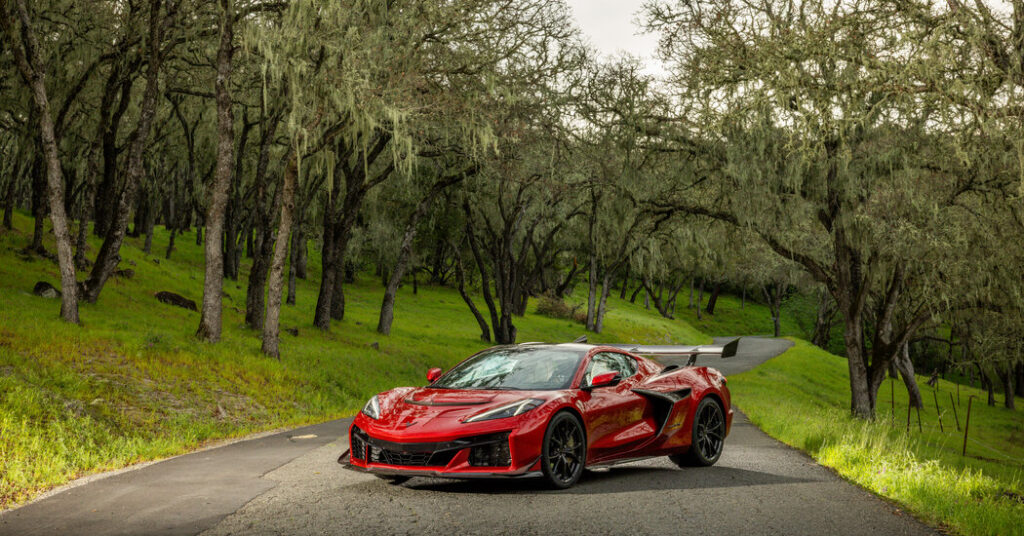
Sporting a zero-to-60 sprint in 1.7 seconds, and an Indy-worthy 233-m.p.h. peak, Chevrolet’s Corvette ZR1X is silly, even surreal. Yet this hybrid hypercar, packing 1,250 horsepower, also makes sense, as driving enthusiasts have expressed seeming ambivalence toward fully electric sports cars.
In familiar Corvette fashion, the ZR1X is a China-level deal versus any rival in its rarefied echelon, even as its $207,000 starting price makes it history’s most expensive production Chevrolet. It becomes the tech showpiece in a Corvette lineup that starts from a reasonable $72,495, less than half the price of a Porsche 911 S. This Corvette also demonstrates how electricity is revolutionizing the top ranks of performance: It could depart from a Manhattan stoplight at 39th Street and nip 160 m.p.h. by 44th Street, a blistering quarter-mile. Theoretically, of course.
Driving the ZR1X at California’s Sonoma Raceway feels like hitching a ride on the Large Hadron Collider, fast enough to rearrange my subatomic particles. In a good way. When I segue to roads in the Napa Valley, the ’Vette’s roaring, twin-turbocharged, 1,064-horsepower V-8 threatens to tear sauvignon and chardonnay vines from their roadside roots. Electrified front wheels, the car’s secret sauce, tack on 188 horses more to the all-wheel-drive ZR1X.
The hand-built, titanium-girded racing engine, autographed by a single master technician, is displayed under a transparent pane like a Louvre jewel ripe for plucking. (A shout-out to Jeff Smith, my signatory from the Corvette factory in Bowling Green, Ky.)
The vented panel pays homage to the classic split-window Sting Ray of 1963. You know, back when 250 horsepower was a lot.
It all sounds intimidating. Yet the ZR1X still feels like a familiar, approachable Corvette. This beast will happily burble in all-day comfort, with room for luggage or two sets of golf clubs.
Unlike a Toyota Prius, its hybrid battery isn’t about efficiency. It’s designed like a kinetic energy sponge, quickly soaking up regenerative brake energy and wringing it back out — akin to Formula 1 racers, which this season draw a record 50 percent of power from electricity.
That battery fits entirely in the center console, allowing the Corvette to hug the ground like no conventional EV. It never dipped below 50 percent full in my Napa test drive, no matter how hard I tried. Press a “Charge +” button, and the ZR1X refills that battery over a few miles of cruising. No plug required.
There’s even an F1-style “push-to-pass” button on the steering wheel. It summons every joule and kilowatt of thrust — perfect for underdog encounters with haughty Ferrari owners.
I’d already tested the non-hybrid, 1,064-horsepower ZR1 version, and it is brilliant, but the ZR1X has a palpable edge in traction, especially dashing from corners.
A clever Performance Traction Management system offers video-game-like settings to accommodate all skill levels. Modes such as “Wet,” “Sport,” “Race 1” and “PTM Pro” progressively dial back stability and traction controls that act as electronic guardian angels for pilots.
If any Chinese automaker built such a giant-slaying hybrid, challenging the world’s most exotic cars at a fraction of their price, the spotlight would be blinding.
The Corvette’s Detroit-underdog status may be overstated; the model has won its production-car class in the 24 Hours of Le Mans nine times since 2020. Still, its famously ingenious engineers haven’t lost the chip on their shoulder.
The latest targets may have seemed too ambitious: hybrids like the Ferrari F80, at an eye-watering $3.7 million, and the $2.1-million McLaren W1. Yet the Corvette generates more power than the Ferrari and virtually matches the McLaren, and its 233-m.p.h. top speed makes it faster than either.
Barely closer to earth, the Lamborghini Temerario hybrid that I tested in Italy may be this Corvette’s closest analog. With three electric motors, it’s a hoot. That delicacy from Sant’Agata Bolognese, with a mere 907 horsepower, starts from $387,000. Its price shoots past $500,000 with options, double that of a loaded ZR1X convertible.
Drew Cattell, a Corvette chassis engineer whom I chased around Sonoma, personally drove the ZR1X to a 6-minute, 49-second lap at Germany’s benchmark Nürburgring circuit. That set a new American production-car record and bested such luminaries as a Porsche GT3 RS and a Lamborghini Aventador SVJ. It whipped the $2.5-million, all-electric Rimac Nevera by 16 seconds, an eternity by racing standards.
For all the wonders of electric vehicles, sports-car fans have uncovered a dirty secret: Most aren’t particularly fun to drive. Blistering straight-line acceleration tends to be their party trick. Then the party ends, dampened by lifeless electric steering or a commuter-car personality. Ask any Mazda Miata driver to trade that underpowered yet joyful roadster for a “faster” E.V. Prepare for an earful.
There are, naturally, exceptions, including Porsche’s Taycan sedan and Hyundai’s Ioniq 5 N S.U.V. But neither of those is a sports car, for good reason. Tiny cars don’t have ideal places to stuff batteries, creating a Sophie’s Choice between driving range and light weight. Those batteries quickly bleed dry in spirited driving, leaving E.V.s poorly suited for romps in lonely canyons, or track days. Those are among reasons two-seat EVs have been virtually nonexistent: a few unicorns like the $2.5 million Rimac Nevera, or a half-baked MG Cyberster, itself unavailable in America.
It’s not merely about internal-combustion noise-making, as E.V. acolytes might assert. What’s missing in many electrics can seem ineffable. But it basically comes down to the man-machine connection, as exemplified by manual transmissions whose demise enthusiasts bemoan.
For too many E.V. makers, “driving” itself has become a side hustle. Their self-described “smartphones on wheels” are designed to distract rather than engage, via a surfeit of screens, apps, now even karaoke machines in Chinese models. But Prince didn’t write sultry anthems about software updates and fast connections. He did write an ode to a much-too-fast Corvette.
Sports-car loyalists tend to hate these digital developments, especially the focus on autonomous driving, and have come to see E.V.s as looming Terminators of fun.
Automakers have noticed. Porsche has backtracked on plans for an electric Cayman and Boxster lineup, seemingly stymied by both engineering and market challenges. Lamborghini scrapped plans for its first E.V., with Stephan Winkelmann, the brand’s chief executive, telling The Sunday Times that his customers had “zero interest” and no “emotional connection” to E.V.s.
E.V. makers, meanwhile, are mimicking the feel of gasoline cars, including simulated engine sounds. The Ioniq 5 N even simulates the gear changes of a gasoline car, letting drivers “shift” through gears that aren’t actually there.
But when enthusiasts say electricity is the death of driving fun, they’re also wrong. Lamborghini, famously wedded to voracious V-12 engines, has joined virtually every go-fast brand — Ferrari, McLaren, Mercedes-AMG, even the Porsche 911 — in offering hybrid models. Having driven nearly all of them, I’ll argue it’s become an unfair fight. Internal combustion alone can no longer compete straight-up against these hybrid warriors.
Owners of solid-citizen hybrids like the Toyota Prius will scoff. Certainly, no one “needs” a sports car of any description, let alone a member of this interstellar species. If you had suggested even 10 years ago that any automaker, let alone Chevy, would offer a 1,250-horsepower electrified sports car, your bartender would have cut you off.
But the ZR1X and hybrids like it are birthing a new golden age of performance, a power coupling of peak internal-combustion and evolving electric tech. Who knows how long this tempestuous hybrid marriage will last. But the ZR1X proves that opposites can attract, and thrive.
The post This Corvette’s a Hybrid, but It’s Built for Raw Power, Not Efficiency appeared first on New York Times.