When a meteor blazed across the morning sky last week, disintegrating over a rural swath of northeast Ohio, it was as if a bat signal went out to some two dozen people around North America. In a flash, these enthusiasts — meteorite hunters from British Columbia to Connecticut to Arizona — sprang into action.
They pored over satellite maps, booked one-way flights and packed their bags (along with wads of cash), preparing to chase the detritus of a rare type of meteor alongside their competitors who, depending on circumstance, could be counted on to offer a helping hand or a cold shoulder.
The prospectors arrived here, west of Akron, from many walks of life and with many motivations. The thrill of the chase. Contributions to science. The wonder of the cosmos.
And, of course, the financial payoff for finding something significant in the remains of what NASA classified as a six-foot wide, seven-ton meteor when it entered the earth’s atmosphere. Nobody is counting on finding a 54-pound specimen like the one found in Niger that fetched $5.3 million at auction last year. Still, 200 to 300 pounds of space rocks were expected to have landed in Ohio and one the size of a gumball might be worth hundreds or thousands of dollars.
“I guess I’m in it for the money,” said Mark Dayton, 61, a former police officer and retired firefighter who plays guitar in country music bands, prospects for gold and has a popular treasure hunting YouTube channel. “I hate to admit that in the newspaper, but I am.”
In truth, Mr. Dayton, who traveled from his home near California’s gold country, is something of a consigliere — someone the academics, the dealers, the novices and the old-timers seem to like and respect. He has been hooked on meteorites since the late 1990s when he sold hard-to-find Hot Wheels Mars Rovers on eBay and the buyer sent him a book by the meteorite expert Bob Haag as a thank you.
But good will carried Mr. Dayton only so far on Thursday.
He set out scouring a park for any signs of shiny black rocks. A pebble no bigger than a thumbnail, found near a pickleball court, turned out to be a fleck of asphalt when it was examined under a magnifying loupe. Public lands and open spaces are the preferred searching grounds — rocks are easier to spot on a baseball diamond than in a forest, and meteor hunters don’t need to ask permission to be on the land.
Where to start is something of an art. When a fireball is spotted, meteorite hunters turn to Mike Hankey, a software developer who is the operations manager for the American Meteor Society. Mr. Hankey compiles hundreds of witness reports and, along with data from Doppler radar, maps the flight of a meteor. Since the St. Patrick’s Day meteor fell at a sharp angle, the meteorite hunters said, it left a lengthy strewn field, as the path is known, about 20 to 30 miles long.
Among the first meteorite hunters to arrive was Roberto Vargas, who drove from his home in Bristol, Conn. He circulated an eye-catching find Wednesday: a glistening rock with delicate tendrils hanging off the edges like minute eyelashes. When this meteor hit the earth’s atmosphere above Lake Erie, it was estimated to be traveling at 44,000 miles per hour, according to NASA.
It caused a sonic boom that rattled windows and could be heard as far east as Pittsburgh. As meteors break apart, the pieces often tumble as they fall to earth. Sometimes they spin, like a bullet. On rare occasions, they come down in a fixed position, leaving the front side smooth and curved. This type of meteor, a eucrite, which hasn’t been seen in the United States in decades, carries so much silica that the heat from the descent leaves a glaze-like coating.
“You don’t find meteorites, they find you,” said Matt Stream, a meteorite dealer from Riverside, Calif. About a decade ago, he said he was hooked on meth and rudderless. After leaving rehab, he enrolled at Northern Arizona University, where he studied environmental sciences, specializing in geology.
Wandering through a field with his eyes glued to the ground, looking for a fleck of black rock in a hay-colored field, was akin to a spiritual journey. He was back to his days as a young boy when his father, a veteran of Vietnam, took him on arduous hikes that expanded what he thought were his physical limits.
“Every time you find one,” Mr. Stream said of meteorites, “it’s like getting a bump — yeah, let’s keep going.”
Finally, by late afternoon, word had gotten out where Mr. Vargas, who had stopped answering texts, was working. In the parking lot of the Sharon Golf Club, a small crowd, including a local television crew, surrounded Mr. Vargas, who had his prize from the previous day displayed on the trunk of his car. He was clearly enjoying the moment.
“People are asking, ‘Are you going to sell it?’” he said. “Nah, I’m going to take this to the grave with me. Three days ago, this thing was on the other side of the moon. Now it’s in my hand.”
Asked where he found the rock, Mr. Vargas was in no mood to offer details.
“Around here,” he said.
In the interest of science, he provided the coordinates for his find to Mr. Hankey, but nobody else. “I don’t like to share the exact spot,” said Mr. Vargas, who gave up his $60,000-a-year job as a therapist in 2019 after he said he made $40,000 hunting meteorites over a weekend in Costa Rica.
Mr. Vargas, like other meteorite hunters, often gives samples to university geologists who examine their makeup. The meteorite hunters are then credited with their finds.
“We give them about 20 percent and they do the work,” Mr. Vargas said of the academics who test for periodic elements, which helps them learn about the parent bodies in space. “It’s a symbiotic relationship.”
Asked how much his rock might be worth, Mr. Vargas shook his head.
“Every reporter asks that,” he said. “I hate that question. I won’t answer it. I don’t like talking about the price. The real value is to science and academia.”
One person who is happy to talk price is Mark Lyons. Short and with a bushy beard, he is a polarizing figure in the meteorite hunting community. Less than a decade ago, he was trying to get money out of Vietnam, where he ran a business helping get students into colleges in the United States. He bought a two-kilogram meteorite for $68,000. He cut it up, sold it for $90 dollars a gram and nearly tripled his investment.
It became a business model. He gobbled up meteorites and sold them cheaply, undercutting the market. The high-volume, low-price model made for an easy nickname: Walmark.
“The goal of any business is to gain market share, so why am I responsible for your misery?” Mr. Lyons said, digging into a plate of pierogies and fried sauerkraut balls at a local watering hole, where many of the meteorite hunters gathered for dinner. “All these meteorite dealers are not business people. I’m a businessman.”
Mr. Dayton learned this several years ago.
He uncovered a whopper of a meteorite, 484 grams, in the Utah salt flats. A short time later, Mr. Lyons found him and offered $50,000 on the spot. Mr. Dayton thought it was worth more. It turned out not to be. He eventually sold it to Mr. Lyons for less than half his original offer.
“That skewed my perspective,” Mr. Dayton said as he sat across the table from Mr. Lyons on Thursday night. “You’re going to get the highest offer the day of the find.”
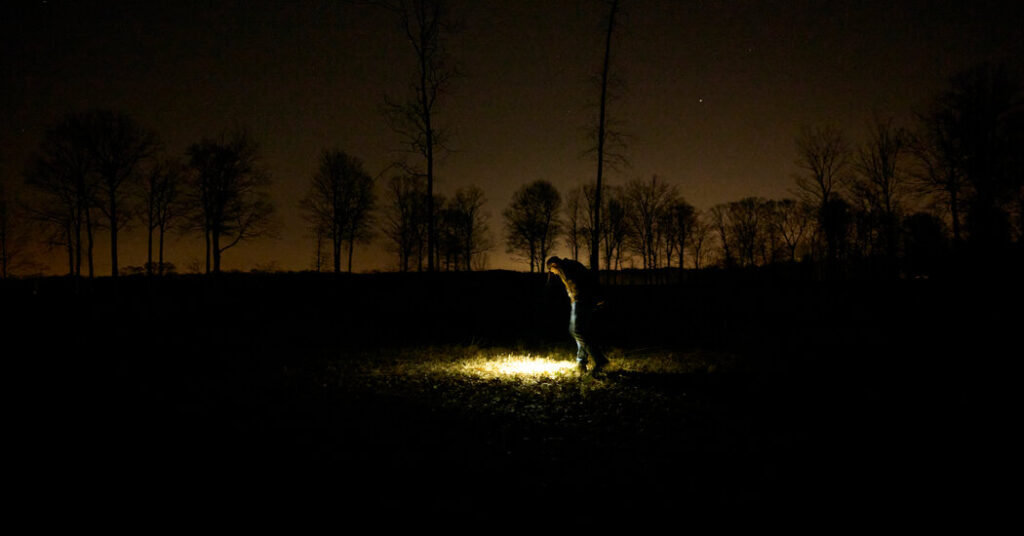
As the meteorite hunters filtered out of the bar, Mr. Dayton did not go back to his hotel. Instead, he headed back to the golf course. About a dozen rocks had been found on the golf course that afternoon, but none by him. So he put on a head lamp, waded through some shrubs and scoured the course some more.
“I’m not sure I can tell you why I’m out here,” he said. “I don’t think it’s competition, but I know if I’m not the first one out here in the morning, I know I’ll be missing out.”
The post A Meteor Exploded Over Ohio. Then the Chase Began. appeared first on New York Times.