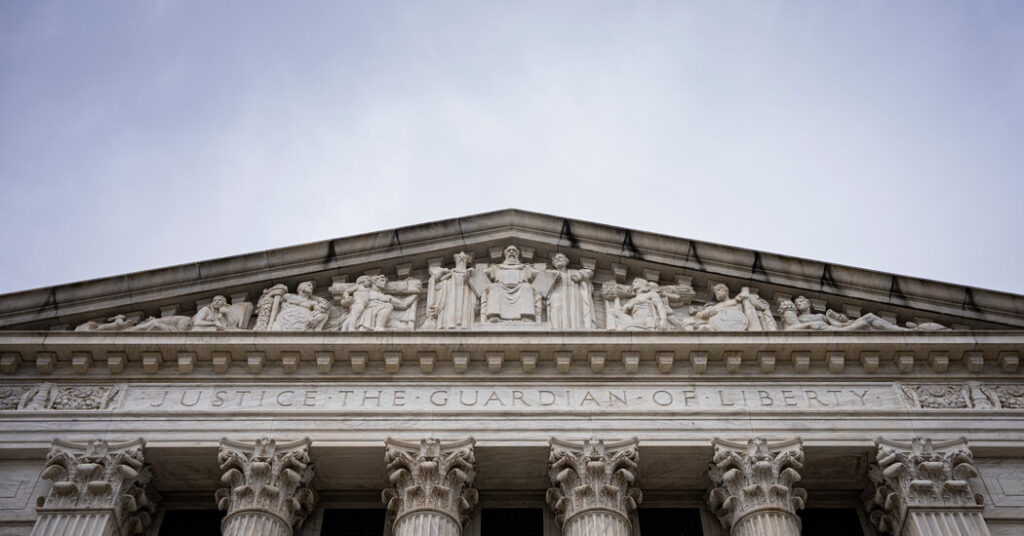
A case about mail voting that will be the subject of oral arguments before the Supreme Court Monday in some ways boils down to a simple question. What is the definition of Election Day?
But the potential political consequences of the case, which was brought by allies of President Trump who want to bar states from counting mailed ballots that arrive after Election Day, are far more tangible.
Coming smack in the middle of this year’s hotly contested battle for control of Congress, the case could upend election rules in at least 18 states and territories, potentially disqualifying hundreds of thousands of mail ballots in upcoming contests that would be considered valid under current law.
The case, Watson v. Republican National Committee, stems from President Trump’s fixation with mail voting, and will test the effort of Mr. Trump and his allies to impose voting restrictions born out of his baseless claims of widespread fraud. There is scant evidence, for instance, for his claim that accepting ballots postmarked by Election Day but received afterward invites a flood of phony votes that sway results.
Whether the law allows for states to establish such grace periods is a more convoluted legal question.
Federal statute establishes Election Day as the “Tuesday next after the 1st Monday in November.” Some say that means all votes must be in the hands of election officials by then; others say ballots must simply be cast and postmarked by that day.
Specifically, Watson v. R.N.C. challenges a Mississippi law that allows election officials to count ballots postmarked by Election Day but arriving up to five business days later. Mississippi is one of 14 states with such laws, though the length of the grace period varies. Similar laws are also on the books in the District of Columbia, Puerto Rico, Guam and the U.S. Virgin Islands.
Since the 2020 election, Mr. Trump has crusaded against mail voting, which exploded in popularity as a safe way to cast ballots during the pandemic.
Democrats flocked to mail voting in far greater numbers that year than Republicans, who were discouraged from using the practice by Mr. Trump’s sharp rhetoric. That in turn created an illusion on election night, when states typically tally in-person votes first, that Mr. Trump was ahead.
In fact, mail ballots took days and even weeks to tally in some states, and no evidence of widespread fraud emerged in any of the states where votes for Joseph R. Biden Jr. caught up to and surpassed those for Mr. Trump. The phenomenon of the “red mirage” was born.
Mr. Trump claimed there was no mirage, and he and his allies have relentlessly continued to rail against mail voting. He has called for its end outright, and sought to place significant restrictions on the process through legislation, failed executive orders and numerous court cases.
“No more crooked mail-in ballots except for illness, disability, military or travel,” Mr. Trump said during his State of the Union address last month. “None.”
House Speaker Mike Johnson joined the fray last month. “We had three House Republican candidates who were ahead on Election Day in the last election cycle, and every time a new tranche of ballots came in, they just magically whittled away until their leads were lost,” Mr. Johnson said. “It looks on its face to be fraudulent. Can I prove that? No, because it happened so far upstream.”
Mr. Trump has been transparent about his belief that changing voting laws would benefit his party.
“We’ll never lose a race in 50 years,” he said during a speech in Georgia last month, referring to passing federal voting legislation currently being debated in the Senate. He also falsely claimed without evidence that Democrats “cheat” with mail in ballots.
Such candor about his political aims has prompted Democrats, voting rights groups and some election administrators to counter that his real goal is to tip the scales of voting rules to give Republicans an advantage, to make voting more difficult or to simply continue to sow doubt about election results.
“We see this as a constant effort to basically intrude into the election process, and for this administration to figure out ways that they can discourage people from going to vote,” said Shirley Webber, the Democratic secretary of state in California. She added: “I find it somewhat ironic” that Mr. Trump had cast ballots by mail himself in the past.
Historically, changing voting rules in the middle of an election year has caused significant voter confusion, and has long been discouraged by election administrators and voting-rights authorities within the Department of Justice.
It has also produced a Supreme Court doctrine known as the Purcell principle, which discourages courts from allowing such changes when voting is imminent. Opponents of the lawsuit may argue that the principle should deter justices from tossing late deadlines.
Even laws signed well ahead of an election can have an outsize impact. In Texas in 2022, critics blamed a new, Republican-backed law featuring rigorous identification requirements for the rejection of roughly 30 percent of absentee ballots in the state’s most populous counties. The law had been enacted six months earlier.
Concerns about delayed counts — which have only grown with the proliferation of mail voting — in some cases reach beyond partisan politics.
Republicans have argued that requiring all mail ballots to be in by Election Day would help alleviate delays in results. Some Democrats and voting-rights advocates agree that weekslong counts can undermine public confidence in elections. But they say the problem isn’t only late-arriving ballots; it’s the mountain of ballots that arrive before the close of polls.
Stuart Holmes, the election director in Washington State, said an estimated 50 percent of ballots statewide — which in 2024 numbered 2 million — are typically received the final week ahead of Election Day. Late-arriving ballots in the state in 2024, by contrast, totaled about 127,000.
On Election Day, ballot drop boxes are “plum full,” Mr. Holmes said. “So those aren’t going to get processed Election Day. And the day after that, we’re still doing all of our signature verification, post-Election Day audits — all of those things contribute to a delay in results.”
Before Mr. Trump arrived on the political scene, Republicans were once the party promoting and using mail voting. The practice helped catapult the party to political dominance in Florida. And the vote by mail law in Georgia was endorsed by a Republican governor and passed by a Republican-controlled legislature.
The process is still popular among Republicans in some deeply red, and particularly rural, parts of the country — raising the prospect of political peril for Mr. Trump and the G.O.P. leaders pushing the Supreme Court to act. In Nevada, a key swing state during the 2024 election, the counties with the highest mail ballot turnout were Douglas County and Nye County, according to the secretary of state’s office. Both counties voted in favor of Mr. Trump by more than 30 percentage points.
Besides Mississippi, three states with complete Republican control — Texas, West Virginia and Alaska — currently allow for some form of late-arriving ballots.
The legal argument made by the Republican National Committee could potentially apply to all late-arriving ballots, including those from the military and overseas voters. Mr. Trump has publicly called for the military to continue being able to cast an absentee ballot by mail.
And late-arriving ballots have benefited Republicans in the past. A brief filed in the case by the Elias Law Group, a Democratic-leaning firm focused on voting rights, argues that former President George W. Bush would have lost the 2000 election had a ban in late-arriving ballots for military members been in place.
Conservatives argue that it’s simply a case of following clearly established federal law.
“If they’re told you must get your ballot in the mail a week before the election in order to guarantee that it’ll get here in time, then that’s what they’re going to do,” said Jason Snead, who leads the conservative Honest Elections Project. “They’ll respond to those changes. And I don’t think that’s a particularly difficult thing to do.”
Calculating the impact of eliminating post-election ballot deadlines is a complex task. A review by the Times last year found that in 2024, at least 725,000 ballots were postmarked by Election Day and arrived within the legally accepted post-election window, according to election officials in 14 of the 22 states and territories where late-arriving ballots were accepted that year. Four of these states — Kansas, North Dakota, Ohio and Utah — have since changed their policies and will accept only mail ballots that arrive by Election Day.
Discerning political impact is even trickier, as Democrats still far outpace Republicans in their use of mail voting. In Virginia, 73 percent of ballots that arrived after Election Day and were counted in 2024 were cast for Vice President Kamala Harris, compared with just 23 percent for Donald J. Trump. But mail ballots that arrived before Election Day had almost the same partisan breakdown.
Regardless of how the court rules, many voting rights experts do not expect Mr. Trump’s obsession with mail voting to subside — especially if Republicans lose seats in the November elections.
Said Wendy Weiser, who directs the Democracy Program at the Brennan Center, a New York nonprofit: “I think it’s all part of an effort to delegitimize elections and mail voting so as to soften the ground for efforts to try to overturn or interfere in election.”
Nick Corasaniti is a Times reporter covering national politics, with a focus on voting and elections.
The post The Supreme Court Could Make It Harder to Vote by Mail in the Midterms appeared first on New York Times.