PUEBLO, Colo. — Zac Grant never let his truck run close to empty. Colorado’s weather was too unpredictable for that, and lately, the cost of fuel had been, too. In the weeks since the United States had attacked Iran, the price for a gallon had shot up nearly 35 percent in Colorado, a hike that far outpaced the national average, and one the state hadn’t seen in at least a quarter century.
Grant, 48, knew he’d pay $40 more to fill his tank than he used to, but his new Dodge Ram 3500 was nearing a quarter tank, and he had work to do. The temperature was 60 degrees higher than it had been the day before, but he waited to turn on the air conditioning. He called up a free AAA app on his phone to find the cheapest fuel. A map of Pueblo lit up with little orange boxes. Grant’s local station had diesel for $4.80, and a few others had topped $5. Grant let out a low whistle.
“The last time I filled up, it was $3.07,” he said. “It will be a sting.”
War always has its casualties, Grant knew, and the amount he would pay that day was but one data point in a swirl of effects that was reshaping the global economy by the hour. With oil tankers struggling to navigate the narrow Strait of Hormuz, the price of a barrel of oil had climbed to more than $100. The war-triggered spike was the largest gas price increase in 30 years, according to a Washington Post analysis of data from the U.S. Energy Information Administration. Here in Pueblo, where the price of gas had risen an entire dollar since the start of the war, that meant people were making dramatic decisions about whether they could afford to go anywhere but work.
Locals in this politically purple dot two hours south of Denver debated the war and its effects with the same fury they’d once brought to arguments over the local abortion clinic and an initiative to do away with the mayoral form of government. Democrats said the war was the president’s way of distracting Americans from the Epstein files and the rising price of groceries, and besides, a Yellowstone supervolcano eruption was more likely to destroy Colorado than an Iranian nuclear missile. No, Republicans countered, President Donald Trump’s attack was a justified use of force that would protect America and its allies.
Grant fell into the latter camp, though his own politics were far muddier than what he saw as the unnecessarily black-and-white tenor of the internet.
Grant took one last look at the app, and he settled on an airport-adjacent Loaf ’N Jug, where a gallon of diesel cost $4.39 — a relatively low price Grant attributed to its location on the main highway. Grant pulled the Dodge into gear, then backed down his gravel driveway.
Willing to bear the pain
Once upon a time, Pueblo had been bluer than the rest of Colorado. That was back when everyone called the town “Steel City” and the unions drove the vote. But most of the steel mills had closed, and the region and its politics had shifted. In 2024, Pueblo was the only county in Colorado to flip from Joe Biden to Trump.
On his drive to the station, Grant passed tractors and irrigation ditches, yards that held more dirt and sage than they did lawn, and more than one pickup truck that looked exactly like his. He’d voted for Trump three times, but Grant didn’t consider himself easy to pin down. He supported the local sheriff, a Democrat, as well as the Republican mayor. And though Republicans spent hundreds of millions of dollars on anti-transgender messaging, he was raising a trans son without qualms. In fact, his kid was one reason he supported the war: He opposed the human rights violations committed by the Islamic regime against gay people and hoped the war would put new leaders in power. Trump’s ban on trans people in the military didn’t bother him even though it meant his son couldn’t join the National Guard, as Grant once had.
Grant turned left into the Loaf ’N Jug and pulled up to the only pump with an open spot for diesel. The last person who’d used it had spent $10 to buy just 2½ gallons. A few weeks ago, $75 had been enough to fill Grant’s 26-gallon tank. But the war prices had hit the Rocky Mountain region especially hard, and he knew he wouldn’t see that price again for a while.
Grant’s ranching job required him to drive 21 miles each way across the county several times a day. Eventually, he knew, the increased prices might hurt his bottom line, but he’d found a way to offset that. He’d changed his 401(k) holdings to invest in the petroleum company Phillips 66.
“Trump is calling on them for more supply out of the U.S.,” Grant explained. “I hate paying it at the pump, but I’ve calculated in years past, and when I do this, I offset my losses most of the time. You got to play the system the same way that the billionaires are playing the system.”
Grant released the nozzle and stared across the highway. Pueblo had its charms — a big city park, a river and a riverside boardwalk with more than a few good renditions of the town’s notorious “Slopper” hamburger dish. But much of it looked like the land around this Loaf ’N Jug — dusty and vast, with more space than stuff. The people who pulled up alongside him tumbled out in pajamas or well-worn clothes. They paid in the smallest increments possible.
A woman in a Jeep parked next to Grant. She had driven an hour from Manzanola to shop at the Sam’s Club, and though she knew the fuel would cost her, the food prices at her local grocery were so steep that the drive felt worth it.
Grant’s pump clicked. He’d spent $90.95 on a tank he’d drain hauling gravel the next few hours.
“How much you got?” he asked the woman in the Jeep.
“Eighty bucks,” she said with a groan.
“And how much was it three weeks ago?” he asked.
“Probably like 50,” she said.
Grant knew the war was the reason they were both shelling out that afternoon, but he also believed the attack had been necessary to protect Americans. These days, when Grant wasn’t ranching or farming, he ran an internet security business with government contracts. One of his business partners was Israeli, and they’d been in a meeting together when Hamas struck the country on Oct. 7, 2023.
“I support the war in Iran because I don’t ever want to relive 9/11,” he said. “I don’t ever want to worry about my mail room because I work for a government contractor receiving anthrax or my business partners’ families being bombed.”
Trump had promised a limited engagement in Iran, and Grant felt like both the U.S. and he could weather a short-term war. But his retirement account trick had its limits. Though oil companies were seeing a revenue boost, their executives worried a long engagement would curb use and cut their profits.
“If it goes longer, I’ll be disappointed,” Grant said. “I will feel like I’ve been lied to.”
A full tank or a meal?
The woman in the Jeep pulled out, and Grant did, too. The Loaf ’N Jug was briefly empty, but by lunchtime, every spot was taken.
A woman in an American flag cap closed her eyes as she filled up a minivan. A man hauling a trailer left the pump running long enough to duck inside for a Gatorade. A few minutes later, Israel Rodriguez angled his 1999 Dodge Durango into a spot, then considered the handful of cash he’d grabbed from home.
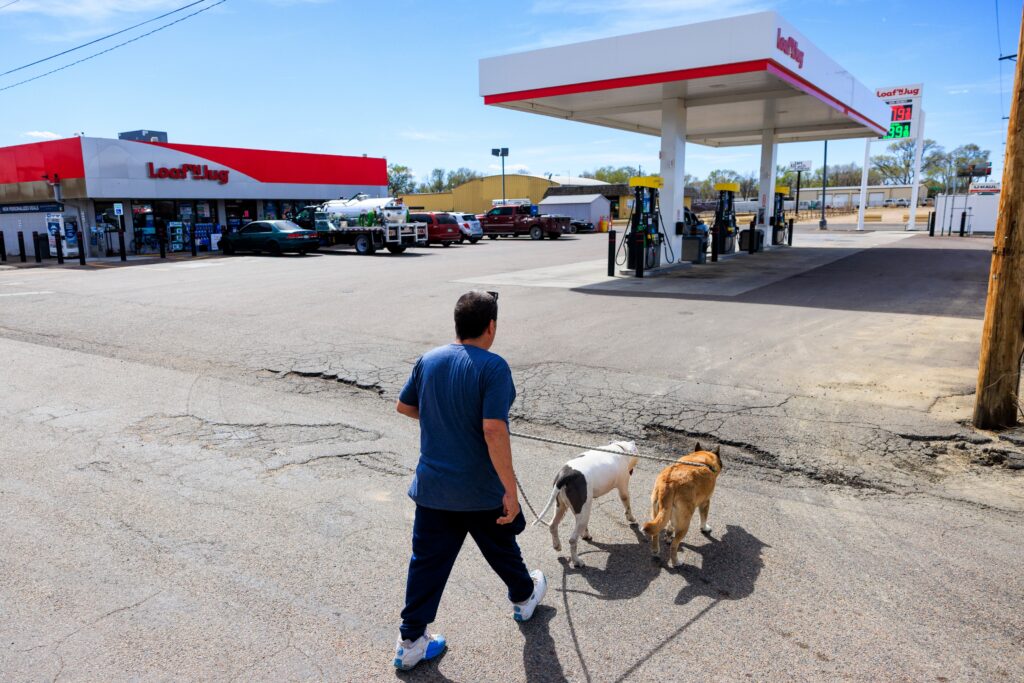
Rodriguez didn’t have the AAA app or a 401(k) investment to move around. He tracked gas prices the old-fashioned way. Every day, he leashed up his two dogs and walked the dirt path from his house to the station, and he took note of the dollar amount gleaming in the sky.
Before the war started, it was $2.19, he said. After America bombed Iran, the number started climbing. $2.39. $2.69. $3.19. $3.29.
Rodriguez still had a third of a tank Monday when the price rose another 30 cents to $3.59, but a mechanic friend told him not to wait another day to buy. As the war dragged on, the mechanic said, a gallon would only grow more expensive. By Tuesday, when Rodriguez drove up, the price was $3.79.
Rodriguez had shopped at the Loaf ’N Jug long enough to know he’d save 10 cents per gallon if he paid inside, so he counted his bills, then strode across the lot. When a clerk asked how much, Rodriguez did the math in his head.
“Thirty-five?” he said, the number as much a question as an answer.
That $35 only got him halfway, so he returned, handed over $10, then tried again. The Durango’s gauge hovered far left of full.
“You’re killing me,” Rodriguez said to the pump. “I can either choose gas or food, but I coach kids’ sports, and I need gas to get there, so I guess I’m not eating.”
When Rodriguez was young, he’d channeled his unspent energy into breaking into stores. He joined a gang and spent a week in jail, but he’d reformed himself when he met his wife. He knew sports could help adolescent boys, but the middle school required athletes to earn good grades, and he’d never made good grades himself. So he offered himself up to the YMCA as a volunteer — every sport, every season.
Rodriguez had debilitating diabetes that left him unable to work, so he and his family lived on the money his wife earned working as an assistant manager in the mall food court 8½ miles away. Some nights, she traded leftovers for Subway sandwiches or chicken wings. Other times, they looked for deals at the nearest Dollar General, but both options required a gallon or two to get there, and Rodriguez thought again of his mechanic’s words.
“Guess I’ll try again,” he said.
For most people, the Loaf ’N Jug was a temporary stop, but for Rodriguez, it was something of a social center. He spent his mornings here. He trained his dogs here. And today, he would eat his only meal on the sidewalk outside. He grabbed a $2 slice of pizza and asked the clerk to put another $15 on Pump 2.
Rodriguez didn’t possess the same optimism Grant maintained about the president. Rodriguez had disliked Trump long before the billionaire broke into politics, and his dislike had only grown in the decade since. Rodriguez thought Trump and everyone involved with the Jan. 6 storming of the Capitol should spend at least 20 years in prison.
Rodriguez hadn’t voted for any of Trump’s opponents, though. In fact, Rodriguez had never voted at all. He’d come close a few times. But the longer he listened to his fellow constituents, the more disaffected he felt. Trump, Biden, Obama. What was the point? No president had ever improved his life in a meaningful way.
He checked his gauge. He’d spent $60, and his Durango was finally somewhere near full. Maybe another president would have stayed out of Iran and kept the prices low, but much to Rodriguez’s own surprise, he thought Trump was wise to attack Iran.
“If he hadn’t, we might have nuclear bombs coming here,” Rodriguez said. “And who cares about gas if we ain’t got no world to live in?”
He let out a big sigh. He would drive the block to the bright blue double-wide he shared with his wife and a son, and then he’d leave the Durango parked as long as he could. He’d already set up a carpool for the next day’s flag football training, and his wife decided an Uber to and from the mall was cheaper than Rodriguez driving her.
By sunset, the price for a barrel of oil had jumped again. The average price for a gallon of diesel had topped $5 for the first time since 2022, and no one knew when the surge — or the war — would end. But just before 8 p.m., a Dodge Ram 3500 once again appeared in the lot.
Grant had spent the entire day hauling gravel across the county. After six hours and 168 miles, he realized he’d already used 22 gallons of diesel. His gauge was far too close to empty for his liking, so he parked at the Loaf ’N Jug and started filling. The counter ran past $75 and eventually topped $100, but Grant’s truck needed more, so the rancher held onto the handle and kept pumping.
Hacker and Moriarty reported from Washington.
The post One gas station, two drivers and three fill-ups: The Iran war hits home appeared first on Washington Post.