On a balmy evening roughly a decade after the brutal terrorist attack that killed his wife, Mohamed El Bachiri sat in a cafe overlooking the Brussels neighborhood where he still lives.
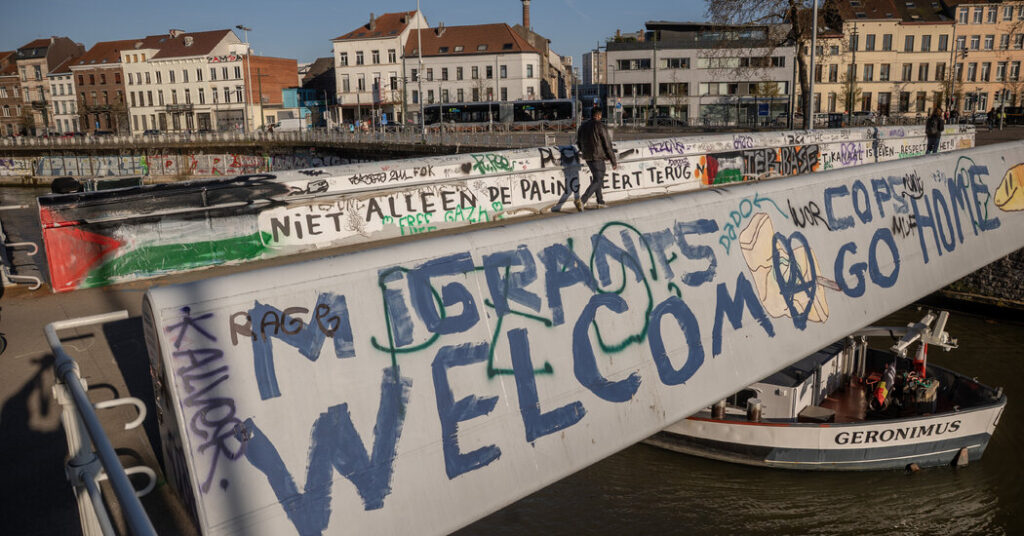
Molenbeek, a densely populated and diverse community separated from Brussels’s city center by a canal, was bathed in golden light and bustling with shoppers and commuters. Beneath that quotidian surface, though, is a community that has spent much of the past 10 years reeling from the aftereffects of the attack.
On the morning of March 22, 2016, two men set off explosives in the departure hall of Brussels Airport, and a third detonated a bomb on a metro train at a stop in the city. It was just months after a string of attacks in Paris had killed 130 people.
The two campaigns were carried out by the same terrorist cell — and seven of the more than 30 people involved in planning and executing them grew up or lived in Molenbeek.
Soon the neighborhood — and especially its large Muslim community — found itself cast in the shadow of deep stigmatization. International journalists descended on Molenbeek, writing stories with headlines calling it “Europe’s jihadi central.” When President Trump called Brussels a “hellhole” in 2016, many assumed it was Molenbeek to which he referred.
“When I was young, being Moroccan in Molenbeek was synonymous with being a criminal,” Mr. El Bachiri said. “But people weren’t calling us terrorists yet.”
“And then came 2016,” he said.
After the attacks, Mr. El Bachiri contended with profound personal loss: Loubna Lafquiri, Mr. El Bachiri’s wife, was on that metro; she had been on her way to work when she was killed. He was left to grieve, and to raise their three children on his own.
He, like others in Molenbeek, have tried to move on and move forward. The community has grappled with why extremism took root there in the first place, attempting to address factors like poverty and isolation that once made the neighborhood fertile ground for recruitment. It has made slow but real signs of progress, slightly improving residents’ standards of living and ushering in vibrant art spaces and beloved parks.
Still, Molenbeek remains dogged by serious difficulties — though this is a new era, and the challenges have taken on new forms.
Issues rooted in poverty
Thomas Renard, the director of The International Centre for Counter-Terrorism, a think tank based in The Hague, said Molenbeek, with about 100,000 residents, was not unique: It was one of several areas in Belgium that became “hubs” for radicalization. Often, a single recruiter or more would work through friends and family networks to pull people to their ideology, creating a snowball effect.
After the fall of the Islamic State caliphate in 2017, terrorist incidents declined across Europe and the number of fatalities from such attacks dropped sharply. In Molenbeek, worries about radicalization began to fade.
Yet there is a link between the factors that made Molenbeek a fertile place for radical recruitment in 2016 and the challenges the community faces today, said Mattias De Backer, a researcher at the department of criminology at Free University of Brussels, or VUB.
Molenbeek remains one of the poorest parts of Belgium, with roughly one in three residents earning incomes below the national poverty line; the typical household was making just over 21,000 euros annually, or about $25,000. It has struggled with chronically high unemployment, especially among young people.
“They grow up there without opportunities,” Mr. De Backer said. Ten years ago, some turned to radical ideologies. “Now, they’re much more likely to turn to drug violence,” he said.
As in several parts of Brussels, Molenbeek is contending with a drug crisis that local officials have tied to gang activity, and it has seen a rash of related shootings over the past year.
Today, the fear that young people will become involved in drug crimes after being recruited by violent gangs worries parents more than radicalization, said Bie Vancraeynest, the coordinator of Toestand, a nonprofit organization. The group sets up temporary meeting spaces in vacant buildings and abandoned lots across Brussels, giving families from the neighborhood, some living in cramped homes, a place to play, meet over coffee, and hold barbecues.
“It’s just a city with so much structural inequality,” said Ms. Vancraeynest.
Pushing toward the future
That fresh set of struggles doesn’t mean that Molenbeek hasn’t progressed.
Local schools are making small improvements on student performance. Joblessness has ticked down over time, though it remains high. And before the recent spate of shootings, drug-linked crime in the wider police zone that includes Molenbeek had declined slightly from 2016 to 2024.
Neighborhood groups in particular have worked to pull the community past its dark history — and the reputation that has haunted Molenbeek.
Bachir Mrabet, who has been working at Foyer, a youth center in Molenbeek, for 40 years, said the center held group therapy sessions a decade ago to help people traumatized by the attacks.
The youngest children were anxious, afraid there were terrorists in the neighborhood. Some older teenagers said they wanted to leave Molenbeek as soon as possible, fearing that the stain of the neighborhood’s reputation would hold them back in life. Others wanted to stay and help rebuild.
“After that, we deliberately went back to normal life,” said Mr. Mrabet. “With a certain degree of caution, but without becoming paranoid. Because life has to go on. And it has gone on.”
Last week, shopkeepers prepared for the neighborhood to break its fast on one of the last days of Ramadan, setting up stands to sell orange juice and pancakes at sundown. Children trickled into the Foyer center to attend judo classes or do their homework.
In a residential area near the edges of Molenbeek, Toestand has set up a community center in a former kindergarten that focuses on helping teens. A sprawling garden has taken over the former school’s playground.
People don’t talk about the 2016 attacks at the center, said Ms. Vancraeynest. The organization also deliberately never applied for funds specifically aimed at preventing radicalization of local residents.
“I believe that youth work and social work have a role of their own and should not be instrumentalized for this,” she said.
More and more people from outside the neighborhood are finding their way across the canal, said Jan Goossens, an artistic director who helped lead Molenbeek’s recent bid to be named a European Capital of Culture 2030. The municipality missed out on getting the title, but some cultural initiatives that were initiated during the campaign remain.
“Every European city today has its Molenbeek, and we either have the choice to stigmatize them and call them hellholes, or see what they have to offer,” Mr. Goossens said.
For his part, Mr. El Bachiri had considered leaving Molenbeek after the attacks that killed his wife, but ultimately decided to stay. To him, what the community offers today is — to some degree — hope for the future.
He is realistic about Molenbeek’s current challenges. He worries that geopolitical issues like the war with Iran may rekindle cultural tensions, and he talks to his children about the risks of drug crime in the neighborhood. But he has also seen his neighborhood come together, and begin to move on, over the past decade.
“You have wonderful people who are doing a lot to uphold Molenbeek’s reputation,” Mr. El Bachiri said. “I think it’s important to tell you that things have changed.”
Koba Ryckewaert is a reporter and researcher for The Times based in Brussels.
The post A Brussels Community Moves on From Terrorist Attacks, but New Challenges Emerge appeared first on New York Times.