Only a few weeks ago, the stars seemed to be aligning for India’s economy.
India was one of the fastest-growing major economies, consistently outpacing its powerful neighbor, China. It had surpassed Britain to become the world’s fifth-largest economy and was within striking distance of overtaking Japan for fourth. In a world beset by risks — from the war in Ukraine to President Trump’s tariff campaign — India’s skilled labor force, fiscal discipline and strong currency reserves made it a relatively safe bet.
An underappreciated component of the momentum was India’s deepening ties to the Arab countries of the Persian Gulf. But that advantage is now turning into a liability.
The U.S.-Israeli war on Iran is a perfect storm for India’s economy.
The Middle East accounts for roughly 40 percent of the country’s oil imports and 80 percent of its gas. As energy prices soar, the effects ripple across the economy, threatening India’s mix of strong growth and mild inflation.
The Gulf is also a crucial export market for Indian goods, now at risk from disruptions to air routes, shipping and business operations. Many Indian businesses rely on hubs like Dubai to distribute their goods globally.
India is the world’s largest recipient of remittances from workers abroad, with about 40 percent coming from the Middle East. Any hit to overseas Indian workers’ earnings would further weaken an already softening currency.
Last week, Goldman Sachs warned that India was facing slower growth, higher inflation and a weaker currency over the coming year, driven by rising energy prices, slowing exports to the United Arab Emirates and its neighbors and potentially lower remittances.
The investment bank said India’s “positive growth story” was now facing a “new broadside.” India’s stock markets have fallen about 10 percent over the past month.
Since the energy crisis of the 1970s, India has relied heavily on oil shipped through the Strait of Hormuz, the narrow shipping corridor along Iran’s southern coast that carries about one-fifth of the world’s oil supply.
Any extended disruption is likely to strain India’s finances. Shortages of cooking gas are already squeezing households. The government has the power to control fuel prices, but cutting excise duties or expanding subsidies for a prolonged period would add to fiscal pressure.
Prime Minister Narendra Modi is expected to keep most prices in check ahead of state elections in April. His government has worked to secure supplies, first obtaining U.S. permission to buy Russian crude that was stranded at sea because of sanctions. India also secured safe passage for two tankers carrying gas that had been stranded in the strait after speaking with Iranian officials.
When global oil prices rise above $100 a barrel, pressure on India’s economy intensifies. It imports about 90 percent of its crude.
In a research note last week, the Australian banking group ANZ said that while the Indian economy was starting from a position of strength with high growth and low inflation, “its ability to cope with a durable energy shock will be tested.”
The report said that the country’s economic players — oil companies, the government and Indian households — “do not have robust financial buffers to withstand a prolonged oil price shock.”
Rathin Roy, an economist and dean at GITAM, a university in Hyderabad, said the crisis in the Gulf would force India to “watch its balance of payments very, very carefully.” Imports will become more expensive just as India’s exports are disrupted. India’s foreign-exchange reserves are strong now but could be cut in half within the year.
India’s government hailed the Arab states of the Gulf as the country’s “largest trading partner bloc” when they announced a free-trade agreement four days before the war began. India sends them a wide range of products: electronics, textiles, gems, basmati rice — even refined fuels.
Talmiz Ahmad, a retired diplomat who has served as India’s ambassador to three Gulf countries, said half of the $50 billion a year in Indian goods exported to the United Arab Emirates was shipped on to Pakistan, Afghanistan and Africa.
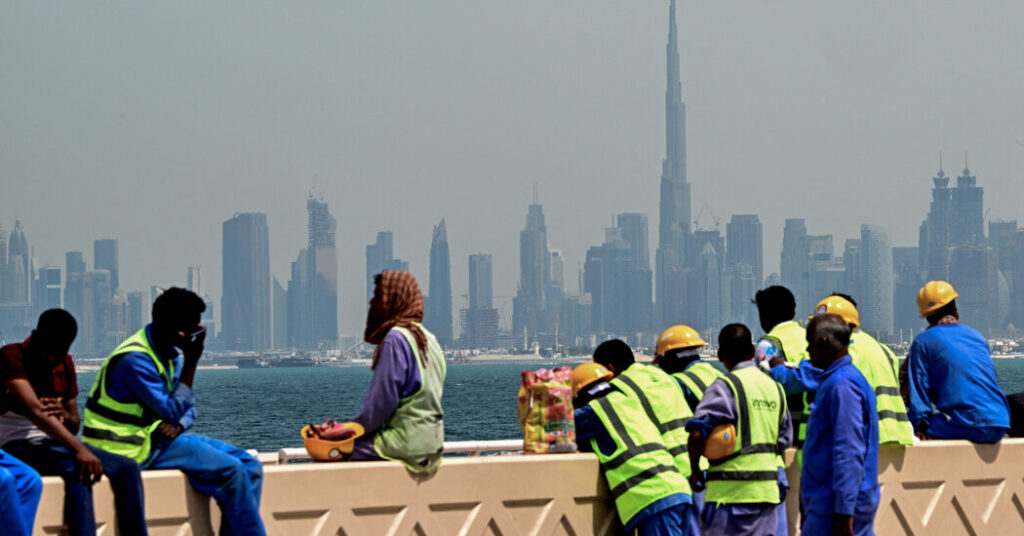
Around 10 million Indians make their home in the six countries lining the southern and western shores of the Persian Gulf. Mr. Ahmad said the economies of the Middle East and India were so interconnected that “every project in the Gulf has an Indian fingerprint.”
India’s ties to the region span the full economic spectrum. The Indian tycoon Mukesh Ambani, Asia’s richest man, broke a local record in 2022 when he paid a reported $163 million for a villa in Palm Jumeirah — a luxury complex in Dubai that came under attack on the war’s first day. At the other end, many unemployed laborers migrate in search of work, often staying on illegally.
Some Indian workers live apart from their families for years to send 50 to 70 percent of their modest incomes home. In their numbers, they add up. Last year, India’s global remittances amounted to nearly $130 billion — nearly the same amount India spends importing oil. More than a third came from the Gulf.
An Indian man working a construction job in Qatar said he had heard blasts and knew of nearby labor camps that had been set on fire by falling missiles during the fighting, but he said his biggest concern was the financial stability of his family 1,800 miles away in the crowded Indian state of Uttar Pradesh.
He said he and his colleagues wanted the war to end so that their projects could resume. He asked not to be identified because he did not want to attract the attention of the local authorities, who have been arresting foreign workers on charges of disseminating alarmist misinformation about the war.
The worker said he had considered returning to India but was afraid his employer would never rehire him.
Suhasini Raj contributed reporting.
Alex Travelli is a correspondent based in New Delhi, writing about business and economic developments in India and the rest of South Asia.
The post As War Disrupts India’s Gulf Ties, Economy Faces ‘New Broadside’ appeared first on New York Times.