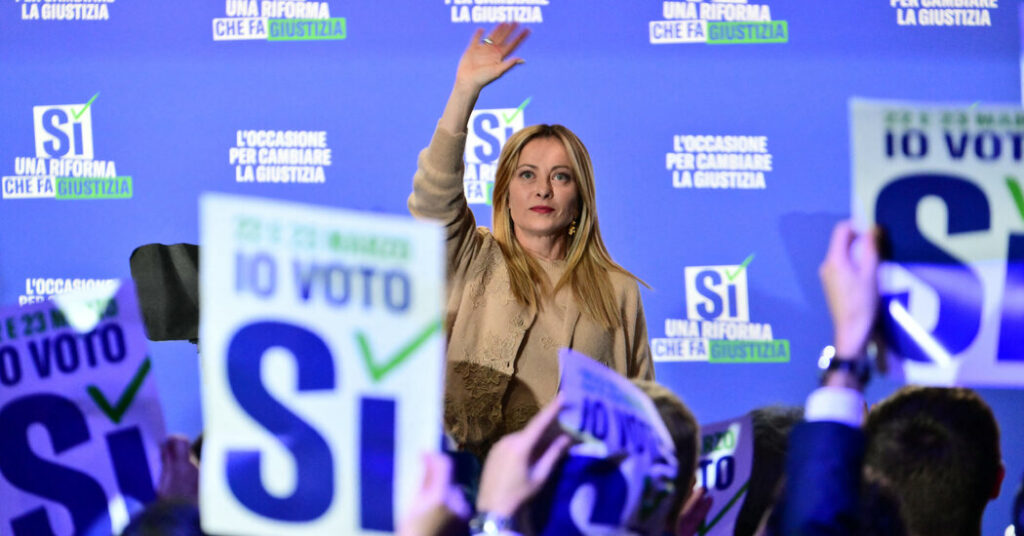
For more than three years, Giorgia Meloni, the first female prime minister of Italy, has led one of the nation’s most stable governments, keeping her coalition intact for longer than all but two of her postwar predecessors.
Yet this week, she faces a rare threat to her authority in the form of a tightly fought referendum being held on Sunday and Monday that polls suggest Ms. Meloni may struggle to win. The prime minister is seeking support for proposed changes to Italy’s Constitution that are so complicated, hardly anyone completely understands them.
Instead, voters may end up treating the polls as a referendum on the prime minister herself.
“The majority of Italians don’t know anything about this or have a very vague idea,” said Roberto D’Alimonte, a political scientist at Luiss Guido Carli University in Rome.
As a result, he said, Italians — if they vote at all — will most likely “vote along political lines, not on the substance.”
The government’s proposal would, among other changes, divide oversight of judges and prosecutors, who are now jointly overseen by a single authority, and create a new council to discipline them. It would also make it harder for a judge to become a prosecutor, and vice versa.
Supporters of the idea say this would prevent too cozy a relationship between the judge presiding over a case and the prosecutor pursuing a conviction. Ms. Meloni has argued that it would make the justice system “more just, more efficient, more meritocratic and more free.” She has frequently accused judges of impeding her efforts to combat illegal immigration and making politically motivated decisions.
Though Ms. Meloni did not place the change at the center of her election campaign, she is channeling a long-held complaint from Italian politicians — including Silvio Berlusconi, the right-wing former prime minister convicted of financial crime — that jurists had become too powerful.
Critics disagree. Margaret L. Satterthwaite, a United Nations expert who researches judicial independence, said in an interview that the changes might give politicians undue influence over the judiciary because their appointees could have more of a role in supervising and disciplining judges.
In the run-up to the vote, political mudslinging has reached peak proportions.
The chief of staff to Ms. Meloni’s justice minister compared prosecutors and judges to “firing squads.” A prosecutor dismissed the measures by saying that they were supported by the mafia and “fringe” Freemasons. Ms. Meloni warned that without the changes, “illegal immigrants, rapists, pedophiles and drug dealers” would jeopardize public safety.
Voters say they are fed up with what they see as a barrage of propaganda and an absence of clear information. “More than anything else, it bothers me that politicians keep taking sides,” said Massimiliano Scarpi, 48, a banking analyst who was taking a smoking break in Verona, a midsize northern city.
After a long day at work, Mr. Scarpi said, “I don’t have the head space” to look “for what’s hard to find — that is, someone to explain it to me.”
For many Italians, the Constitution, ratified in 1947, is a sacred document protecting them from the return of fascists like Benito Mussolini, an ally of Hitler who ruled Italy until 1943. Efforts to tamper with the Constitution — particularly by a prime minister whose party can trace its roots back to the ashes of Italian Fascism — are regarded with suspicion.
Even amendments proposed from the left have not fared well: A decade ago, when the prime minister at the time, Matteo Renzi, proposed a constitutional overhaul to drastically reduce the size of the Italian senate, voters rejected the measure and Mr. Renzi resigned.
As Italians absorb news reports about the Trump administration’s efforts to influence the American judiciary, “it does contribute to a global climate where you say, ‘Well, let’s be careful,’” said Jean-Pierre Darnis, a professor of Italian politics and contemporary history at the Université Côte d’Azur in France.
Unlike in Mr. Renzi’s case, Ms. Meloni has pledged to stay in office regardless of the outcome.
Still, Ms. Meloni’s support for the measure means that anything other than a convincing “yes” vote could dent her political standing, Mr. Renzi said in an interview. To make her feel secure going into an expected parliamentary election next year, “she will be relaxed only if she wins with more than 60 percent,” said Mr. Renzi, who leads a small center-left opposition party. Current polls show the “no” vote pulling slightly ahead.
Under the current judicial system, an umbrella organization appoints and disciplines prosecutors and judges. Under the new system, that body would be divided into three different councils, one to manage the careers of prosecutors, another for judges and a third to discipline both. Each council would be composed of prosecutors and judges chosen by lottery — as well as political appointees who would be chosen by lottery from a shortlist of law professors and experienced lawyers nominated by Parliament.
Sabino Cassese, a former judge on the Constitutional Court, described himself in an interview as “a leftist” who “would never vote for Meloni.” He said he supported the constitutional change because “impartial” judges should not serve with prosecutors on the same oversight body.
Italy’s National Association of Magistrates — which represents both judges and prosecutors — opposes the plan. It warned that appointing lawyers by lottery could give too much power to unqualified people, and said the changes could limit judicial independence.
“Not everyone who has a driver’s license can drive a Formula One car,” said Cesare Parodi, the head of the association.
Both supporters and critics of the plan have struggled to explain their reasoning to voters. Opponents say Ms. Meloni’s government has deliberately obfuscated its proposals.
“You’re not stupid if you’re not understanding,” said Marco Rossi, 33, a lawyer in Verona, during a 90-minute presentation at a “vote no” event organized at a bar by a far-left party. “That was the goal,” he said.
Carlo Nordio, the justice minister, said in an interview that the opposition has rejected the overhaul to tarnish Ms. Meloni, not because they necessarily disagree with the need for change. “A large part of the opposition thinks that if the referendum is negative for the government, Prime Minister Meloni will emerge very weakened,” he said. “And so they have endowed this referendum with an extremely political meaning.”
For now, the biggest risk for Ms. Meloni’s camp is the disengagement of voters.
Damiano Tommasi, Verona’s left-leaning mayor, said he believed Veronesi are more interested in resolving problems with public transit, labor shortages and how to integrate immigrants.
The risk is they treat the referendum as an “an opinion poll about who proposed it,” he said.
Motoko Rich is the Times bureau chief in Rome, where she covers Italy, the Vatican and Greece.
The post Italy’s Leader Wants to Change the Constitution. Italians Don’t Get It. appeared first on New York Times.