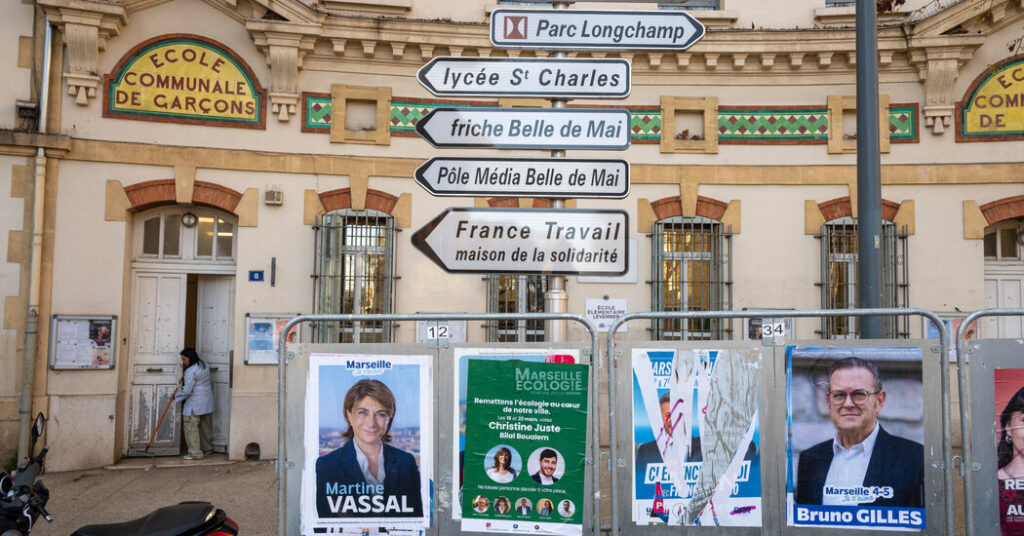
France’s municipal elections, which began last week and end on Sunday, are being scrutinized for what they may presage for the country’s presidential elections next year. Among the big questions is whether France is on the cusp of a populist, far-right wave like those that swept Argentina, Italy and the United States in recent years. The answer, pending a second round of votes, is a definite maybe.
Far-right candidates performed strongly in the first round of voting a week ago in several major cities, including Marseille, Nice and Toulon. That shows the durable appeal of the National Rally party, which comfortably leads presidential polls. But the party did less well outside its strongholds in France’s south, and tactical voting in the second round could limit its gains even there.
France’s centrist parties, including that of President Emmanuel Macron, continue to languish, reflecting deep-seated disenchantment with mainstream politics. Turnout in the first round was the lowest since at least the 1950s, except for the 2020 election, when the pandemic kept voters away.
“French people are not uninterested in politics,” said Philippe Marlière, a professor of French and European politics at University College London. “They just don’t like the old ways of doing politics.”
How does the election work?
To elect its more than 34,000 mayors, France uses a two-round system: If no one wins an absolute majority in the first round, the strongest performers proceed to a runoff a week later. Most small-town elections were won outright last week, but the races in many major cities require another vote on Sunday.
Like all local elections, the races are driven primarily by parochial issues. But France’s mayors help elect the Senate, so the results have national implications.
What’s the key race to watch?
The far right has never run Marseille, France’s second-largest city, since the restoration of French democracy after World War II. So for the National Rally — whose candidate, Franck Allisio, finished just behind the city’s left-wing mayor, Benoît Payan, last week — a victory would be a landmark breakthrough.
But Mr. Allisio’s hopes of overtaking Mr. Payan in the second round were dented after a far-left candidate dropped out, making it easier for Mr. Payan to firm up his base.
Mr. Allisio views Marseille as a template for how the National Rally could win the presidency next year, under the leadership of Marine Le Pen or her protégé, Jordan Bardella. Instead, he may end up as the latest populist politician to channel the frustration of French voters, only to fall short when the electorate gets a second look and recoils from the prospect of a far-right government.
What does the vote tell us about polarization?
The first round highlighted just how polarized French politics have become.
The far-left party, France Unbowed, also performed well, capturing town halls in the working-class suburbs of Paris and in the economically depressed industrial north. That suggests that the party’s pugnacious leader, Jean-Luc Mélenchon, could play a consequential role in the presidential election.
Only a month ago, France Unbowed was on its heels, implicated in a deadly attack on a young right-wing activist, Quentin Deranque, that prosecutors said was carried out by left-wing militants with links to the party. Separately, critics accused Mr. Mélenchon of anti-Semitism after he deliberately mispronounced the name of Jeffrey Epstein, the financier and convicted sex offender, at a rally.
And yet the party beat expectations in Saint-Denis, a Paris suburb, and Roubaix, a gritty textile town in northern France. Analysts said that anger over the war in Iran may have propelled turnout among Muslims, who are often among the party’s more reliable supporters.
What’s happening in Paris?
Paris has its own political weather system, often quite different from that in the rest of France. Voters there are electing a successor to Anne Hidalgo, a Socialist and the city’s first female mayor, whose popularity waned over 12 years in office. In the first round, her former deputy, Emmanuel Grégoire, finished well ahead of his rivals, suggesting the capital would remain in the hands of the left.
Yet last week, as the other candidates began horse-trading, Rachida Dati, a conservative candidate who finished a distant second, suddenly emerged as a genuine rival. Ms. Dati picked up the support of a center-right candidate and got a further lift when a right-wing candidate withdrew from the second round to help her.
What does the vote mean for President Macron?
Mr. Macron isn’t on the ballot, but the vote will most likely underscore his lack of domestic influence, given the struggles of centrist candidates. He said little during the campaign, though with the weakened Socialists seeking alliances with the far left after the first round, he finally spoke out. At a cabinet meeting, his spokeswoman said, Mr. Macron “emphasized that party agreements should not overshadow certain principles.”
Ana Castelain contributed reporting.
Mark Landler is the Paris bureau chief of The Times, covering France, as well as American foreign policy in Europe and the Middle East. He has been a journalist for more than three decades.
The post France Is Voting for Thousands of New Mayors. Here’s Why It Matters. appeared first on New York Times.