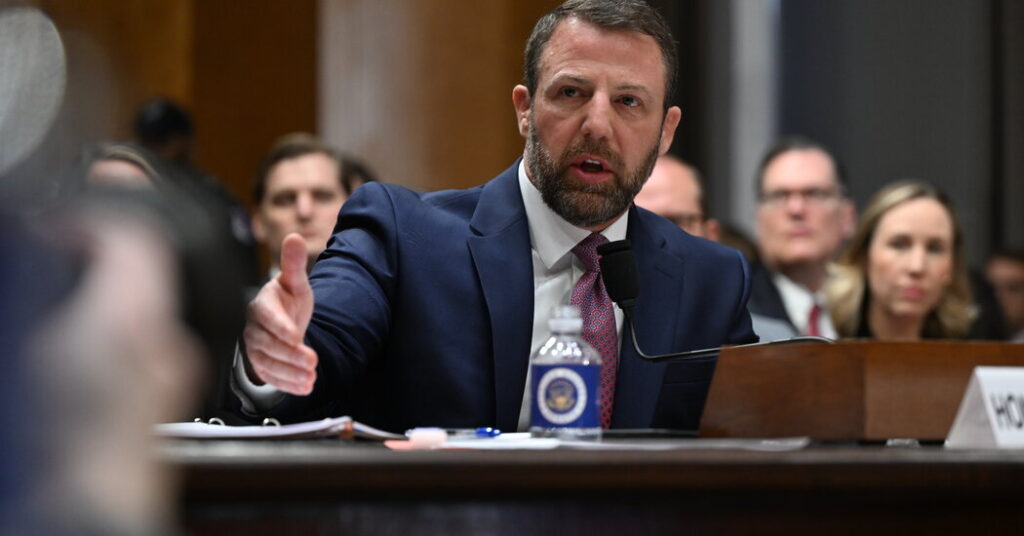
Senator Markwayne Mullin, the Oklahoma Republican chosen by President Trump to be the next homeland security secretary, surprised some lawmakers this week when he broke with the administration and signaled that he would be willing to require judicial warrants for immigration agents to enter private homes.
It was a concession that Democrats had sought for weeks as a condition of reopening the Department of Homeland Security, which has gone without funding for more than a month amid a fight over immigration tactics, and one that the White House had repeatedly rejected.
What some of his colleagues may not have known is that well before the hearing — and before Mr. Mullin had been nominated to head the department — he had been quietly working with a House Democrat to hash out a compromise on immigration enforcement that offered substantially more ground than the White House had publicly given in talks aimed at reopening the agency, according to two people familiar with the discussions.
For weeks, Mr. Mullin and Representative Josh Gottheimer, a moderate Democrat from New Jersey, have been discussing a bill to fund the Department of Homeland Security that could placate Democrats seeking restrictions and a White House disinclined to give ground, according to both people, who spoke on the condition of anonymity to discuss ongoing negotiations.
Their proposal, according to a draft reviewed by The New York Times, would require federal immigration agents to obtain judicial warrants “for forced home entry, unless in hot pursuit.”
It also would effectively bar civil immigration enforcement actions at certain sensitive locations, including hospitals, churches, schools and polling places, in most cases, except with the approval of a judge. And the legislative framework calls for reverting to the training, use-of-force and detention facility standards that were in place under the Biden administration.
Mr. Mullin, a first-term senator who served for a decade in the House, has often served as an emissary between the two chambers and between Congress and Mr. Trump. But his conversations with Mr. Gottheimer, a longtime friend, were held separately from weekslong formal negotiations between Senate Democrats and the Trump administration.
It is unclear whether Mr. Mullin has circulated the proposal among senators, whose approval would be crucial for any deal.
The White House border czar, Tom Homan, has twice this week met with a bipartisan group of senators and outlined narrower changes that the Trump administration would be willing to accept. A White House official, who requested anonymity to discuss ongoing negotiations, suggested that Mr. Mullin’s discussions with Mr. Gottheimer were informal and said that Mr. Trump’s team was leading formal policy conversations.
But Mr. Mullin’s pursuit of a bipartisan compromise with Mr. Gottheimer — and the proposal itself — suggest that he has for some time been open to moderating Mr. Trump’s immigration crackdown, and to changes at the agencies that he is poised to lead.
And it appeared to echo the softer approach that Mr. Mullin has projected at a time when some Republican lawmakers and members of the administration have conceded that Mr. Trump’s deportation campaign has generated a public backlash that could hurt their party in this year’s midterm elections.
“My goal is for people to understand we’re out there, we’re protecting them, and we’re working with them,” he said at his confirmation hearing this week.
Mr. Mullin’s office did not immediately respond to a request for comment.
Mr. Gottheimer declined to answer questions.
“As a rule, for fear of undercutting progress, I won’t discuss any ongoing negotiations with my colleagues,” he said in a statement.
The White House has so far refused Democrats’ demands that federal immigration agents obtain judicial warrants and be barred from wearing masks to hide their identities.
In a letter to senators on Tuesday, Mr. Homan said the administration was open to requiring that officers display visible identification, and to limits on immigration enforcement at sensitive locations and expanding the use of body cameras. He did not address Democrats’ call for a use-of-force policy, a demand they made after federal immigration officers killed two U.S. citizens in Minneapolis.
Body cameras and clear identification for immigration agents are also required in the proposal by Mr. Gottheimer and Mr. Mullin, but it goes further. It would mandate that the F.B.I. and federal prosecutors take the lead when investigating shootings involving immigration officers, like those in Minneapolis.
It also would require that Immigrations and Customs Enforcement discuss civil immigration enforcement operations with local law enforcement officers.
Mr. Mullin suggested he was open to both changes during his confirmation hearing, where Mr. Gottheimer was at various moments seated behind him in support.
Mr. Mullin told senators that he believed the F.B.I. and the Justice Department should lead investigations into shootings involving ICE agents, and that he wanted to try to ease conflicts between federal immigration agencies and local law enforcement officials.
According to one of the people briefed on the negotiations, Mr. Gottheimer has kept the minority leader, Representative Hakeem Jeffries of New York, informed of his conversations with Mr. Mullin.
Christie Stephenson, a spokeswoman for Mr. Jeffries, said in a statement that “the bipartisan progress that has been made on a judicial warrant requirement, protecting sensitive locations like polling sites and independent state investigations is a meaningful step in the right direction.”
But, she added, Mr. Jeffries still maintained that any deal to fund the department needed to include requirements that immigration agents “stop hiding behind masks with impunity.”
Michael Gold covers Congress for The Times, with a focus on immigration policy and congressional oversight.
The post Mullin Explored Bipartisan Deal to Rein in Immigration Crackdown appeared first on New York Times.