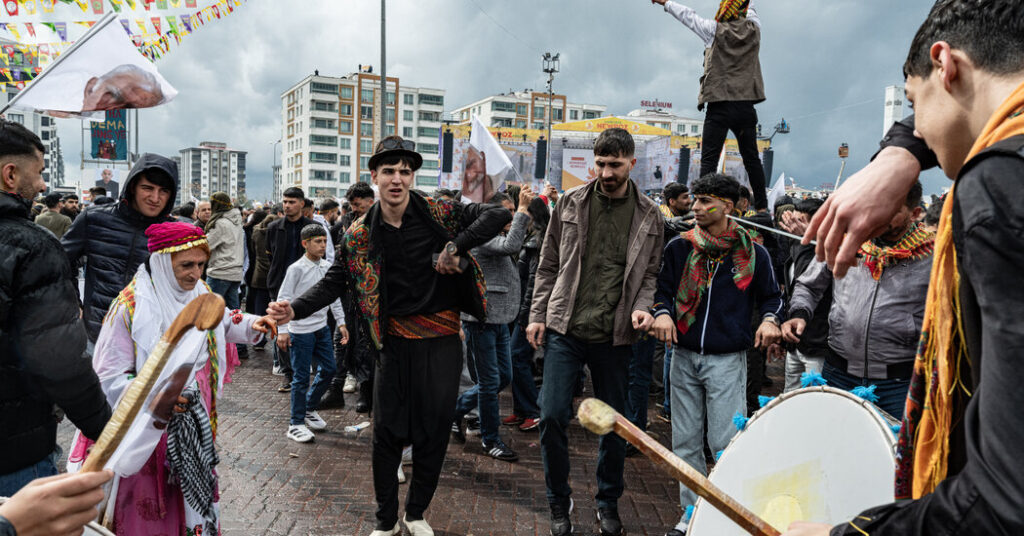
Flames from a giant bonfire rose toward the sky. The ground rumbled underfoot as men pounded drums and women and men clasped hands and line danced to the beat.
Surrounded by tens of thousands of people who had braved rain, mud and multiple police pat-downs to celebrate the Kurdish holiday of Newroz in the city of Diyarbakir in southeastern Turkey on Saturday, a former teacher waxed poetic about the day’s importance.
“Just as the heart pumps blood to the body to keep humans alive, Newroz pumps blood — freedom, peace and national unity — into the hearts of the Kurds,” said the teacher, Mehmet Sahin, 58.
Newroz is the Kurdish version of an ancient holiday that is celebrated in different ways across parts of Asia, the Caucasus and the Balkans, and by diaspora communities from the region in Europe and the United States.
Known as Nowruz in Persian and Nevruz in Turkish, it marks the start of spring in the northern hemisphere.
For the Kurds, who form a sizable ethnic minority in Turkey and the neighboring Middle Eastern countries, it is the year’s most important holiday, its celebration intertwined with cultural identity and politics.
Many in the crowd on Saturday sported traditional Kurdish clothes not often seen in Turkish cities. Men donned army-green jumpsuits with baggy pants and wide, embroidered belts. Women wore flowing dresses with bright, flowery patterns. Seemingly ever-present were scarves and braided headbands in red, yellow and green — the colors of the Kurdish flag.
As Kurdish politicians gave speeches amid the music and dancing, a huge tepee of logs was set alight, a key Newroz tradition. From the stage, a woman read a message from prison from Abdullah Ocalan, the founder of the Kurdistan Workers’ Party, or P.K.K., which for four decades fought a bloody insurgency against the Turkish state.
Turkey, the United States and the European Union consider the P.K.K. a terrorist organization, largely because of attacks that killed Turkish security forces and civilians. The group announced last year that it was disbanding as part of a new peace process.
Traces of the Turkey-P.K.K. conflict dotted the celebration. Reaching the heavily guarded park where the festivities took place required passing through two security checks, and police officers filmed everyone who entered.
Inside, people waved flags bearing Mr. Ocalan’s face and carried posters of male and female militants killed in the conflict. Also common were photos of Selahattin Demirtas, a prominent Kurdish politician who has been detained since 2016 on numerous charges, including terrorism and insulting President Recep Tayyip Erdogan. Rights groups have called his detention politically motivated.
“Nowruz means more than just the arrival of spring,” said Bahar Yildirim, 38, who was leading her mother toward the celebration on Saturday. “It means life and the struggle of the Kurdish people.”
Her brother, a militant, had been killed in 2006 at age 21, she said, adding that the holiday also commemorated people like him.
“Kurds gave their lives just to say ‘I exist, with my country and my language,’” she said.
This year’s holiday came as Kurds in different countries found themselves once again embroiled in the region’s conflicts.
As the United States and Israel wage war on Iran, the United States is considering backing Kurdish militants to fight the Iranian government. In Syria, the United States recently abandoned a Kurdish-led militia that had been its closest ally during the fight against the jihadists of the Islamic State.
In Turkey, Kurds are waiting to see how they might benefit from the government’s peace process with the P.K.K. The Turkish government has long held that the country’s Kurds have the same rights as all Turkish citizens. But it has refused to recognize them as a separate ethnic group and to deem Kurdish an official language.
In a video message on Saturday, Mr. Erdogan said he hoped that the holiday and the spring weather to follow would “carry hope to our hearts, calm to our societies and peace to our world.”
He sent holiday greetings to people in 10 different countries and territories, naming them one by one. He did not mention the Kurds.
The Kurds’ complicated place in the region is a product of history. In the early 20th century, world powers promised them a state in the Middle East, but left them out when new national borders were drawn after World War I.
Now estimated at 40 million people, the Kurds are one of the world’s largest contiguous ethnic groups without their own country. They mostly live in the border regions of Iran, Iraq, Syria and Turkey. Over the decades, they have suffered discrimination and government efforts to suppress their culture, language and traditions. Various Kurdish groups have also launched efforts — armed or otherwise — to achieve independence or greater autonomy.
That past gives Kurds in different countries a sense of shared destiny.
Kurds in Turkey “feel directly” what happens to their brethren in Iran and Syria, Tuncer Bakirhan, the co-chairman of Turkey’s largest pro-Kurdish political party, said in an interview.
“The Kurdish issue has been left without a solution for the last 100 years,” he said. “Now, in each country, Kurds should embrace their democratic rights and freedoms.”
More than 40,000 people, most of them civilians, have been killed since the start of the Turkey-P.K.K. conflict in the mid-1980s. Mr. Ocalan, the P.K.K.’s founder, initially sought to achieve an independent Kurdish state but later shifted his focus toward expanding Kurdish rights inside the countries where Kurds live.
The new peace process began last year. In February, Mr. Ocalan, who has been held in an island prison in the Sea of Marmara south of Istanbul for more than two decades, called on the P.K.K. to disarm, saying that its armed struggle had outlived its purpose. In May, the group announced that it would disband.
The process has moved slowly since.
Mr. Erdogan and his allies have emphasized the importance of the group’s dissolution in order to free Turkey from terrorism and strengthen it against regional turmoil.
The Kurds say that the government must make concessions too, including recognizing Kurdish culture, permitting Kurdish-language education and releasing people detained during the conflict.
Mr. Bakirhan, the pro-Kurdish party co-chairman, said his constituents often ask when their detained relatives will be released and when Kurds who went into exile to avoid prosecution will be able to return.
“The answers to those questions don’t belong to us,” he said. “The government should answer them.”
Many people at Saturday’s celebration expressed cautious optimism that the peace process would move forward this year.
“The Kurdish side did what they have to do, but we haven’t seen anything from the other side yet,” said Enver Yildirim, a municipal worker who had come to celebrate with his wife and their two daughters, ages 12 and 14.
“They have to have the consciousness,” he said of why he had brought his daughters. “They need to know their history so that they can build their future.”
Ben Hubbard is the Istanbul bureau chief, covering Turkey and the surrounding region.
The post With Fire and Song, Kurds in Turkey Hail the Start of Spring appeared first on New York Times.

![‘Project Hail Mary:’ Yes, That Was Really [Redacted]](https://dnyuz.com/wp-content/uploads/2026/03/1774130703_Project-Hail-Mary-2-1024x576-350x250.jpg)