KIRKENES, Norway — King Crab Safari Captain Dirk Heidschwager hauls a round net up 20 feet from the fjord bottom, revealing four crusty dinner-plate-size shells rimmed by eight spindly legs. The three male crabs are hauled into our polar skiff; the last goes back into the sea to produce the next generation. “We’re female friendly,” quips Captain Dirk.
Then our boat skips across the Kirkenes inlet to a weathered wooden shack that looks ready to slip into the sea. For the crabs, it’s the steam pot. For the 14 passengers on Havila Voyages’ king crab fishing excursion, it’s time for a taste of history, culture and all the king crab we can eat.
Over the past seven days, some 350 passengers aboard Havila Capella have sailed roughly 1,400 miles along Norway’s coast from the 1,000-year-old city of Bergen, filled with bright wooden houses, to Kirkenes, north of the Arctic Circle near the Russian border. Since 1893, cruise ferries have transported mail and people to 34 ports along this rugged coast where agriculture, herding and fishing still shape local life. Havila’s four newly built ships entered service in 2021. Most of those aboard are tourists who have signed up for 6- or 13-night scenic journeys; others are locals or travelers making short trips.
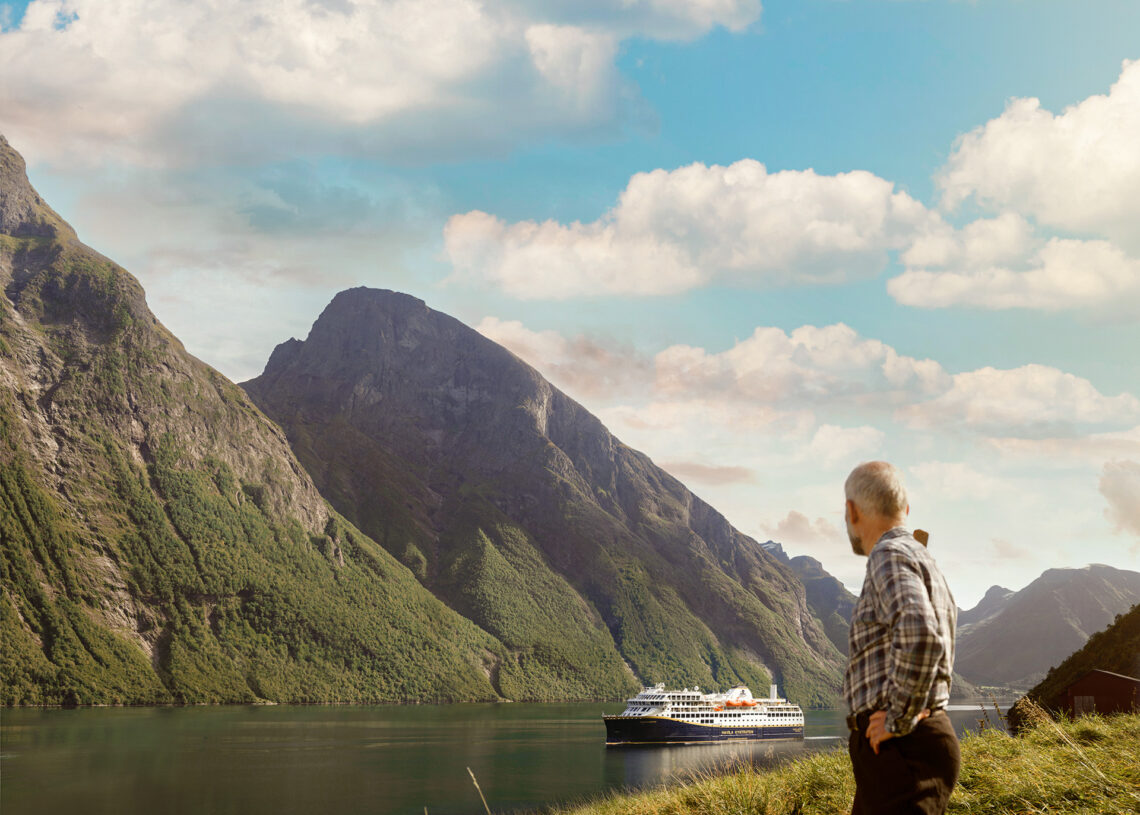
On this summer sailing, even those onboard for a single night get a preview of Norway’s dramatic landscape as we sail past the coastal city of Alesund into the Geiranger Fjord, so stunning it has earned a UNESCO World Heritage designation. Waterfalls gush from 4,000-foot-high peaks carved by glaciers eons ago. The waters plunge into a slim nine-mile seaway some 1,800 feet deep.
“It’s overwhelming,” says Teuvo Moilanen, who is visiting from Finland. “The fjord gets narrower and narrower and higher and higher. Today we have so much [digital] entertainment available, and yet this is still so powerful.”
The fiercest of the waterfalls roars right through the tiny village of Geiranger. On conventional cruise lines such as Viking and Celebrity, passengers have several hours in port — time enough to climb the riverside boardwalk and see geological exhibitions at the Norwegian Fjord Center. But the ferries of Havila and rival Hurtigruten, which pioneered these voyages, are public transport vessels that keep strict schedules. Passengers who want to explore further have two options. They can disembark, luggage and all, and book a later bus or ferry to another coastal destination. Or they can sign up for a ship-arranged tour into the mountains that includes a guide, gondola ride and dinner in a peak-town restaurant with panoramic views. (In many cases, the ship arranges land transport for you to meet it in another port.)
Time in port is just one of the differences between Norway’s ferry sailings and a traditional cruise. Havila ships have no casinos, no dedicated children’s spaces, no spa and no in-room food service. Onboard programming is limited, consisting mostly of talks by staff and commentary about sights along the way. Port stops are frequent; the vessels visit 34 towns in six days, with many brief calls late at night. The bar is a laid-back space designed for enjoying the scenery, without a disco ball in sight.
Other shipboard features feel familiar. The Scandinavian-styled staterooms with pale wood and clean lines exude serenity. Our sea-view cabin includes a comfortable sofa, wardrobe cabinet and counter-like desk stretching along the long wall beneath a TV screen. As on most cruise ships, the en suite bathroom is snug but functional. Hot tubs atop the deck provide warming dips. There are no cabin balconies; for itineraries north of the Arctic Circle, the weather is usually so brisk it doesn’t matter.
In this unseasonably warm July, we might have used a terrace as temperatures hit the 80s. But open decks and wide windows throughout public spaces offer endless views of peaks dusted with snow above the quiet sea — and a chance to chat with fellow travelers, most from Europe and North America. Some, like Brenda Berlot of Wisconsin, have come to see the land of their ancestors. Others are here for the adventure of exploring the far north.
“Who knew it would be so green?” says Hal Sklar of Washington, D.C. Kathy Hartmann-Campbell of Switzerland agrees. “I expected it to be barren. It’s unbelievably beautiful.”
From the main dining room, we watch remote farms and fishing towns slide past as we breakfast on made-to-order eggs and lunch on tapas such as ceviche, soup and small sandwiches. In this summer month of midnight sun, the dramatic scenery continues to unfold into the evening as we dine on duck breast, steak in Béarnaise sauce and fish.
The delicate flavors and artful presentation are better than typical cruise-ship cuisine — especially surprising in a region where plain, hearty food like pickled fish is standard fare. One evening, we splurged on the multicourse menu in the ship’s fine-dining restaurant, Hildring, deeming the king crab in ponzu sauce and scallop in horseradish vinaigrette well worth the $40-per-person surcharge.
To limit food waste, meal portions are smaller than what Americans usually find at home (though double servings are available). This is just one of several eco-friendly practices on board. All food ingredients are locally sourced. Havila’s hybrid ships are fueled by liquefied natural gas and 86-ton battery packs that can power the ship for four hours, reducing emissions and noise; one of those ships will soon be powered by biofuel whose residual is a fertilizer usable for farming. Recycling is a way of onboard life; cabins are serviced every other day to reduce laundry.
As Capella glides soundlessly across the smooth sea, guests gather on the deck to watch the waning sun cast an orangey glow behind peaks on the ever-shifting horizon. Rocks look more like castle ruins than the wind-carved cliffs they are. A fishing village with more boats than houses emerges around a bend. A distant fog-swathed isle looks like King Kong’s Skull Island. Moss and emerald seem to swirl across the tree-covered hillsides, dotted with fields of carrots, potatoes and cabbages first cultivated by the Vikings.
The scenery is gorgeous, sure. But how does anyone survive on a remote farm north of the Arctic Circle miles from any visible village?
This place is not as remote as it seems, we learn. Norway’s vast 60,000-mile roadway system provides easy access to towns with grocery stores, churches, bars and port stops along the Norwegian coastal sea route. A new high-speed $47 billion highway system is underway. We and our fellow passengers could have flown to the Arctic capital of Tromso or to Kirkenes. But we would have missed so much along the way.
A handful of stops on our journey north allow time enough for more than a glimpse.
In bustling Tromso, my husband and I grab e-bikes and head for the striking Arctic Cathedral. The ride is quick but terrifying; we’ve misjudged the traffic patterns and nearly end up in a heap. A safe, reliable public bus takes us to the Polar Museum that pays tribute to early explorers who ventured here via ships, dirigibles, hot air balloons and dogsleds.
The irresistibly kitschy Troll Museum offers plenty of laughs and cultural insight, as well. Exhibits explain Norse folk beliefs, cautionary tales of evil sea trolls and mischievous tree trolls turned into cliff faces after being caught in sunlight. (Note to self: Don’t be late to breakfast.)
But most stops are brief. Curious passengers sign up for ship-arranged tours including ATV treks, hikes to outlying villages, bike and kayak tours, history walks and birdwatching excursions. Hartmann-Campbell and her husband, Werner Hartmann, sign up for a history tour by wooden boat, bus ride through the countryside, the king crab fishing trip and a gondola ride above Geiranger; the open boat ride to a maelstrom is already filled. But the most memorable, they later agree, is a visit with a Sami family.
“They told us how they balance between their traditions and modern life today,” Hartmann says. “They still have dogs and travel with dogsleds to their reindeer herds. But they also use motorized snowmobiles. Climate change affects them and their animals because the snow gets frozen over sometimes by rain, and the reindeer cannot get down to the grass [and] need to be fed. Reindeer are still providing food and skins for their daily life.”
Almost magically, as the couple’s bus returns to the ship, reindeer herds appear along the road.
The group’s final excursion, the king crab trip, spotlights the evolution of traditional fishing life. Windproof coveralls and life jackets protect us on the speedy boat ride to the baited crab net. With the three male crustaceans retrieved, we zip back to the surprisingly sturdy shack for an education on king crabs.
Their name, we learn, derives from the blue color created when their iodine-rich blood hits snow (“because all royals have blue blood,” the captain quips). The crabs are actually transplants, the result of a 1960s effort to relocate food from Russia’s sparsely populated western region of Kamchatka to the populous east. The crabs procreated quickly, and within a decade, they had spread into the waters of Norway.
Eight long legs are visible; two small claws are evidence of their kinship to lobsters. The massive crabs before us measure about two and a half feet from tip to tip; bigger ones are tough and tasteless, we’re told.
Captain Dirk quickly kills the crabs before snapping off the legs — each as big as a turkey’s — tossing the carapace and its insides to the birds and fish. The legs go into the steamer; we head to the shack for our feast. The air goes quiet save for the slurps of sweet, tender meat dipped in drawn butter.
It’s a tasty finish to a week of soul-soothing beauty. Says Berlot, “Maybe we’ll come back in winter.”
IF YOU GO
Since 2021, Havila has operated four identical purpose-built ships along coastal Norway’s ferry route under a government license. Ships operate daily throughout the year. Tickets can be purchased for the six-night route between Bergen and Kirkenes, a 13-night round-trip voyage, or short voyages to ports along the route. Six- and 13-night voyages include three meals daily in Havrand, the main dining room. Short-sail passengers can purchase meals in a shipboard cafe.
Six-night voyages start at about $1,600 per person, double occupancy. havilavoyages.com
On Havila, lunch and dinner seatings are at set times and tables. This can be awkward when tablemates speak different languages. Requests for table changes are handled discreetly.
Hurtigruten, which launched coastal service in 1893, now operates coastal ships carrying 500-600 guests each. Hurtigruten also offers “Signature” voyages with more time in fewer ports. hurtigruten.com
On both brands, excursions are booked separately and vary by season and line.
The post Norwegian ferry cruise is an eco-friendly, slow alternative to traditional ships appeared first on Washington Post.
![‘Project Hail Mary:’ Yes, That Was Really [Redacted]](https://dnyuz.com/wp-content/uploads/2026/03/1774130703_Project-Hail-Mary-2-1024x576-750x536.jpg)