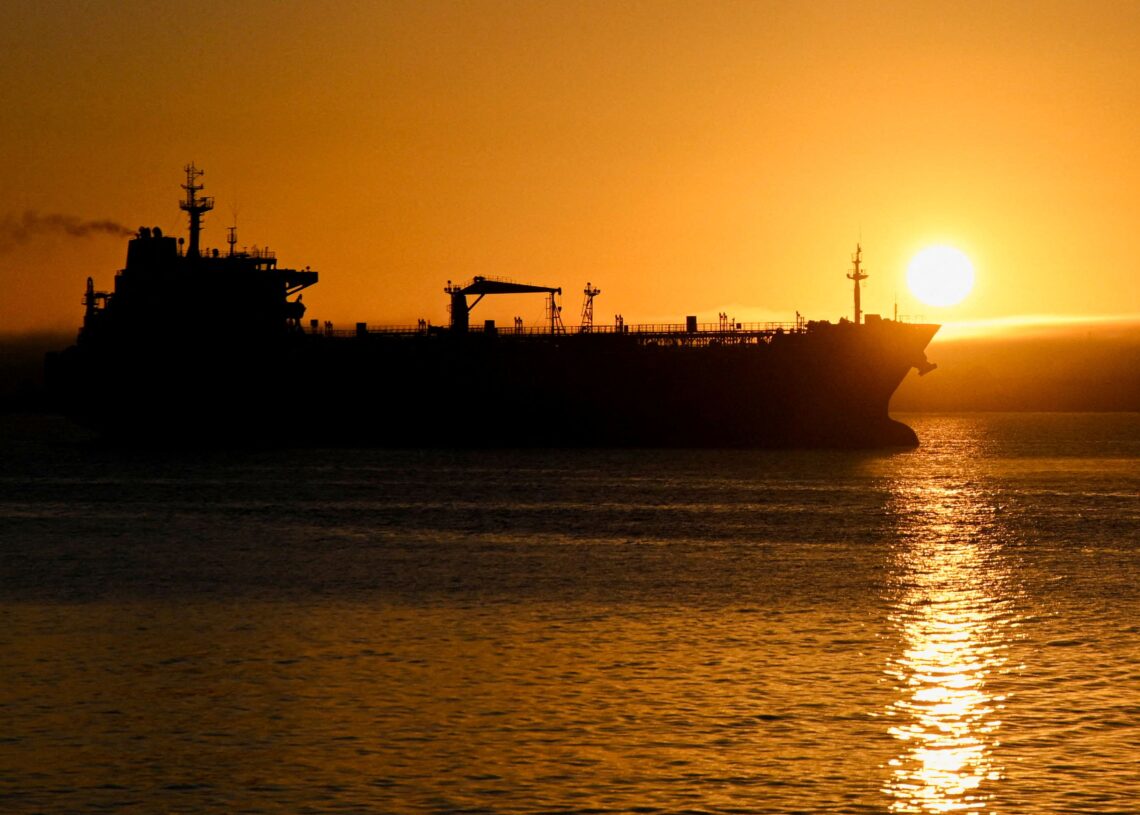
A Russian tanker powering across the Atlantic could soon become the first real test of how far the Kremlin is willing to go to aid its old allies in Cuba amid the Trump administration’s pressure campaign against Havana.
Six decades after the Cuban missile crisis brought the globe to the brink of nuclear war, the effective oil blockade the administration imposed on Cuba in January is worsening blackouts and fuel shortages on the island, bringing one of Russia’s last strategic partners in the Western Hemisphere to its knees. But as President Donald Trump threatens to “take”the country, now teetering on economic collapse, Moscow has appeared to offer little more to Havana than lip service.
That could be changing. The Russian-flagged, state-owned tanker the Anatoly Kolodkin departed March 8 from Primorsk, Russia, carrying 750,000 barrels of crude that, once refined, could provide Cuba with several precious weeks of energy. Britain’s Royal Navy tracked the ship and its Russian navel escort through the English Channel. Then the escort veered off and the vessel continued its journey solo.
The Kolodkin’s destination is listed on manifests only as “Atlantic, For Order.” But the maritime tracking agency Vortexa indicates the Cuban port of Matanzas, home to the island’s largest oil terminal, as the most likely destination, according to Michelle Wiese Bockmann, a senior analyst at the maritime intelligence firm Windward, Vortexa’s partner. Other firms have also reported the ship appears to be heading to Cuba. It’s about a week away from the island, Bockmann said.
Kremlin spokesman Dmitry Peskov didn’t confirm or deny Moscow’s links to the Kolodkin or another ship carrying Russian oil in the Atlantic on Friday. But he suggested Moscow was looking for ways to offer Cuba relief.
The Russian government is “in constant contact with the Cuban leadership, with our Cuban friends,” he said. “And we are, indeed, discussing with them possible options for assisting Cuba in the difficult situation it finds itself in.”
Any attempt to deliver crude to Cuba could trigger a direct confrontation with an administration with which Moscow has been eager to build a new working relationship. Last week, the U.S. Treasury Department, looking to ease the surge in energy prices caused by the war in Iran, temporarily lifted sanctions on countries that purchased Russian oil then already at sea. But on Thursday, Treasury issued new guidance that specifically barred Cuba from receiving Russian oil — a move that appeared to send an unsubtle message to Moscow: Back off.
For Russian President Vladimir Putin, the question of how and whether to aid Cuba these days is perhaps more about optics. After the U.S. extraction of Venezuelan President Nicolás Maduro in January, and the subsequent pivot of his authoritarian socialist regime toward Washington, Russia has precious few friends left in the Americas. Russia in 2024 sent warships, including the frigate Admiral Gorshkov and the nuclear submarine Kazan, on port visits to Havana to project power in the region. Last year, Havana and Moscow signed a military cooperation agreement that includes joint military drills, training and the refurbishment of Cuban military equipment.
But Cuba has never truly regained the strategic importance to Moscow it enjoyed during the Cold War. More at stake for the Kremlin now is defending the value of Russian friendship, which has been brought into question by Moscow’s muted support for its beleaguered allies in Venezuela and Iran.
“Russia has been seriously hurt by its lack of willingness to defend Maduro at all, and playing not a visible role in the Iran conflict,” said Douglas Farah, president of the national security consulting firm IBI Consultants. “If they feel they can get away with [shipping oil to Cuba], they would probably love to.”
But Moscow is mostly “probing the strength of American will,” he said, and will change course if confronted. “I seriously doubt, even with the U.S. being very distracted in Iran, that Russia would test the military resolve of the United States, especially given Trump’s, you know, ongoing behavior.”
A second ship, the Hong Kong-flagged Sea Horse, laden with 190,000 barrels of Russian fuel, has spent weeks plotting a bizarrely atypical course in the Atlantic. At one point last month its registered destination was Cuba, Bockmann said, but after the new guidance Thursday, it said it was heading for Venezuela.
Russian military bloggers have grown increasingly frustrated with what they say is Moscow’s drift toward accommodation with the Trump administration since U.S. forces captured Maduro. Some warn that Washington is systematically strangling the country’s strategic partners around the globe.
“Our problem is that the next time we decide to turn our geopolitical skis toward the Global South, we will see a brazen, grinning orange face in its place,” Russian nationalist author Zakhar Prilepin wrote in January.
Kremlin supporters are seizing on the Kolodkin’s voyage as an opportunity to show defiance.
“The island of freedom and socialism is being strangled by the U.S. before the eyes of the entire world,” Russian political analyst Sergei Markov said. “Everyone pinned their ears back like rabbits — and only Russia, a brave and proud country, sent tankers to Cuba.”
Putin, who received Cuban Foreign Minister Bruno Rodríguez in Moscow last month, said Russia regards the latest U.S. sanctions against the island as “unacceptable.”
“Our countries have a special relationship forged by history,” Putin said last month. “We have always stood by Cuba’s side in its struggle for independence, for the right to develop along its own path, and have always supported the Cuban people.”
Foreign Minister Sergei Lavrov, speaking with Rodríguez last week, “confirmed Russia’s principled position” against “the U.S. exerting economic and political pressure on Cuba.”
Ties between Moscow and Havana stretch back to the early years of the Cold War, built on shared ideology and enmity with Washington. When Castro seized power in 1959 and declared a socialist state, the Soviet Union gained a key ideological and military partner 90 miles from the United States. The partnership peaked during the 1962 missile crisis, when the U.S. discovery of Russian missile sites on the island forced a nuclear confrontation between the world’s superpowers.
Over the following decades, the U.S.S.R. poured billions of dollars into the Cuban economy in subsidized oil, trade agreements and technical assistance. But that support largely collapsed with the Soviet Union itself in 1991, plunging Cuba into years of severe economic hardship — an era known on the island as the Special Period — from which it has never fully recovered.
Putin has worked in recent decades to rebuild the partnership. In 2014, he canceled 90 percent of Cuba’s $32 billion Soviet-era debt. Then came agreements that granted Russia exemptions from import taxes, the right to use Cuban land for at least 30 years and preferential access to property, markets and labor. Russia committed to supplying Cuba with 1.64 million tons of oil and oil products annually via energy company Rosneft and pledged to help build a hydroelectric plant and a solar facility on the island.
Since capturing Maduro, the Trump administration has turned its attention to Cuba. The oil blockade has led to a humanitarian crisis as Cubans run out of fuel and blackouts plague the nation.
Cuba requires roughly 100,000 barrels of oil a day but can produce only 40,000. Since the administration coaxed Venezuela and Mexico to stop shipments to the island, and has threatened everyone else, Cuba has struggled to bridge that gap.
Russia provided roughly 7,000 barrels a day, according to Jorge R. Piñon, a researcher at the Energy Institute of the University of Texas at Austin.
Should Russia abandon Cuba now, said Farah, of IBI Consultants, the effects would be felt far beyond the island.
“It’s about the symbolism of Cuba as their longtime allies since the late 1950s or the 1960s, and the fact that symbolizing is very strong across Latin America,” he said. Delivering oil, he said, “would be to say, ‘We can still help our allies and we’re willing to do so with some risk and don’t everybody turn your back on us.’”
The post Cuban oil crisis? Russian tanker could challenge U.S. blockade. appeared first on Washington Post.