Robert S. Mueller III, a career prosecutor who became a central figure in two searing national traumas, first as FBI director in the aftermath of the 9/11 terrorist attacks and later as special counsel investigating ties between President Donald Trump’s campaign and Russia, died Friday. He was 81.
Mr. Mueller’s family confirmed his death in a statement Saturday to the Associated Press. Mr. Mueller had been diagnosed with Parkinson’s disease in 2021, according to a statement his family shared with the New York Times last year.
During more than four decades in law enforcement — as line prosecutor, U.S. attorney and FBI chief — Mr. Mueller developed a reputation as a stickler for detail who savored methodical investigation and nearly always got his man. Some colleagues privately spoke of the decorated Marine veteran as “Bobby Three Sticks,” referring to his patrician pedigree and the three-fingered Boy Scout salute.
Mr. Mueller was confirmed as FBI director by a 98-0 Senate vote and reported for duty on Sept. 4, 2001 — one week before the al-Qaeda assaults on the World Trade Center and the Pentagon that would define his tenure. Over the next 12 years, he became the longest-serving leader of the FBI since J. Edgar Hoover, and he guided the bureau under Presidents George W. Bush and Barack Obama through its transformation from a domestic crime-fighting agency to a global intelligence organization focused on the war against terrorism.
At the FBI, in an era of increasingly partisan national division, he built a reputation for nonpartisan rectitude and stone-faced reserve, frustrating speechwriters by crossing out every “I” they wrote into his prepared remarks. It wasn’t about him, he told them: “It’s about the organization.”
Then, in his last major role on the national stage — as special counsel investigating Russian interference in the 2016 presidential election that brought Trump to office — Mr. Mueller, long venerated as an impeccable public servant, suddenly became a political target.
Mr. Mueller found himself excoriated from the right as a symbol of what Trump and his supporters viewed as a witch hunt designed to bring down the president. At the same time, his investigation was welcomed by the left as an injection of integrity, an impartial reminder of a time when a consensus on the facts was politically achievable.
Mr. Mueller maintained a public silence through the 22 months of his Russia investigation, which yielded indictments leading to convictions of a Trump campaign chairman, a deputy campaign manager, a national security adviser and one of his personal attorneys.
In his report, released in April 2019, Mr. Mueller concluded that “the Russian government perceived it would benefit from a Trump presidency and worked to secure that outcome,” and that the Trump campaign “expected it would benefit electorally from information stolen and released through Russian efforts.”
But the investigation “did not establish that members of the Trump Campaign conspired or coordinated with the Russian government” — a conclusion that Trump and his supporters cited as evidence that the probe had been a partisan fishing expedition.
In the months after Mr. Mueller completed his work, the Trump administration dismantled some of the investigation’s most prominent results. The Justice Department dropped charges against Trump’s first national security adviser, Michael Flynn, even though Flynn had pleaded guilty twice to lying to the FBI. And the department undercut prosecutors’ recommendation of a substantial prison term for Trump political adviser Roger Stone, who was convicted of obstructing Congress and witness-tampering. All four prosecutors who handled the Stone case withdrew from the matter in protest.
Trump regularly denounced the Mueller investigation as a “hoax,” “a total disgrace” that amounted to “treason.” In 2020, he issued pardons to Flynn, Stone and several others convicted in the probe.
Mr. Mueller’s team of prosecutors believed they had shown that Trump’s actions were improper, and they assumed that Congress would take up their findings in an impeachment process. But the investigators declined to pursue any criminal charge against Trump, writing that an “accusation against a sitting President would place burdens on the President’s capacity to govern.”
As a result, Mr. Mueller’s report said, the investigators decided to avoid any “approach that could potentially result in a judgment that the President committed crimes.”
Mr. Mueller’s reluctance to return Trump’s fire in public comments and his decision to steer clear of impinging on a president’s ability to govern opened him to withering criticism that he had failed to hold Trump to account.
The special counsel’s findings were not the core issue in Trump’s impeachment later that year. The House impeached Trump in December 2019 on charges that he abused his power by pressuring Ukraine to investigate a Democratic rival and that he obstructed the impeachment inquiry. The Senate voted 52 to 48 in February 2020 to acquit Trump. The votes in the Democratic-controlled House and Republican-controlled Senate were largely along party lines.
The special counsel’s decision not to reach a conclusion on whether Trump had obstructed justice was roundly blasted by many Democrats and some Republicans, although some defenders argued that Mr. Mueller correctly reasoned that only Congress had the authority to bring charges against a sitting president.
“The very qualities that got Mueller appointed and enabled him to push through with the investigation — his reputation as the sole figure in Washington who was above partisanship — turned out to be the qualities that made him stop short of concluding what most people thought he should conclude about the president,” Garrett M. Graff, author of a book about Mr. Mueller’s FBI years, “The Threat Matrix,” said in a 2020 interview for this obituary.
“So despite his incredible legacy of service,” Graff continued, “the verdict from history on Bob Mueller is going to end up being much more complex because of the final months of his career.”
Report defended
Trump declared Mr. Mueller’s report “complete and total exoneration,” and his attorney general, William P. Barr, decided that the report’s evidence “is not sufficient to establish that the President committed an obstruction-of-justice offense.”
Mr. Mueller had two opportunities to defend his work, and he was widely perceived to have done so weakly.
He wrote to Barr, saying that the attorney general’s brief public characterization of the 448-page report had failed to “fully capture the context, nature, and substance of this office’s work and conclusions.” But that letter was made public five weeks after Barr had summarized the report as a vindication of Trump’s behavior.
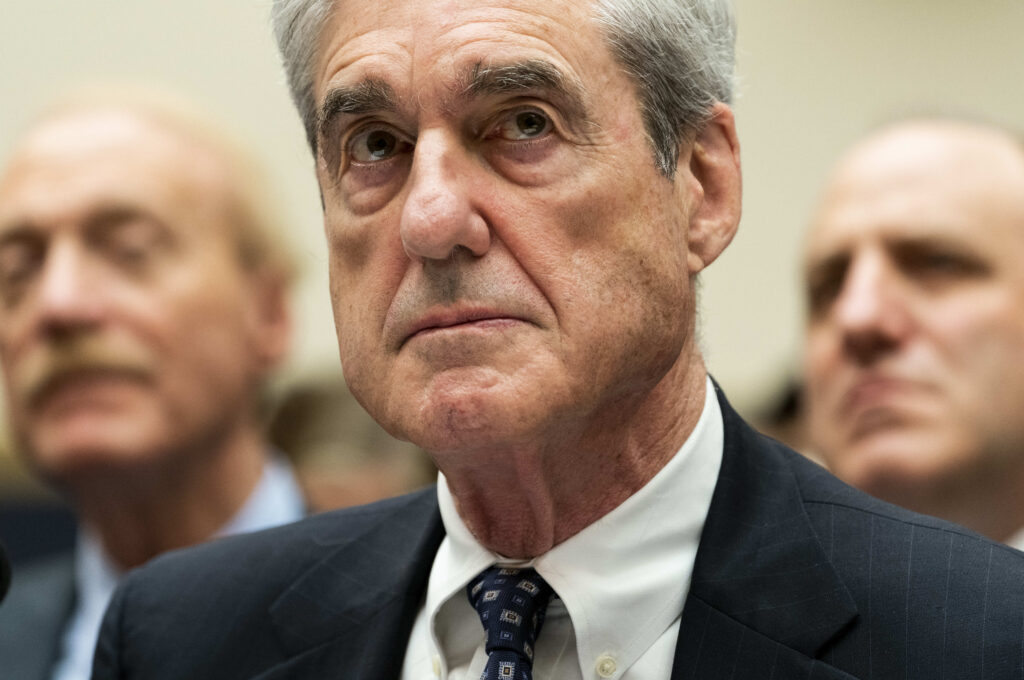
By the time Mr. Mueller appeared in a nationally televised House hearing to defend his work, expectations ran sky-high, as a sharply divided nation vested its hopes and dreads on the silver-haired, button-down prosecutor.
No one who knew Mr. Mueller expected him to present a brief against the president, let alone express any personal view about Trump’s actions. “The work speaks for itself,” Mr. Mueller said after his report was released.
His House appearance, at age 74, about two years before he was diagnosed with Parkinson’s, came amid rumors that he had not been his usual acute and precise self in recent months. Every hair was in place, his trademark white shirt was crisp. But under questioning, his voice grew thin, uncertain. He tripped on the president’s name and testified, after a long pause, that President George H.W. Bush had appointed him U.S. attorney in Boston, when in fact the president had been Ronald Reagan.
Mr. Mueller’s difficult performance at the House hearing — combined with the Trump administration’s persistent attacks on his credibility and a backlash from Democrats who had hoped for a more definitive finding of wrongdoing by Trump — appeared to recast his legacy.
“Bill Barr has tried to erase the entire investigation from history, and so far, he’s winning,” Graff said in 2020. “So despite Mueller’s 50 years at the Department of Justice and his place as the second most important figure in the history of the FBI, after J. Edgar Hoover, he’s likely to be remembered as a disappointment for those final two years as special counsel.”
Elite background
Robert Swan Mueller III was born in Manhattan on Aug. 7, 1944, and grew up in Princeton, New Jersey, and on Philadelphia’s Main Line, a member of a WASP elite that presumed a path through New England prep schools and Ivy League universities. His father was an executive at DuPont, and his mother, the former Alice Truesdale, came from a family that made its fortune in railroads.
Mr. Mueller was sent to boarding school at St. Paul’s in New Hampshire. Before he graduated in 1962, he became captain of the soccer, lacrosse and hockey teams, and he played hockey with classmate John F. Kerry, a future U.S. senator, secretary of state and presidential nominee.
At Princeton University, where Mr. Mueller followed his father, he was accepted into one of the most socially exclusive eating clubs, and he embarked on a path toward medical school until organic chemistry got the better of him. He majored in politics, graduating in 1966.
Three months later, Mr. Mueller married Ann Standish, a descendant of people who came to America on the Mayflower. They had two daughters, Cynthia and Melissa. Complete information on survivors was not immediately available.
After pursuing a master’s degree in international studies from New York University, Mr. Mueller entered the Marine Corps Officer Candidates School at Quantico, Virginia. He said he was inspired by the example of a fellow Princeton scholar and athlete, David Hackett, who lost his life in Vietnam while evacuating fellow Marines from a battleground.
In December 1968, Mr. Mueller led a rifle platoon in an eight-hour battle around a complex of North Vietnamese army bunkers. Four months later, he led a group of his men to assist about a dozen comrades who were under assault by North Vietnamese troops. He was shot in the thigh.
“Although seriously wounded during the fire fight, he resolutely maintained his position and, ably directing the fire of his platoon, was instrumental in defeating the North Vietnamese Army force,” according to the citation of his Bronze Star medal. He also received the Purple Heart.
Becoming a prosecutor
Determined to continue in public service, Mr. Mueller graduated in 1973 from the University of Virginia law school and worked at a firm in San Francisco before joining the U.S. attorney’s office there in 1976.
He spent most of the rest of his working life as a federal prosecutor, first in San Francisco; then in Boston, where he served as U.S. attorney from 1986 to 1987; and finally in Washington.
A lifelong Republican, Mr. Mueller moved to the Justice Department’s main office in 1989, during President George H.W. Bush’s administration. Beginning in 1990, he headed the criminal division and supervised high-profile cases such as the prosecution of Panamanian dictator Manuel Antonio Noriega and the terrorist bombing of Pan Am Flight 103.
In 1993, as President Bill Clinton’s administration took office, Mr. Mueller took a $400,000-a-year, white-collar litigation job in the Washington office of a Boston law firm, Hale and Dorr. It was not a happy time. “He couldn’t stand selling his services to defend people he thought might be guilty,” Thomas B. Wilner, a longtime friend and Washington lawyer, told The Washington Post in 2018.
Disturbed by a surge of homicides in Washington, Mr. Mueller called the District’s chief federal prosecutor, U.S. Attorney Eric H. Holder Jr., in 1995 and asked for a frontline job prosecuting homicides. Mr. Mueller requested no special rank, but Holder gave him the title of senior litigation counsel.
He was “just a line guy,” Holder told The Post, “interviewing people at crime scenes, going to people’s homes to build cases, working with street cops.”
He reportedly got a kick out of answering his phone, “Mueller, Homicide.”
Holder later put him in charge of the homicide section.
In 2001, after three years as U.S. attorney for the Northern District of California, Mr. Mueller was tapped to lead the FBI. Always a workaholic, he began spending nearly all his waking hours at FBI headquarters, traveling from his District home in a black SUV and arriving shortly after 6 a.m. for briefings. He wore the Hoover-era G-man uniform: dark suit, red or blue tie, and always a white shirt.
Mr. Mueller gradually restructured the FBI’s bureaucracy, and he conceded that the 9/11 attacks might have been averted had the agency picked up on reports from its field offices about suspicious activity. He also pushed the bureau to focus anew on field agents gathering information rather than waiting for tips.
At times, Mr. Mueller went out of his way to emphasize civil liberties, but he also presided over the FBI in the aftermath of 9/11, when the agency was accused of violating its guidelines to collect data on Americans.
In 2004, Bush administration officials sought to take advantage of a weakened Attorney General John D. Ashcroft, hospitalized after gallbladder surgery, to push through an extension of a warrantless wiretapping program aimed at ferreting out terrorist threats. Ashcroft had opposed an extension.
Mr. Mueller sent a note to the White House: “Should the President order the continuation of the FBI’s participation in the program … I would be constrained to resign as Director.”
Bush backed down.
But Mr. Mueller had not intervened earlier, when the FBI found out that the National Security Agency was conducting wiretaps without a warrant, an apparent violation of the Foreign Intelligence Surveillance Act.
And a Justice Department inspector general’s probe concluded that Mr. Mueller’s FBI had continued collecting confidential data on people in the United States from 2003 to 2006, in violation of bureau guidelines. Mr. Mueller said reforms he initiated, such as conducting regular audits and establishing an Office of Integrity and Compliance, halted such violations.
Mr. Mueller had clashed with the White House in 2006 after the FBI conducted its first search of a congressman’s office. Armed with a warrant, agents combed the office of Rep. William J. Jefferson (D-Louisiana) after he was accused of accepting bribes. Leaders of both parties howled that the raid violated the constitutional separation of powers, and the Bush administration directed the FBI to seal Jefferson’s documents.
Mr. Mueller again threatened to resign, arguing that the search had been approved by a federal judge. The White House yielded, and Jefferson was convicted of corruption charges.
When Mr. Mueller’s 10-year term ended in 2011, Obama asked him to stay for two more years. The Senate unanimously confirmed his extended appointment.
One more call to duty
After Mr. Mueller left the FBI in 2013, he returned to his former law firm, which had merged with another to become WilmerHale. There, he led an investigation into the NFL’s suspension of Baltimore Ravens running back Ray Rice on domestic abuse charges.
But once again, the private sector did not hold Mr. Mueller’s interest. In May 2017, Deputy Attorney General Rod J. Rosenstein appointed Mr. Mueller special counsel, with the task of determining whether the Trump campaign had violated federal law by coordinating with Russian officials during the 2016 campaign.
Within a few months, Mr. Mueller’s investigation produced charges against top Trump aides. Trump’s former campaign chairman, Paul Manafort was indicted on charges including tax fraud and money laundering. He was convicted in 2018 and sentenced to more than seven years in prison; he was released into home confinement in 2020 during the coronavirus pandemic.
As the investigation deepened, Trump spoke to aides about sacking Mr. Mueller, but backed off after White House counsel Donald McGahn threatened to resign. Trump successfully dodged Mr. Mueller’s repeated efforts to interview him, agreeing only to provide written responses to questions.
As Trump waged rhetorical war against him, Mr. Mueller mostly maintained a public silence. But he rose to his staff’s defense when the president claimed that Mr. Mueller had hired partisan Democratic lawyers to conduct a “witch hunt”; not once, he said in his 2019 congressional testimony, had he asked his attorneys about their politics.
That sort of thing, he added, “is not done. What I care about is the capability of the individual to do the job and do the job quickly and seriously and with integrity.”
The post Robert Mueller, ex-FBI director at center of political tempest, dies at 81 appeared first on Washington Post.