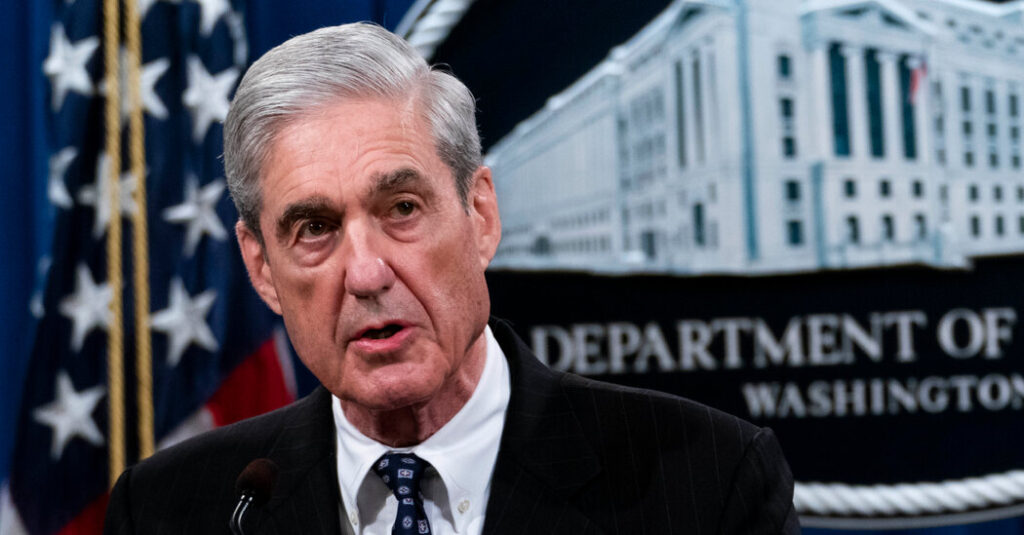
Robert S. Mueller III, who led the Federal Bureau of Investigation for 12 tumultuous years, brought politically explosive indictments as a special counsel examining Russia’s attack on the 2016 presidential election, and then concluded that he could neither absolve nor accuse President Donald J. Trump of a crime, died on Friday. He was 81.
His family confirmed the death in a statement, but did not specify a location or cause.
A button-down, lockjawed, rock-ribbed exemplar of a vanishing caste, the liberal Republican, Mr. Mueller became the F.B.I. director just a week before the terrorist attacks of Sept. 11, 2001.
He went on to impose the most significant structural and cultural changes in the history of the F.B.I., seeking to transform the bureau into a 21st-century intelligence service that could protect both national security and civil liberties. And his counterterrorism agents were the first to blow the whistle on abuses at the secret prisons that the C.I.A. had established after 9/11 to detain, interrogate and, in some cases, torture terrorism suspects.
But he may be best remembered for what he did after he left the F.B.I., when he was summoned to investigate a sitting president.
The Justice Department named Mr. Mueller special counsel on May 17, 2017, eight days after Mr. Trump dismissed the F.B.I. director, James B. Comey, who was investigating the interactions between the Trump campaign and a Russian covert operation to help him win the White House.
The president’s reason for dismissing Mr. Comey was no secret. The next day, in the Oval Office, he told the Russia foreign minister and the Russian ambassador: “I just fired the head of the F.B.I. He was crazy.” Mr. Trump continued: “I faced great pressure because of Russia. That’s taken off.”
Upon hearing of Mr. Mueller’s appointment, and knowing his reputation, Mr. Trump was despondent. “Oh, my God,” he said. “This is terrible. This is the end of my presidency.”
He knew, as Mr. Mueller later put it, that “a thorough F.B.I. investigation would uncover facts about the campaign and the president personally that the president could have understood to be crimes.”
One potential charge was obstruction of justice, the statute that had paved the way to President Richard M. Nixon’s resignation in 1974 and President Bill Clinton’s impeachment in 1998. Justice Department guidelines, never tested in court, decreed that a sitting president could not be indicted. Yet Mr. Trump’s many political foes hoped that the special counsel might somehow help unseat him.
Mr. Mueller hired a team of federal prosecutors whose collective experience reached back to the Watergate scandal. They brought indictments against a cohort of Russian spies and the command structure of a troll farm in the Russian city of St. Petersburg, the Internet Research Agency, which had conducted a misinformation campaign in the 2016 election at the direction of the Kremlin.
They sent Paul Manafort, Mr. Trump’s first campaign manager, to prison for fraud. They won a guilty plea from retired Lt. Gen. Michael Flynn, Mr. Trump’s first national security adviser, and a conviction of Roger Stone, one of Mr. Trump’s oldest political advisers, for lying to investigators.
The investigation reversed the polarity of public perceptions of the F.B.I., whose agents executed Mr. Mueller’s orders. Liberals who had long loathed the bureau now claimed to love it. Conservatives who had long revered it now reviled it. The American Civil Liberties Union held rallies championing Mr. Mueller. For his part, Mr. Trump assailed the F.B.I., the Justice Department and, eventually, Mr. Mueller himself, writing repeatedly on Twitter that the case was a “WITCH HUNT!”
Mr. Mueller stood above the fray, never commenting, never showing his hand. But when he confronted the issue of holding the president accountable for obstruction of justice, he balked.
An F.B.I. in Turmoil
Mr. Mueller became the sixth F.B.I. director on Sept. 4, 2001. His second week in office brought an epochal catastrophe.
Early on Sept. 12, the day after airplanes hijacked by the terrorist group Al Qaeda had hit the World Trade Center and the Pentagon, killing 2,977 people, President George W. Bush asked Mr. Mueller bluntly what the F.B.I. was doing to thwart the next attack.
The president posed that question to him daily at dawn briefings for years thereafter. But the bureau Mr. Mueller had inherited was fatally incapable of carrying out its counterterrorism and counterintelligence missions.
The F.B.I. had “failed again and again and again,” in the words of Thomas H. Kean, the Republican chairman of the 9/11 Commission, which investigated the systemic governmental flaws that enabled the plot to succeed.
The bureau’s chains of command had buckled and snapped. Computer systems constantly crashed. Wiretaps of foreign terrorists went unread for want of translators. When anthrax-laced letters sent to senators and journalists killed five people, only a few days after 9/11, it took the F.B.I. nearly seven years to identify a suspect, a government biodefense scientist.
“We have to smash the F.B.I. into bits and rebuild it,” the F.B.I.’s assistant director for counterterrorism, Dale Watson, had told his White House counterpart, Richard A. Clarke, before the attacks.
Smashing things was not Mr. Mueller’s way. But in his effort to transform the F.B.I., the first goal required, among many other things, repairing lines of communication with political leaders at the White House and in Congress, the electronic eavesdroppers at the National Security Agency, and the spies at the Central Intelligence Agency. Those channels had been broken for years; the imperious J. Edgar Hoover, who founded the bureau and led it from 1924 to 1972, had seen the C.I.A. as his greatest enemy, after Communism and the civil rights movement, and the rivalry had persisted long after his death.
When it came to preserving civil liberties in an age of counterterrorism, Mr. Mueller was largely on his own in an administration that saw itself engaged in a zealous crusade. He had to enforce the provisions of the newly enacted Patriot Act, which vastly expanded the government’s surveillance powers, while upholding the Constitution. That was a treacherous tightrope to walk.
The F.B.I. rounded up more than 1,200 people in the eight weeks after 9/11; none were members of Al Qaeda. In the process, it violated some elemental legal protections. The bureau also sharply increased the use of informants who served as agent provocateurs in Islamic communities. All this was done under the president’s command to put the F.B.I. on a military footing in the aftermath of the attacks.
But Mr. Mueller’s counterterrorism agents also exposed the C.I.A.’s secret “black sites.” They reported torture and abuses at those facilities and in the bleak chambers of the Abu Ghraib prison in Iraq. In October 2002, F.B.I. agents at Guantánamo Bay in Cuba, where terrorism suspects were imprisoned and interrogated, opened a running file that they later labeled War Crimes.
Mr. Mueller said publicly that same month that he wanted no one to assert that Americans had won the war on terror but lost their freedom on his watch. Nevertheless, as the fear of another Al Qaeda attack consumed the Bush White House, the tensions between national security and civil liberties became unbearable.
Early in 2004, Mr. Mueller and his immediate superior at the Justice Department, the deputy attorney general, Mr. Comey, learned that Mr. Bush had authorized the N.S.A. to spy on Americans. The program, code-named Stellarwind, was so secret that very few people were aware of how it worked.
The N.S.A., created to gather foreign intelligence abroad, was eavesdropping freely in the United States, without search warrants, collecting electronic records of millions of telephone conversations, emails and internet addresses. Then it sent the raw data to the bureau. The F.B.I. found that dealing with this deluge was like trying to drink from a fire hose. And the surveillance program had never saved a life, stopped an imminent attack or unveiled a member of Al Qaeda in the United States.
Of greater concern to Mr. Mueller and Mr. Comey was their determination that the program violated the Constitution’s protections against illegal searches and seizures. They convinced Attorney General John Ashcroft that he could not reauthorize Stellarwind. But Mr. Bush did so, unilaterally, on the morning of March 11, 2004, asserting in effect that his power overrode the Constitution.
Mr. Mueller took meticulous notes. He recorded that the president was “trying to do an end run around the law.” At 1:30 a.m. on March 12, he sat at his kitchen table and drafted a letter of resignation. “I am forced to withdraw the F.B.I. from participation in the program,” he wrote; if the president did not back down, he would resign. Both Mr. Comey and Mr. Ashcroft were determined to go with him.
Eight hours later, with the resignation letter in the breast pocket of his suit, Mr. Mueller sat alone with Mr. Bush in the White House.
“I had to make a big decision, and fast,” Mr. Bush wrote in his memoirs. “I thought about the Saturday Night Massacre” — the 1973 Watergate debacle in which President Nixon forced the attorney general and his deputy to resign to protect his secret White House tapes, a desperate move that in time destroyed his presidency.
“That was not,” Mr. Bush observed, “a historical crisis I was eager to replicate.” He could stand his ground “while my administration imploded.” Or he could bow to Mr. Mueller and let the secret programs be scaled back and placed on a legal footing. He chose the second path, though it took years.
In May 2005, Mr. Comey told a select audience at the N.S.A. what Mr. Mueller had done: “It takes far more than a sharp legal mind to say ‘no’ when it matters most,” he said. “It takes moral character. It takes an ability to see the future. It takes an appreciation of the damage that will flow from an unjustified ‘yes.’” Stellarwind stayed secret for seven months thereafter, until The New York Times revealed its outlines.
Mr. Mueller never spoke publicly of his confrontation with the president.
At the F.B.I.’s headquarters — the J. Edgar Hoover Building, a Brutalist edifice standing halfway between the White House and Capitol Hill — Mr. Mueller ran a tight ship. He was like a battlefield commander; his word was law. He could be brusque and unforgiving, yet field agents seemed to like his style; they nicknamed him “Bobby Three Sticks,” after the Roman number that followed his name.
Garrett Graff, a young journalist who had been granted unique access to the Mueller F.B.I., noted that the director, in meetings with subordinates, would quote a gruff line spoken by Gene Hackman, playing a Navy submarine captain, in the 1995 Cold War thriller “Crimson Tide”: “We’re here to preserve democracy, not to practice it.”
After Hoover’s 48-year reign, a tenure unmatched in the high offices of American government, Congress had mandated a 10-year term of office for F.B.I. directors. None ever lasted it out, except Mr. Mueller. In 2011, President Barack Obama asked him to stay on two more years. Congress concurred. Its members widely regarded him as the best director in the bureau’s 100-year history, Hoover being relegated to a category all his own.
When Mr. Mueller finally stepped down in June 2013, to be succeeded by Mr. Comey, the president praised him effusively.
“Under his watch, the F.B.I. joined forces with our intelligence, military and homeland security professionals to break up Al Qaeda cells, disrupt their activities and thwart their plots,” Mr. Obama said in a 10-minute Rose Garden ceremony. “Countless Americans are alive today, and our country is more secure, because of the F.B.I.’s outstanding work under the leadership of Bob Mueller.”
And with that, Mr. Mueller ended a lifetime of public service. Or so he thought.
From New York to Vietnam to D.C.
Robert Swan Mueller III was born in Manhattan on Aug. 7, 1944. The first child of Alice (Truesdale) and Robert Swan Mueller Jr., he was a scion of what was once known as the Eastern Establishment.
His patrician parents first lived on Park Avenue, and later in a stately manor on Philadelphia’s Main Line. His father, a Navy officer in the Atlantic and the Mediterranean during World War II, became an executive at DuPont, America’s oldest and most powerful chemical company. His mother was a first cousin of Richard M. Bissell Jr., later chief of the C.I.A.’s clandestine service, the creator of both the U-2 spy plane and the plan for the disastrous 1961 Bay of Pigs invasion.
He enrolled at St. Paul’s, an elite prep school in Concord, N.H., where he was elected captain of the soccer, hockey and lacrosse teams. His classmate Maxwell King, later the editor of The Philadelphia Inquirer, said he embodied “the tradition of the ‘muscular Christian’ that came out of the English public-school world of the 19th century.”
A photo of the 1961-62 varsity hockey squad shows Mr. Mueller sitting next to his teammate John Kerry, the future senator and secretary of state, both with lantern jaws and steely gazes.
Mr. Mueller graduated from Princeton in 1966, with a bachelor’s degree in politics, and from New York University in 1967, with a master’s in international relations. Before enrolling at N.Y.U., he married Ann Cabell Standish, who had embarked on a career of teaching children with learning disabilities. (They would have two daughters, Cynthia and Melissa, and later three grandchildren.)
A complete list of survivors was not immediately available.
In 1968, not many men with blue blood were signing up to shed it in Vietnam. But after a close friend and lacrosse teammate at Princeton died in battle, Mr. Mueller joined the Marine Corps. After Officer Candidate School and the Army’s Ranger School — Marines trained as Rangers often led long-range reconnaissance patrols, hunt-and-kill missions with a high mortality rate — he shipped out to the Dong Ha combat base, on the northern edge of South Vietnam, near enemy territory.
“You were scared to death of the unknown,” he told Mr. Graff 40 years later. “More afraid in some ways of failure than death, more afraid of being found wanting.” That species of intense fear, he said, “animates your unconscious.”
On his first tour, as a second lieutenant, he earned a Bronze Star for valor on Dec. 11, 1968, while leading an outgunned rifle platoon ambushed in Quang Tri province by an enemy armed with rocket-propelled grenades, machine guns and mortars.
His citation said he “personally led a fire team across the fire-swept area terrain to recover a mortally wounded Marine,” and it commended his “courage, aggressive initiative and unwavering devotion to duty at great personal risk.”
Four months later, he was shot through the thigh with an AK-47 round while leading his platoon to rescue American soldiers under a lethal Vietcong attack. He was awarded the Purple Heart.
His wife of two years had told him during a rest-and-recuperation stop in Hawaii that the law might be a wiser pursuit than the war. He took her counsel and left Vietnam for the University of Virginia. The month he finished law school, in the spring of 1973, was the moment when Watergate metastasized into “a cancer on the presidency,” as the White House counsel John Dean told the president while the tapes were still spinning in the Oval Office.
In 1976, Mr. Mueller became a federal prosecutor in San Francisco and rose swiftly through the ranks to become chief of the criminal division for the Northern District of California.
In 1982, he moved to Boston, where he prosecuted fraud, corruption, money-laundering and terrorism cases. In 1989, after a stint as a partner at a white-shoe Boston law firm, he joined the Justice Department in Washington. He became chief of the criminal division in 1990. In that post, he led close to 100 U.S. attorney offices and some 2,000 federal prosecutors, as well as the F.B.I. and its enormous powers, including its ability to wiretap and conduct electronic surveillance.
His immediate superior was the deputy attorney general — William P. Barr, whose path would cross Mr. Mueller’s again nearly 30 years later, in the Trump administration.
Mr. Mueller oversaw the prosecution of the Panamanian strongman Manuel Noriega, a longtime ally of the C.I.A. in its war on Communism in Central America, who had been indicted as a cocaine kingpin. The United States had gone to war in Panama to dislodge him from power.
Mr. Mueller’s most difficult case was the bombing of Pan Am Flight 103 over Lockerbie, Scotland, which killed 259 people. The F.B.I. had failed to solve it for two years. Mr. Mueller used his power under law to obliterate the bureau’s byzantine lines of authority in the case. He brought in the C.I.A., Britain’s MI5 and the Scottish constabulary, and they all shared their information.
A tip from the Scots put the F.B.I. on the trail of one of Col. Muammar el-Qaddafi’s intelligence officers, who had used his cover as security chief for the Libyan state airlines to plant the bomb. He was indicted in 1991; it took 10 years to convict him.
In 1993, with the inauguration of Mr. Clinton, Mr. Mueller left the Justice Department to become a partner at Hale & Dorr, now WilmerHale, one of the nation’s most elite law firms. And then, in 1995, at 50, he made a move that astonished his peers.
He telephoned the chief federal prosecutor in Washington — Eric H. Holder Jr., later Mr. Obama’s attorney general. Mr. Mueller had been several rungs above Mr. Holder at the Justice Department barely two years before. Mr. Holder recalled the moment at Mr. Mueller’s F.B.I. retirement ceremony.
“One day he called me — out of the blue — and asked if I could use a homicide prosecutor in my office,” Mr. Holder said. “Our nation’s capital was a city in great distress — we were called the murder capital of the United States.”
Mr. Holder told him that “he might be a little overqualified for a job as a line prosecutor. But before he could change his mind, I just said, ‘When can you start?’”
Over the course of three years, Mr. Mueller successfully prosecuted dozens of killers, helped bring down the homicide rate, and showed grace in comforting survivors.
He also answered his own telephone: “Mueller, homicide.”
Investigating the President
When Mr. Mueller’s phone rang again in May 2017, the Justice Department was on the line. He was called upon to serve as special counsel in a case where the chief subject of the investigation was the president of the United States.
Mr. Trump had just dismissed Mr. Comey, who as F.B.I. director was investigating whether the president’s associates had colluded with Russia in its covert operations to sway the 2016 election.
To some legal experts, it seemed that the president’s action revealed a corrupt purpose, making the sacking look like the Saturday Night Massacre in broad daylight. Mr. Comey himself told the Senate Intelligence Committee, “I take the president at his word — that I was fired because of the Russia investigation.”
Mr. Mueller sought to interview the president under oath, to determine why in fact he had fired Mr. Comey. Mr. Trump’s lawyers balked, fearing a perjury trap sprung by the president’s propensity to lie.
At this crucial juncture, Mr. Mueller hesitated.
He did not issue a grand-jury subpoena to compel Mr. Trump’s sworn testimony. He settled for written questions, and allowed the White House lawyers to limit them to events before Mr. Trump became president.
When the responses finally arrived on Nov. 20, 2018, Mr. Trump failed to respond to almost every crucial question, citing a failure of memory. Mr. Mueller once again sought an interview on 10 key areas of his investigation. Mr. Trump’s lawyers refused. And so the investigation never entered the minefield of the president’s mind.
The final 448-page report went to Mr. Barr, now the attorney general, on March 22, 2019. Mr. Mueller had trusted Mr. Barr, his longtime colleague and a family friend, to deliver its conclusions, unvarnished, to the American people. He would be sorely disappointed.
The report concluded that Russia had systemically sought to help Mr. Trump win the election, and that the candidate and his campaign encouraged their clandestine assistance. It laid out 10 cases in which the president and his aides had sought to impede the F.B.I. investigation. Its key passage read: “While this report does not conclude that the President committed a crime, it also does not exonerate him.”
But the attorney general, while keeping the text of the report secret, ostensibly to redact sensitive information, announced only that “the Special Counsel’s investigation is not sufficient to establish that the President committed an obstruction-of-justice offense.”
Mr. Trump proclaimed that he had been “totally exonerated.”
No outsider could read the report for the next 25 days. What followed was, as Mr. Mueller wrote in an angry private letter to Mr. Barr, “public confusion about critical aspects of the results of our investigation.” In retrospect, it appeared to many that this might have been the attorney general’s intent.
Mr. Mueller did not speak out. Save for a painfully reticent session of testimony before Congress, where he hewed to the formal language of his report, he kept his silence until July 2020, when Mr. Trump commuted Mr. Stone’s prison sentence for obstructing the Russia inquiry.
Writing for the editorial page of The Washington Post, Mr. Mueller rebutted the president’s claims that the investigation into the 2016 election was political and illegitimate.
“We made every decision in Stone’s case, as in all our cases, based solely on the facts and the law and in accordance with the rule of law,” Mr. Mueller wrote. “The women and men who conducted these investigations and prosecutions acted with the highest integrity. Claims to the contrary are false.”
He noted that the investigation established “that the Russian government perceived it would benefit from a Trump presidency,” adding that it also found that the Trump campaign “expected it would benefit electorally from information stolen and released through Russian efforts.”
In a final attack on Mr. Mueller’s legacy, Mr. Trump issued presidential pardons to Mr. Flynn, the former national security adviser, in October 2020, and to Mr. Manafort, his onetime campaign manager, and Mr. Stone, in December 2020.
Both Mr. Flynn and Mr. Stone were key figures in inciting the mob that stormed the Capitol on Jan. 6, 2021. The assault on Congress, carried out in the president’s name, intended to overturn his defeat in the 2020 election.
On Aug. 3, 2023, the special counsel Jack Smith indicted Mr. Trump for his role in the insurrection, acting to hold him accountable for his effort to block the peaceful transfer of presidential power and to threaten American democracy.
The post Robert S. Mueller III, 81, Dies; Rebuilt F.B.I. and Led Trump Inquiry appeared first on New York Times.