EAST JERUSALEM — Eid al-Fitr, the holiday marking the end of Ramadan, arrived this year in a Middle East shadowed by the danger and disruption of war. In a rare confluence, Nowruz, the Persian new year, fell on the same day — making Friday a double holiday for many Iranians.
It’s a time when people are meant to be the best version of themselves. During Eid, Muslims celebrate the end of the fasting month of Ramadan, a time of personal reflection and spiritual renewal. Nowruz, which marks the start of spring, is an annual triumph of light over darkness — a cultural rather than religious celebration.
The dual holiday, however, was palled by death and tension.
Those fears took different shape in the many countries affected by the conflict that has rippled across the region since the United States and Israel began their attack on Iran late last month, setting off widespread Iranian retaliations and renewed fighting between Israel and the Iran-backed militant group Hezbollah in Lebanon.
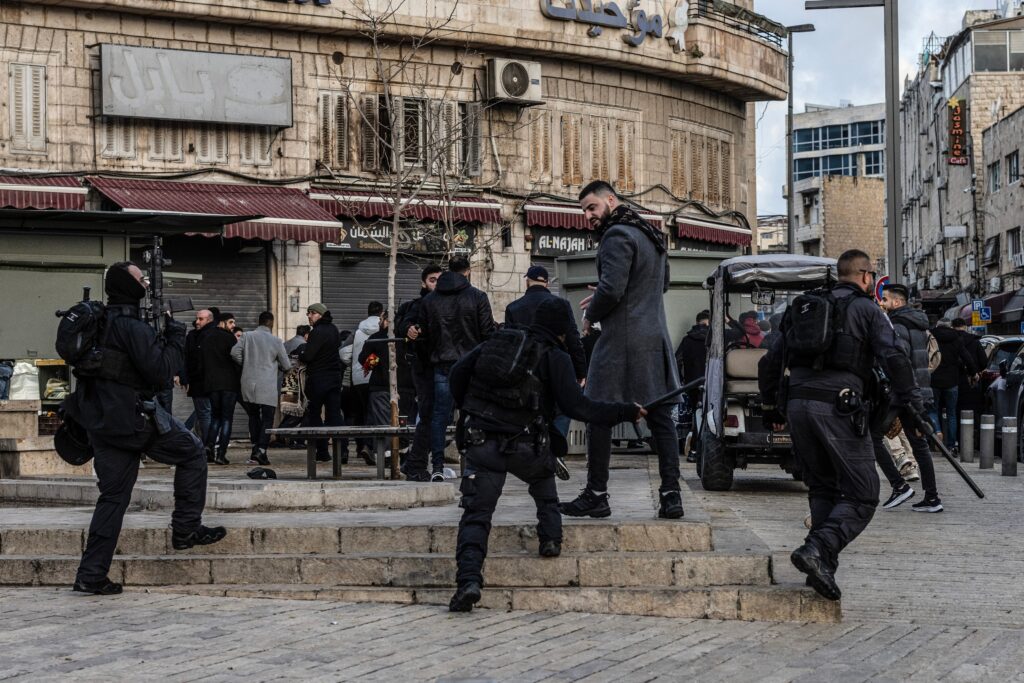
In Jerusalem Israeli authorities barred Palestinian worshipers from entering the Old City and praying at Al-Aqsa Mosque during Eid for the first time since the 1967 war. It was closed for almost all of this year’s Ramadan prayers too. In normal times, more than 100,000 people perform Eid prayers at the mosque, among the holiest sites in Islam.
The shutdown, ordered by Israel citing war-related security concerns, forced Palestinians to find other places — as close to the holy site as possible — for their congregational prayer.
In a tense confrontation Friday at dawn, hundreds of Palestinian worshipers gathered to pray on Salah al-Din Road, which intersects with the barricaded gates of the Old City, and began to walk forward. Israeli law enforcement, armed and stationed in groups, started throwing stun grenades and using batons, sending the crowd running.
Other groups of Muslim worshipers tried to gather within the nearest distance to the gold-domed mosque, carrying their prayer mats to nearby streets overlooking the Old City under the dawn light. Helmeted police weaved through crowds of people praying and police patrolled the Old City’s outer walls on horseback.
“We used to pray at al-Aqsa Mosque, but this year we can’t, so we tried to reach the nearest point,” said Fatima Nasser, who joined a group with many families praying in the middle of a street with her daughters, Iman, 13, and Leen, 16.
“We pray for peace for all Muslims people around the world. Eid is a beautiful occasion, but unfortunately now it’s not in a good condition,” Nasser said, walking with her girls up a hill, eager to start eating festive kahk cookies.
“Eid every year for us in Jerusalem is the Al-Aqsa Mosque and praying in it,” said Aya Amr, 29, who had just left the street prayer. “Without the Al-Aqsa Mosque there would be no spirit of Ramadan or now for Eid.”
Nasser said that Eid is a “present from God to us” after the month of fasting. “We are trying to purify ourselves,” she said.
The missile exchanges have jarred with the spirit of the holidays underway across the region.
Four Palestinian women were killed by missile fragments that hit a makeshift salon in the West Bank while getting their nails done in time for Eid this week. It was a celebratory day “when all the girls go to the salon,” said Hadeel Masalmeh, who co-owned the business.
Debris from the interception of an Iranian missile landed near Jerusalem’s Temple Mount — a hilltop compound home to Christian, Jewish and Muslim holy sites, known by Muslims as the Noble Sanctuary — on the afternoon of Eid.
So far in three weeks of fighting, at least 1,000 have been killed in both Iran and Lebanon; 18 in Israel; eight in the United Arab Emirates and more in other Persian Gulf countries and the Palestinian territories, according to national and local authorities.
Iranians, meanwhile, celebrated the turn of their new year with their country at war for the first time in nearly four decades, as the U.S. and Israel pummel the country while calling for regime change. Many Iranians say they are experiencing a mix of hope, fear and deep uncertainty about what lies ahead.
Israeli Prime Minister Benjamin Netanyahu greeted Iranians with a Nowruz video message, saying that this year’s holiday has a special meaning. “A year of freedom, a new beginning of hope to all of you, my dear friends,” Netanyahu said. The Israeli leader has called on Iranians to rise up against their government despite the risk they will “get slaughtered.”
In the northern Iraqi city of Irbil, where Iranian residents have celebrated Nowruz with boisterous traditions like jumping over bonfires and wearing colorful clothes, the mood this year is more of a silence than celebration.
Ayoub Arefi, 45, standing in the refugee camp he used to live in before recent drone attacks forced its evacuation, paused when asked about his holiday spirit.
“This is the first Nowruz that feels empty … The grief is heavier than any desire to celebrate,” Arefi said, walking along buildings ripped by shrapnel marks. Courtyards where families would have gathered to celebrate were littered with rubble.
Arefi is in mourning, like so many Iranians: Some have lost friends or relatives; others are constantly worried about loved ones still inside Iran.
“We didn’t even prepare the table. It felt like an empty ritual, disconnected from reality,” he said. “Our families are now scattered and displaced because of the shelling. There is no taste for celebration when we are no longer together.”
In a small room that she now shares with another family in Irbil, Ala Ahmed, 45, sat beside her 4-year-old. “There is no Nowruz this year … Joy cannot be forced, especially after losing friends.” Priorities have shifted: “Now we are just trying to survive. To get through the day safely.”
Still, some are hopeful that the war could be an inflection point that ushers in good.
Back in Israel, Yaron Larian, 68, sitting before piles of dusty, folded Persian rugs at his carpet shop in Tel Aviv’s Jaffa Flea Market, said this Nowruz was a “big day because people have the hope that something will change.”
Larian left Iran for Israel the same day the shah, or monarch, fled in 1979. The current regime is “killing for nothing, they kill so much people, innocents.” That Nowruz translates to “new day” is extra meaningful, he said, as he sewed up a geometric rug.
Despite hundreds of thousands of people being displaced and without shelter in Lebanon, as the Israeli military trades attacks with Hezbollah, some chose to celebrate in their informal encampments by donning their best clothes in the sprit of Eid. A group of three little girls wore matching dresses as they walked by the makeshift tents. The sounds of sonic booms from Israeli jets overhead rattled camp residents.
Abu Ali, 63, has been displaced several times, including in the last war in 2024 and going back to the Lebanese war in 1975. He said more people have been arriving to the camp site in the last few days as Israeli strikes on Beirut’s southern suburbs intensified. Still, he’s adamant that he’ll return south to rebuild his destroyed home. “No can step on our rights,” he said.
In Gaza, Amal Moataz, 20, a second-year pharmacy student living in a tent atop the rubble of her family’s home, said the Eid atmosphere in Gaza feels “a little brighter than before.” No longer do they hear the constant airstrikes that defined daily life during the war — “yet the happiness is incomplete,” she said.
“Before the war, we lived with dignity in our own home,” Moataz said. The family used to welcome guests by preparing coffee and pastries, and buy special trays just for Eid. She used to help her mother prepare traditional Eid pastries a week in advance; they’d share them with neighbors and friends, and they’d share theirs in return.
“We are living in a state of neither war nor peace, not knowing what the future holds,” she said. “It’s very painful.”
Westfall and Levine reported from East Jerusalem. El Chamaa reported from Beirut, Salim from Irbil, Iraq, and Shamalakh from Cairo. Heba Farouk Mahfouz in Cairo contributed to this report.
The post The Middle East celebrates Eid and Nowruz under the shadow of war appeared first on Washington Post.