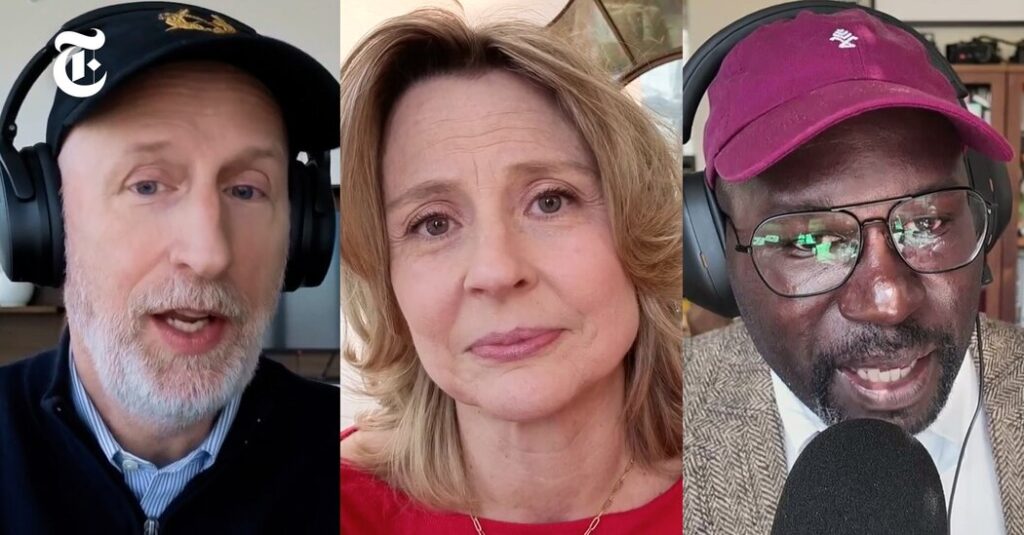
President Trump has his own ideas about American power, American voters, and American enemies. On “The Opinions,” the writer Michelle Cottle and the columnists Jamelle Bouie and David French argue that unfortunately Trump misunderstands all three.
Below is a transcript of an episode of “The Opinions.” We recommend listening to it in its original form for the full effect. You can do so using the player above or on the NYTimes app, Apple, Spotify, Amazon Music, YouTube, iHeartRadio or wherever you get your podcasts.
The transcript has been lightly edited for length and clarity.
Michelle Cottle: We’re going to get down to business. First up, we talk about the war in Iran and President Donald Trump’s approach to our allies. And Jamelle is going to explain to us what he thinks Trump is really focused on these days. Hint: It’s not the war or even White House renovations.
As always, got to note that we’re taping this on Thursday, so the specific shape of the chaos will change a million times, probably, before you all hear us. And with that, let’s get down to business.
So, we are moving into the fourth week of America and Israel’s war with Iran. There is no end in sight. And, from best I can tell, no clear direction of where this is going.
Each day, we’re seeing new attacks on Iran. Oil prices have spiked. Trump decided he’d fix that by relaxing sanctions on Russia. And — surprise — our allies are not super excited about sending ships to protect the Strait of Hormuz to help with the war they were not consulted on.
So, on a scale of one to 10, guys, how shocked should Trump be that he is getting the cold shoulder from Europe on a lot of this? And where do you think the dynamic is headed? Jamelle, you go first.
Jamelle Bouie: I don’t think Trump should be shocked at all. He spent the first year of his presidency doing everything he could to degrade America’s relationship with its European allies in particular — undermine the NATO alliance, threaten territorial acquisition against a NATO member, just all kinds of destructive things. And so, no, you shouldn’t be surprised that when you bully people and then you come to them hat in hand for help, they say: No, thanks. Not going to do it.
And this is the other part of it, right? That it’s a testament to how little this war was planned out, and how little forethought there seems to have been; that the same administration, which has taken a hammer to America’s clean energy development, renewable energy development, that is actively hostile to it — in fact, our wonderful newspaper published a story this week about how the administration wants to spend up to a billion dollars to keep a wind energy company from building new wind energy infrastructure. And instead wants to divert that to fossil fuel production. So you have this administration that is ideologically anti-renewable energy, and then it’s like: Also, I’m going to start a war with the one country that could unilaterally cause an energy crisis through the denial of fossil fuels. Brilliant work, genius stuff.
Cottle: Strategy at its finest. David?
David French: I mean, look, this is a war that Trump started, that our NATO allies were not consulted on. They had been relentlessly scorned. As of today — on Thursday, Michelle — we have received reporting that Denmark was actually preparing for a potential invasion of Greenland, that under the guise of exercises, they had sent troops, and the troops had explosives to blow up airfields in case America tried to invade. I mean, this is the environment in which we launched another war.
And then, you know, there’s a lot of reporting that says Gen. Dan Caine warned Trump that the Strait of Hormuz would close. And he pushed past the warnings in a way that, essentially, he denied to himself that a potential crisis could exist. And now that it exists, he’s lashing out in a million different directions.
And this is the first time in my life that we have had a war leader where you wonder — and I don’t even wonder that much — is he really mainly motivated by self-interest here, or is he mainly motivated by the national interest? And everything about Trump that we know says this is a dude who’s mainly motivated by self-interest and is also extraordinarily mercurial.
And so, we just saw this whole exchange, this big escalation in the war where there was an Israeli strike on Iranian natural gas fields. Then there was an Iranian strike on Qatar’s natural gas fields. And, by the way, these are two of the most important facilities for the production of this vital resource in the whole world. And Trump comes out and says, well, Israel struck Iran and then Iran struck Qatar, and I didn’t want any of this.
And then, within moments after that, you get reports saying: What are you talking about? Israel says they did consult, that this was a strike approved by the United States. And that Trump just doesn’t like the blowback from the Gulf states as a result of all of this.
And so, you really get the sense that Trump, the commander in chief, is flying by the seat of his pants. The military is executing the missions that it’s being assigned to execute with extreme competence. It’s just that if you have a flawed strategy to begin with, if you have mercurial leadership at the top, even the best military execution will often just be wasted.
Cottle: Well, it certainly seems like we are running into, with this administration — or perhaps it’s just this president — that eternal tension between short-term goals and long-term goals. And he doesn’t really seem to have long-term goals on anything. So, his approach to this seems to be: Well, it’s great! I can blow this up, and look at how tough we are here.
I think Jamelle’s brought this up before: He’s got all these toys to play with, and he’s got all this military might, and we can worry about where this leaves us, in broader picture terms, for later. I mean, what could possibly go wrong?
So, what are we learning about his view of American power? And also, do we think the White House is learning anything about the gap between how the president views that power and how things actually play out? I mean, do we think anything is sinking in over there?
Bouie: I’m skeptical. It’s clear to me that the president has a view of American power that’s very childish: We have lots of weapons, we have lots of things that can blow things up, and that’s all we really need. He seems to have this view that American influence — both American influence in the American military and other forms of power, like economic power — are inexhaustible resources that you can just call on again and again and again, and do what you want.
And that isn’t true. That is very much not the case. But there’s no indication that anyone in the White House — or, at least, anyone the president will listen to, I’ll say that — is explaining to Trump, getting him to understand that they may have already reached up against the limits of what the country can simply do given the situation, given our deteriorating relationships with our allies, given everything.
It’s always been so striking to me that Defense Secretary Pete Hegseth has these press conferences where he doesn’t at all talk in strategic terms about the conflict. It’s all: we’re going to rain down death upon the enemy! And then: why can’t you ——
Cottle: Conan the Barbarian.
Bouie: Why can’t you clap harder? Which, I’ll say, beyond being evidence of someone who maybe doesn’t even understand the difference between strategy and tactics — like, setting that aside — there’s something actually quite disturbing about the fact that high-level American officials are talking about war as if it were a video game.
Cottle: Which, I hear, is not impressing military veterans. Like, they’re embarrassed by the idea that this is being treated like Call of Duty, or whatever. David, before you jump back in, I have a question for both of you: I keep hearing that the Trump administration is surprised that this didn’t go like Venezuela. That can’t be true, right?
Someone tell me that they understood the difference between Venezuela and Iran? Someone?
French: It can be true, Michelle. It can be true because ——
Cottle: No, David. No.
French: Donald Trump, I think, has trouble understanding the true believer.
Bouie: Yeah.
French: In other words, the person who actually really, truly believes what they say.
Cottle: Because he doesn’t believe in anything.
French: Well, he’s not a true believer. And guess what? He’s gotten where he’s gotten by steamrolling over a lot of people, and exposing a lot of people to not be true believers.
So, think about how many people in the Republican Party have bent the knee to Trump in spite of all of the depredations, all of the corruption, all of the departures from previous conservative orthodoxy. I mean, heck, his own vice president compared him to Hitler at one point.
Cottle: Awkward. Yeah.
French: Marco Rubio, arguably his favorite member of the cabinet right now, was virulently against Trump. And so, he’s seen this happen so many times, where people who have postured themselves as true, people of true conviction, have just yielded.
And now he’s taking on, as opposed to a strongman regime in South America — which has some ideological components, of course, but it’s still ultimately a strongman regime. And then you go to Iran, which is an Islamic revolutionary regime, and one of the ways it cemented itself in Iran was by fighting a war with Iraq in such total disregard of the lives of its own citizens. And Iran is confronting American power.
And we can hit them, and we can hit them, and we can hit them. And the true believers are still going to believe. And that is something that everyone who’s fought in the war on terror really understands — we really get it. We know it in our DNA that we are dealing with an enemy that really believes. And then Trump here is confronting this, and it doesn’t compute to him. You see it in some of this temper tantrum that he’s pitching over why are they closing the Strait?
Cottle: Yeah.
French: We won! Like, what are they doing?
Cottle: Don’t they know we won?
French: He’s making the very fundamental mistake that so many war leaders make, which is totally misunderstanding the mind of the enemy.
Bouie: Yeah, I think the observation that Trump does not understand people who actually believe things is so true. I mean, there are many things wrong with him. But in terms of just political strategy, and his ability to operate in the political world, I think this is the big one.
It leaves him ill equipped with domestic opposition, for one. But it also leaves him ill equipped on the foreign stage. He thinks everyone is as pliable with treats as he is, and they just aren’t.
Cottle: OK, so in terms of repercussions: I’ve always had the sense that he just has no grasp that things could later come back to bite him or have an enduring impact beyond “that went boom.” He started this war, caught the American people and all of our allies completely off guard — only Israel seemed to be in the loop.
So, how is this sitting with our NATO allies, and are we going to see a permanent-ish shift with global alliances?
French: I’m so glad you brought up that word, permanent-ish — which should be a word if it’s not. It’s really important for people to understand that he is breaking things you can’t fix. One of the things he’s breaking is our relationship with our NATO allies. Think of it from this standpoint: If you’re a defense planner, defense planners plan on the 20- to 25-, to sometimes 30-, 40-year time horizons. And so, if you’re planning, can you count on the United States of America? If you know, even if Trump loses, you’re one election away from another Trump-like figure? You would need a generation of rejection of Trump-like figures before you could reincorporate a consistent America into your defense planning.
Because the one thing you know, it’s not — in the United States, it’s not just Trump. It’s Trump and the 77, 78 million people who voted for him. And if you’ve got that constituency out there, that means America is not reliable. That is the message that has been sent. It’s the message that’s being absorbed, and it’s going to haunt us for a generation.
Cottle: Jamelle?
Bouie: I think that’s exactly right. As long as there’s a possibility that, like, suing voters in Wisconsin could deliver the country to a guy like Trump — you’d have to be delusional if you’re in another country to trust us for anything but the immediate short term, right? Like there’s just no reason to.
Cottle: So, David, you wrote that the global rules-based order is done. Was Trump’s transactional approach the final blow, or was it already moving in that direction before he entered the room?
French: I mean, let me put it this way: We’ve had a global rules-based order that’s always been teetering from the moment it was created. So, it’s always been relatively fragile, in part because you had the five powers of the Security Council: Russia, China, France, U.K. and the United States. So long as the most powerful of those five — the United States was largely in agreement, never perfectly, but largely — was in agreement with the rules-based order, it could kind of stick together. It would be tape and baling wire and everything, but it was holding together enough to do the No. 1 thing it was designed to do, which is to prevent great power conflict. But if you take the most powerful of those five countries, and you remove them from the category of largely siding with the rules-based order, like U.K. and France, and turn them into something much more like an independent autonomous actor, like Russia and China, then you fracture it.
Bouie: I know we want to move on to the next topic, but just to add to this — and actually to be a little bit exculpatory for Trump with regards to the rules-based order. President Joe Biden turned a blind eye to Israel’s horribly destructive war in Gaza, right? As evidence mounted that the Israeli military was wantonly bombing civilians in Gaza, Biden continued to provide arms. And that, as much as anything, has really convinced people that the notion that there are rules that nations must follow is on the decline, that the U.S. would turn a blind eye to really awful behavior.
And so, as is often the case with Trump, it is taking existing trends and then just dashing down the track. So, hypocrisy in American behavior — both its own behavior and its approach to its allies — has now been embraced in a kind of nihilistic might-makes-right way, but, like, you can see the continuities there.
Cottle: All right, so we’ve spread the blame a little. That seems fair. OK. So, Trump’s approach to the war seems all over the place and hopelessly muddled. But when it comes to what he wants back here, things that directly affect his fortunes — like the midterm elections — it’s pretty clear exactly what he wants and how he wants to achieve it.
In this case, I’m talking specifically about the SAVE America Act. Jamelle, you’ve been writing about this. You want to just start us off by laying out what the SAVE America Act is and why the president is so fixated on it?
Bouie: Sure. So, the Safeguard American Voter Eligibility America Act is Trump’s current obsession. Was it two weeks ago that he said he would not sign any new bills unless this was passed into law? And what the SAVE America Act ostensibly is meant to do is protect the integrity of American elections from voter fraud and noncitizen voting.
Now, this raises kind of a natural question: But how serious of a problem are voter fraud and noncitizen voting? In part because the provisions of the SAVE America Act — in particular, a pretty strict requirement to prove your citizenship in person when registering to vote — could potentially disenfranchise tens of millions of Americans.
So, if that’s the risk, disenfranchising tens of millions of Americans, keeping them from exercising their constitutional right to vote — which although it is not explicitly written out of the Constitution, I think it’s heavily implied by the Constitution’s amendment — how big is this problem? And it turns out that this problem doesn’t exist. It’s a fake problem.
I’ll put it this way: The Heritage Foundation, a conservative think tank — a very conservative think tank — has a database that purports to show all the examples of voter fraud over the course of several decades. And what the Heritage Foundation finds is that it happens, but effectively, it’s not an actual problem. And the times when it does happen, more often than not, it’s a mistake. It’s someone who thought that they could register to vote and so they registered to vote.
So, it’s most often simple administrative mistakes. Not malicious activity, and certainly not as the president portrays, as Speaker Mike Johnson portrays, an organized effort to defraud Americans of their votes.
So for Trump to say back — and he has said this — that this is a means to reduce the electorate so that Republicans have an easier time to win, I’m not sure that’s how it would actually work out in practice, but that’s the intent. I do think it’s just vitally important to say that there is simply no world in which it is justifiable to deprive, potentially deprive tens of millions of Americans of the right to vote in order to prevent a nonexistent problem. It’s like going to someone in Rhode Island and saying, do you want to spend a million dollars on volcano insurance?
French: Why are you against volcano insurance, Jamelle?
Bouie: Right, right. Aren’t you worried about volcanoes? Do you want molten rock to destroy your home? A sensible person would pay for the volcano insurance.
French: Jamelle is pro-lava. That’s right. He is pro-lava.
So, there are a couple of things that are driving me crazy about this debate. No. 1 ——
Cottle: Just a couple? Go ahead.
French: Just a couple. Well, top two things. No. 1: When somebody describes this as “a voter ID bill,” they are being deceptive.
First, let me just say I have zero objection to a normal voter ID requirement. In other words, you have a driver’s license, you walk in, you show your driver’s license or your state ID, to show that I am the person I claim to be. I’ve done that for years and years and years voting in Tennessee. I show my ID. No big deal.
This is not a pure voter ID bill. It is not. It is saying that when you’re registering, you’re going to have to prove citizenship. Now, how do you prove citizenship? Well, there’s a list of approved ways to demonstrate citizenship in the bill that includes things like a passport, which a lot of Americans don’t have. Or it includes a birth certificate, which tons of married women, for example, don’t have that matches their current last name.
Your driver’s license — in most states, even your REAL ID driver’s license isn’t going to be enough. Now, there’s a handful of states where the driver’s license is also effective as proof of citizenship. But there’s a specific list that is not just, “Show up with your driver’s license.”
And so, this is something that is adding layers. It is adding hurdles that the vast majority of Americans aren’t even aware of because it’s been presented to them as a voter ID bill, and they’ve got a driver’s license in their pocket and they don’t think a thing about it. They don’t realize that there is this extra requirement for registration, different from what they’ve experienced before, and that millions of them do not currently have access to the necessary documents, and to get access is going to cost money. And it’s going to cost time.
The second thing that’s really interesting — and Jamelle, in your latest piece, you touched on this — have Republicans thought this through?
Cottle: That’s what I want to know.
French: Because if you look at the numbers, in 2024, Kamala Harris won college-educated voters by more than 10 points. Trump won non-college voters by more than 10 points, and there were more non-college voters than college voters. OK, fast-forward to right now: Who do you think has their citizenship document squared away more? College voters or non-college voters? It’s college voters by a mile.
Cottle: Well, one of the things that would be interesting to see how it pans out is that I think mail-in voters would have to start submitting copies of their identification. Now, if you’re me and you have a printer at home that you can easily copy your driver’s license with, that’s not a problem. I think that Republicans are working on the assumption — and, to clarify, some Republican lawmakers are not that keen on doing things that would throttle mail-in voting. This is Trump’s personal obsession. He’s still bitter about 2020, the blue shift, all that stuff. But I think Republicans, to some degree, aren’t factoring in the fact that they were seen as the party who had the most reliable voters. But if you have switched to being the party that has to rely on voting to be easy enough that irregular voters are going to put you over the top, you should really be doing a gut check on what it means that these things are geared at making it less convenient for people to vote. And I’m not sure that’s going to pan out how they think it’s going to.
Bouie: I have a very maximalist view of voting and voter participation. I think it should be as easy as possible.
Cottle: Yes! Thank you.
Bouie: If we’re not going to have universal voting — which, I have been persuaded, would be desirable, where you have to go out and vote. You don’t necessarily have to cast a ballot for a candidate, but as a civic ritual, we all go out and vote.
But short of universal voting, I think it should be as easy as possible. You want to mail in a ballot? Go for it. You want to vote 10 days, two weeks before the election? Go for it. It doesn’t matter to me if the trade would be an ID requirement with IDs being readily available; that you can easily obtain an ID to prove your identification and then you can vote. It’s amazingly easy; the barriers are incredibly low. I would take that trade in a heartbeat, right?
But if what you want to do is disenfranchise a bunch of working-class white voters who are the bedrock of your coalition, I’m also not necessarily going to stop you. I’m going to say, “You shouldn’t do it for — —”
Cottle: “Go for it, big guy.”
Bouie: “You shouldn’t do it, for ethical and moral reasons, but if you insist.”
Cottle: All right, the SAVE America Act is not expected to pass the Senate.
Bouie: No.
Cottle: So, what is the point of spending so much time and political capital trying to push it through? Especially when it seems like there are better uses of this president’s attention and time. Jamelle?
Bouie: This is Trump’s obsession, right? As you noted, Michelle, he is still incredibly bitter about the 2020 election. He still complains about not winning the popular vote in the 2016 election. It’s like a fundamental injury to his ego that he has lost an election and he blames everything but himself. And so, it’s his personal obsession. And the Republican Party, as it exists, has built itself around satisfying this guy’s ego demands. I have no doubt that Republicans with their right minds understand the points you’ve been making about the basic counter-productiveness of this legislation. But also the muscle of opposing the president on one of his priorities is just something they’ve never exercised.
And so, they’re going to go through this. They’re going to waste floor time on the Senate when, you’re right, there are better things that they could be doing. There is a whole war that they’re fighting. They might want to eat up floor time talking about that, debating that, dealing with legislation with that. But the president wants it and he is pouting and holding his breath, and stomping his feet. And so, they’re going to humor him.
Cottle: Love a good tantrum. David: It seems like it could be not-so-hot for their political fortunes in a year, when voters seem to want to talk about other things and they’re concerned that their leaders aren’t focusing enough on ways to make their lives better. Do we really think that this is what is driving the majority of the American public crazy?
French: You raise a really good point and that is that we’ve been having this pattern in American politics, where the vast bulk of voters are saying: “Hey, guys, I want prosperity and stability. This is what we want: prosperity and stability.” And every two years, they come forward and they vote for prosperity and stability according to their best assessment at the time, and then they recede back and go back to their lives. In the meantime, the activist base never recedes back anywhere.
And it just keeps hammering away at its pet issues. In this case, the president of the United States and his MAGA activist base have this same pet issue. And so, they are hammering away at this when they’re about to experience a general election electorate that’s going to come forward and say: “Where’s my peace? Where’s my prosperity? Where’s my stability?” I think they’re going to experience a tremendous electoral consequence.
Cottle: I live in D.C. I feel like I should just go down and stand on the Capitol steps, waiting for the Republican lawmakers to come through and just start screaming: “He’s not on the ballot, he’s not going to pay for this. But you guys are really risking getting your butts thumped this year.” Because he can get away with things, even when he is on the ballot, that this team cannot — his team does not do that well when they are answering for what he has been doing. Everything we’re looking at with the midterms suggests that they are in trouble, and he’s not making it better. I mean, a war in Iran is definitely not what people signed up for, much less all of this weird conspiracy mongering and clinging to 2020.
And instead, they’re clogging up some housing bill — the bipartisan housing bill that they were very interested in waving around as an achievement. Nope, that’s just sitting there stuck, because he can’t quite get past his pet obsession. It just boggles the mind that so much important stuff is going to get left to wither because he can’t let go. The man can’t let go!
Bouie: It’s astonishing. The generic ballot right now for Republicans is devastating, right? The Democrats are up plus eight, plus nine of the generic ballot. Even if the Iran war was not causing a global energy spike, the cost of energy going up, it would be an anchor on the president, on the Republican Party.
I drive an electric car, so I’m a little bit — gas prices, I don’t think about them too much these days. But I do notice them, and I’ve noticed gas go up like 50 cents in a couple of weeks, right? Like diesel has gone up to like $5 a gallon. And if anything people were voting for, it was cheaper gas.
Cottle: Well, rural America is going to feel it much more than, say, me or David, because we’re in urban areas. We have public transportation.
Bouie: Right. So, he’s literally taking money out of people’s pockets with the decisions he’s making. And this is going to trickle down to Republican lawmakers. Like people are not going to respond well to this. And that’s on top of the fact that Democratic energy around the election is sky-high.
So, you’re going to have lots of Democrats motivated to vote, you’re going to have lots of Republicans discouraged, you’re going to have lots of infrequent voters who are just angry and not going to come out to vote. And it could be a total collapse. And I do not understand — I just cannot get into the psychology of a Republican lawmaker who looks at the objective political conditions of this year and says to themselves, “I’m going to hug the president even closer.” It makes no sense.
Cottle: Let’s leave the doom and gloom there, and the predictions, and move on to everyone’s favorite piece of this, which is recommendations. Jamelle, what do you have for show-and-tell this week?
Bouie: I watch a lot of movies with my kids. That’s how it goes. And I recently showed them a movie that I liked a lot when I was their age. And it is the 1990 “Teenage Mutant Ninja Turtles” film, directed by Steve Barron. But more relevantly, for our purposes, the production company is Golden Harvest, which is a Hong Kong production company. They did a lot of martial arts films.
And so, I have fond memories of this from when I was a little kid, and then I’m watching this again with my kids and I’m like, “OK, first of all, this movie, much darker than I remember it being.” It’s actually quite gritty.
Cottle: “Ninja Turtles” is dark?
Bouie: The first “Ninja Turtles” movie is quite gritty. And then, the fight choreography is excellent. It’s exceptionally well made. The suits, the puppets are by the Jim Henson Company, so they look great.
Cottle: Yes.
Bouie: I mean, the level of actual craft brought to this movie is remarkable.
Cottle: I’ve never seen that!
Bouie: It’s fun for kids, but also it’s a legitimately good movie. The sequels are terrible. The kids will lap up any slop I will give to them, but the first movie is quite good.
Cottle: OK. David?
French: So I’m going to go in a completely different direction here to anything I’ve ever recommended before: I’m going to go food, all right? And I’m going to ask Americans to reconsider the McDonald’s double cheeseburger.
Cottle: What? No, no, no.
French: Yes, yes, yes. OK. So, when you travel as much as I do, you begin to reacquaint yourself with the good fast foods to eat that are like the perfect size of meal and sticktoitiveness. And I just want to say, I think too many Americans sleep on the McDonald’s double cheeseburger.
It is a perfectly sized sandwich. It is perfectly flavorful, and then, when matched with, of course, the medium fry, it really is the most efficient, high-quality lunch food that’s consistently reliable, always good.
My editor and the team — the folks I work with here — constantly make fun of my constant presence at McDonald’s. But I just want to present it to the listener: If you have written off McDonald’s, give the McDonald’s double cheeseburger another try.
Cottle: OK, I’ll back you on the fries, but that’s as far as I’m going to go.
Bouie: Also a shout-out to the Taco Bell bean and cheese and rice burrito, grilled.
French: Ooh, strong.
Cottle: Yup. OK. I can do me some T-Bell.
Bouie: If you order from a kiosk, you can get any kind of modification you want to. You have to request it grilled and it’s terrific.
Cottle: OK. Well, I’m going in the direction of music. For reasons that I can’t even remember why, I have, of late, just been revisiting Lucinda Williams. Basically, “Car Wheels on a Gravel Road,” 1998. Complete masterpiece. Can’t recommend highly enough. The nice thing about talking to my phone is that I can just say, “Play me Lucinda Williams,” and it’ll just go through all of the catalog, whatever I want.
And then, by chance, I discovered that she is going to be in D.C. for a concert or two in May. I’ve rounded up a bunch of women. We’re going to crash this. It’s going to be fantastic. But it’s been a while. I just want to recommend going back, listening to her greats and remembering a time when we were all more naïve and optimistic.
French: Love it.
Cottle: And with that we are going to land this plane. Guys, thank you so much. I couldn’t make sense of all this without you. Let’s do it again.
French: Thanks, Michelle.
Bouie: Always happy to chat.
Thoughts? Email us at [email protected].
This episode of “The Opinions” was produced by Derek Arthur with help from Vishakha Darbha. It was edited by Jillian Weinberger and Kaari Pitkin. Mixing by Efim Shapiro. Video editing by Arpita Aneja. The postproduction manager is Mike Puretz. Original music by Pat McCusker and Carole Sabouraud. Fact-checking by Mary Marge Locker and Michelle Harris. Audience strategy by Shannon Busta and Kristina Samulewski. The director of Opinion Video is Jonah M. Kessel. The deputy director of Opinion Shows is Alison Bruzek. The director of Opinion Shows is Annie-Rose Strasser.
The Times is committed to publishing a diversity of letters to the editor. We’d like to hear what you think about this or any of our articles. Here are some tips. And here’s our email: [email protected].
Follow the New York Times Opinion section on Facebook, Instagram, TikTok, Bluesky, WhatsApp and Threads.
The post Trump’s Recklessness Will ‘Haunt Us for a Generation’ appeared first on New York Times.