“Jury Duty” started as a gamble.
In 2023, a solar panel contractor named Ronald Gladden showed up for jury duty at a courthouse near San Diego. He had been asked to participate in a documentary about the trial. It seemed a little odd, but Gladden adjusted just fine to having the cameras rolling and answering questions from the filmmakers about how the case was unfolding. The twist? Everyone besides Gladden was an actor. The increasingly outlandish events he experienced were (partially) scripted.
What happened next was a bigger surprise. After a muted debut, “Jury Duty” became a surprise hit through word-of-mouth buzz and TikTok edits. Viewers loved Gladden, a steadfast and sweet everyman weathering bizarre situation after bizarre situation, but they were also drawn to the high-wire concept. If Gladden figured out why he was being filmed, the show would self-destruct.
Executive producer Todd Schulman wanted to capture that precarious feeling again. “The reaction surpassed any of our wildest dreams or expectations,” Schulman said. “Inevitably, you start talking about, ‘Could we, should we do this again?’”
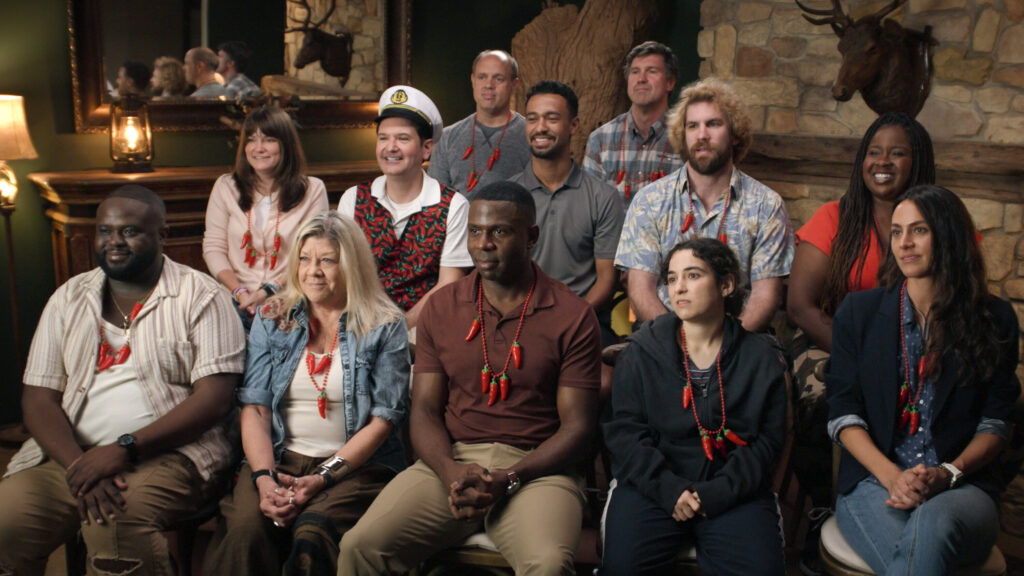
“Jury Duty Presents: Company Retreat,” which premiered Friday on Prime Video, answers Schulman’s question. It doesn’t take place in a courtroom, and Gladden is nowhere to be seen. Instead, the “Jury Duty” producers thought about different scenarios that would allow them to keep a normal person in one location as things got progressively weirder. They settled on a corporate team-building trip for Rockin’ Grandma’s Hot Sauce, a condiment company that they made up. (Washington Post owner Jeff Bezos is the founder of Amazon, which owns Prime Video.)
This new season still needed a hero. So, the producers added listings to various job websites, including Craigslist, in search of a temporary assistant. Eventually, they found Anthony Norman, a young father who’d done temp work for two years. After several interviews, writer and executive producer Anthony King was certain Norman would be a thoughtful and unsuspicious lead.
“Anthony went through job interviews the same way anyone would,” King said. “In some ways, the vetting for hiring someone to a job — which is what he was trying to get — speak to some of those things, because you wanna hire someone who feels like they can be part of a team, and who is someone you wanna be around for eight to 10 hours a day.”
Before Norman was offered the job, he was asked if he’d be comfortable being on camera. The hot sauce company, as it was explained to him, was participating in a documentary about small-businesses retreats. His answer was an emphatic yes.
The producers also confirmed that Norman had not seen the first season of “Jury Duty,” according to Schulman. He declined to explain how they figured it out. But Schulman wasn’t concerned that success of the first season would hinder the casting process. “We don’t live in a monoculture anymore. If you told me we had to do a show with the cast of ‘Stranger Things’ that was like ‘Jury Duty,’ we could still find people who would not recognize any of them” he said.
Even before Norman was interviewed, the “Jury Duty” team took pains to make it seem like Rockin’ Grandma’s Hot Sauce was real. If he got curious, Norman would be able to purchase hot sauce from their website. All of his fictional co-workers had Instagram accounts. They even had the company’s CEO (played by Jerry Hauck) do a ceremonial first swing at game for an independent baseball team. “Our goal is always to build a digital world that’s as solid as the actual world,” Schulman said.
So much can go wrong on a “Jury Duty” set. Before Norman showed up, the cast went through a broad rehearsal process, where director Jake Szymanski urged the actors to stay flexible. Depending on what Norman did or said, the actors playing his co-workers had to be ready to improvise. “I refer to it as directing and rehearsing by flow chart,” Szymanski said. “We have what we want to happen, we rehearse, and then we have five other things that we think might happen, and we rehearse for those as well.”
The cast tried to guide Norman toward the scripted scenes. But there’s no accounting for the spontaneity of humans — or nature — it turns out. During one important scene of exposition, where the actors and Norman ate lunch outside, a swarm of wasps descended. As a result, Norman took his meal inside, ending the scene because there weren’t any hidden cameras near him.
“You have to pause on that whole scene and go, ‘Okay, guys, maybe we’ll try to get him back out here. Maybe we will try to put these story beats — we’ll tell them in a different place,’” Szymanski explained. “We need to set up a different area and come up with a plan B.”
While there was some cover because Norman thought they were filming a documentary, it wouldn’t make sense for that camera crew to be focused only on him. He’s just a temp, after all. So, the visible crew tried to focus on other characters, while an 80 to 100-person crew hid in nearby buildings, some of whom operated hidden cameras focused on Norman. Most of the doors around the retreat center were locked, just in case Norman started wandering around.
Of course, mistakes are bound to happen: One of the hidden cameras was fully visible during an early scene at the Rockin’ Grandma’s office in Los Angeles. Later, the team in the control room winced in horror when they realized that a script was sitting on a table near Norman. With the help of crew members, both issues were fixed before he noticed.
“Part of the excitement of the show is that, at any moment, it could be completely destroyed by anyone or any mistake or anything,” King said.
At times, Norman said he felt like he was on a TV show. Ultimately, though, he thought that what unfolded over the retreat was too unbelievable to be scripted, including a shady investment firm that gets involved with Rockin’ Grandma’s and a hypnotist who reveals embarrassing secrets. “It is really hard to believe that there’s a TV show being made about you in secret,” Szymanski added. “You would have to be somewhat of a psychopath or a narcissist to believe that.”
A few detours and scrambled scenes later, the “Company Retreat” team was able to get to the show’s intended conclusion. Then came the other tricky part: explaining to Norman that, while he might’ve not been in on it, he certainly was not the joke.
“It’s always the actors who are the goofballs,” said King, adding that throughout “Company Retreat,” Norman became an unsuspecting hero. “We’re always giving this person, who doesn’t know they’re on a show, the opportunity to help, to be who we hope we would be in those situations.”
This time, it wasn’t difficult to explain to Norman what happened. To understand that he wasn’t a punch line but the hero of the show, all Norman had to do was watch the first season of “Jury Duty.”
The post How ‘Jury Duty’ kept its high-wire act secret for another season appeared first on Washington Post.