The body lay slumped on the jail floor, curled around a metal toilet.
Investigators found no evidence of homicide, just a few scraps of rolled-up paper, singed and scattered on the floor like scorched confetti.
For months, inmates had been falling ill at the Cook County jail in Chicago. Officials said they had heard rumors that extremely toxic drugs were infiltrating the facility, delivered on something so ordinary that it seemed impossible to stop.
Then the body appeared, and “something clicked,” said Justin Wilks, the head investigator at the jail.
The paper itself must be the culprit — and it was deadly.
More overdoses soon followed. The next month, in February 2023, another inmate died from smoking paper laced with mysterious new drugs. In April, one more.
“People were dying so fast,” Mr. Wilks said. But when officials at the jail told their law enforcement colleagues about it, they said, some found it hard to believe.
By year’s end, at least six people had died of overdoses, putting the jail at the vanguard of a new kind of drug war, one in which extraordinarily powerful drugs can be invented faster than the authorities can identify them.
And where something as ubiquitous as paper can become lethal.
Today, fringe chemists are ushering in a total transformation of the illicit drug market. Operating from clandestine labs, they are churning out a dizzying array of synthetic drugs — not only fentanyl, but also hazardous new tranquilizers, stimulants and complex cannabinoids. Sometimes, several unknown drugs appear on the streets in a single month. Many are so new they are not even illegal yet.
Nearly all of them are harder to trace than conventional drugs, less expensive to produce, much more potent and far deadlier, according to scientists and law enforcement officials across the globe.
The unbridled rise of synthetic drugs is as profound for the illicit drug market as the television was for the radio, or the computer for the typewriter, scientists say, and it is confounding law enforcement officials the world over.
“This is the modern drug epidemic: It’s like nothing that’s happened in the world before — anywhere,” said Bob DuPont, a drug czar under President Richard M. Nixon.
After that first death in the Cook County jail in January 2023, it took months for Mr. Wilks’s team to realize that these mysterious new drugs were being sprayed onto the pages of the most innocuous-seeming items: books, letters, documents, even photographs.
The sheets of drugs, worth thousands of dollars a page, were being torn into strips and smoked by inmates who went into crazed, exorcistic fits, as if possessed by a phantom narcotic the authorities could not see, much less stop.
Just figuring out what the paper had on it was maddening. The specialized labs needed to run the tests often took months to send back mind-boggling chemical formulas that left some officers scratching their heads.
Desperate, the jail added 24-hour surveillance, searched more cells and beefed up the mail room, inspecting every item by hand.
But the traffickers were cunning. When regular mail got checked more closely, smugglers began lacing legal correspondence. Soon, officers discovered sealed packages that looked as if they had been shipped directly from Amazon, with drug-soaked books inside.
In the summer of 2024, Mr. Wilks’s team found a single sheet with 10 different concoctions sprayed onto it — a mix of opioids, depressants, cannabinoids and stimulants all jumbled together on the same page, like a Rosetta Stone of synthetic drugs.
Scientists were baffled and alarmed: Why would anyone spray so many different, lethal substances onto a single piece of paper? It was a distillation of the dark future these drugs threatened.
Soon, another inmate died, with many of the same novel drugs in his system. For Mr. Wilks, it was a crushing realization. Eighteen months into his investigation, he was no closer to finding the supplier — and the array of deadly new drugs was evolving faster than he could track it.
“We have to do something,” Mr. Wilks told his staff. “Another person can’t die on my watch.”
An Illicit Arms Race
For most of human history, illicit drugs came from the land.
The trade in opium from poppies stretches back thousands of years. Even during the 20th century, when the United States declared its war on drugs, officials were still largely focused on three substances derived from plants: marijuana, cocaine and heroin.
Today, the dynamic is almost unrecognizable.
Supercharged drugs are increasingly synthesized in labs by illicit chemists who whip up new varieties like chefs testing recipes. More than 1,440 new psychoactive substances have been recorded since 2013, tripling in a little over a decade, according to the United Nations Office on Drugs and Crime.
The explosion parallels a surge in the death toll. In 1971, the year Nixon declared drug abuse public enemy number one, 6,771 Americans died of overdoses. Now, more than 70,000 Americans die annually, surpassing all American military deaths during the Vietnam War.
Fentanyl has received much of the attention, and rightly so: It is a factor in most recent overdose deaths, often in combination with other substances. But while fentanyl is the most infamous of these new drugs, it is far from the most powerful or the most addictive.
Some of the newer substances dwarf the potency of drugs that were introduced only a few years ago.
“Today is the most dangerous time in the history of the world to be using drugs,” said Dr. Andrew Monte, the head of the Rocky Mountain Poison Center.
“That’s until tomorrow, when there’s a new drug,” he added.
An arms race for potency is underway, scientists and officials say. The stronger the drug, the bigger the high. Dealers can also provide drugs in smaller quantities, making them easier to smuggle, with greater profit potential.
The consequences are severe: higher risks of respiratory suppression, psychosis, violence, overdose and death.
Nitazenes, a class of synthetic opioid that killed one of the inmates at the Cook County jail, can be 20 times more potent than fentanyl, a grim reflection of how the battle against illicit drugs often ends up spawning newer, even deadlier ones.
As quickly as the authorities ban one substance, narco-chemists drum up novel, more potent variations that have not been outlawed yet. Drug recipes are shared online and orders are often placed there, too, part of a radical transformation of the criminal world that experts call “the digitization” of drugs.
Few places illustrate the struggle more clearly than the Cook County Correctional Facility, but it is not an isolated case. At least 15 other states have arrested or prosecuted individuals for smuggling drug-soaked paper into jails or prisons, according to a New York Times analysis of case data from New York to Texas to Hawaii.
Jails often sit at the forefront of new drug trends. The tighter settings breed creativity, forcing dealers and users to find new ways around the 24-hour surveillance.
On the streets, such innovation is not always as necessary: It is easy enough to peddle fentanyl or marijuana. But Mr. Wilks worried this new threat, so effective at fooling law enforcement, might escape his walls.
The deaths in Cook County set the authorities on an uncharted course through this changing landscape, where paper, a medium as old as Ancient Egypt, can kill.
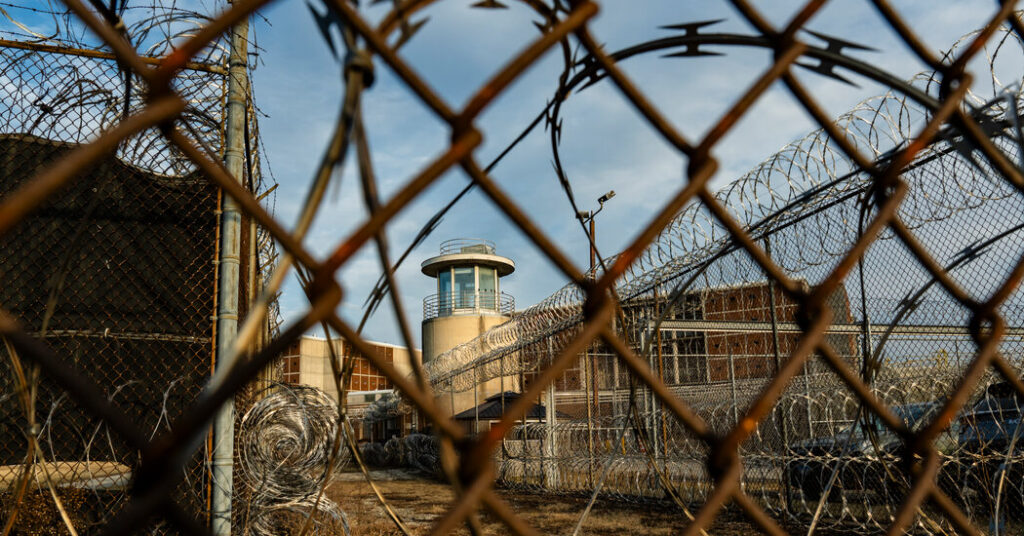
Yet the jail’s extraordinary restrictions also created the ideal conditions to fight back: a fortress of concrete and razor wire where the authorities had license to scrutinize almost anything. In this closed system, with 5,000 inmates under constant watch, this deadly new drug paradigm could be studied and, possibly, beaten back.
If they could not stop it there, Mr. Wilks worried, what would happen if these drugs hit the streets?
‘Don’t Die In Jail’
Paper is a lifeline in jail, a tether to parents, partners and children in the outside world.
After the first person died from smoking a drug-laced piece of it in 2023, the Cook County sheriff, Tom Dart, called around to other jails and prisons grappling with the same phenomenon. Some had decided to ban paper outright.
Sheriff Dart refused.
“We had never seen or heard of anything like this before,” said Sheriff Dart, who runs the Cook County jail. “It required us to completely redo what we were doing.”
The jail has been criticized at times for not keeping a close enough eye on inmates. But getting rid of paper altogether would rob them of what they missed most in lockup: human connection. That seemed particularly harsh to Sheriff Dart, considering that most inmates in the jail were still awaiting trial and had not been convicted yet.
“The physical card a child sends their dad — in the correctional setting, it’s a big deal,” he said. “To dismissively say were going to ban everything from coming in, it was just something that I didn’t want to do.”
As the death toll mounted in 2023, the jail stepped up random searches and taught inspectors to master the natural touch and smell of paper, hoping to catch when it had been adulterated, however slightly. The drugs were so novel that even the dogs could not smell them.
“Everybody uses paper for everything,” Mr. Wilks said. “The schools inside use paper, the staff uses paper, and the inmates get paper in the mail every day.”
Almost everything the jail did seemed to spur more innovation. The paper dealers even found ways of smuggling in psychoactive droplets, so that the jail’s own commissary forms could be transformed into smokable drugs. Mr. Wilks feared that dirty corrections officers could smuggle the chemicals in their water bottles.
“Every time we figured something out, they’d make a change,” Mr. Wilks said.
Because the labs took months to identify these new compounds, the authorities were always several steps behind, trying to break up a fast-changing drug ring with dated intelligence.
The jail put up posters barking out the dangers of drug-soaked paper.
“Don’t Die in Jail,” they said.
But even death did not dissuade users.
In fact, it seemed to have the opposite effect. Many inmates had built up their tolerances and craved the strongest paper they could get. The greater the high, they reasoned, the greater the escape.
“A lot of us are facing life in prison, and to leave that behind, even for a minute, is all you want,” said Rashad Rowry, 33, a former inmate in Division 9, the maximum-security wing of the jail, explaining why he used to smoke paper. “People using in here will say, ‘Just ’cause he died doesn’t mean I’m going to die. He was probably just weak.’”
More inmates have died of overdose in Division 9 than in any other wing of the jail, and from the moment you enter, the smell of scorched paper fills the air, clinging to your hair and clothes. Officers can spot users by their fingertips, which are often stained with a brownish resin.
Using is not cheap. A small rectangle of paper the size of a driver’s license can cost up to $800. A whole sheet of paper can reach $10,000. Inmates recounted begging family and friends for thousands of dollars over the years they spent in jail.
Outside the walls, synthetic drugs are often far cheaper than traditional ones. But inside the jail, the price reflects how hard it is to smuggle them in — and how desperate inmates are to get high.
Several inmates spoke openly about having seizures, passing out and being rushed to the hospital. “You lose your extremities, you lose your motor skills,” said Kenneth Olugbode, another inmate, describing the overdoses he witnessed in Division 9. It is impossible for inmates to know how potent a strip of paper is until they smoke it.
Mr. Olugbode’s friend Eric Gunn was one of the first inmates to die in Cook County jail. The day before Mr. Gunn overdosed, he had promised to join a Zoom call for his grandmother’s birthday.
“He said he’d be dancing and showing me all of his moves,” she recalled.
Instead, on Feb. 9, 2023, shortly after 1:30 p.m., an officer doing rounds saw him lying on the floor, unable to speak, the autopsy report said.
An Ever-Present Enemy
In the summer of 2024, jail officers found the Rosetta Stone — the sheet of paper with 10 different synthetic drugs on it.
The discovery was particularly unsettling: A single sheet of paper coated with the biggest, and possibly deadliest, array of synthetic drugs yet.
The kaleidoscope of drugs horrified scientists, who viewed it as a manifestation of how drastically chemistry had run off the rails.
“That is a brutal amount of material,” said Christopher Pudney, a scientist who studies novel drugs. “It epitomizes the dangers of these new drugs.”
And then, not long after discovering the drug-laden sheet, the authorities found Daniel Aranda-Delgado, 27, dead of an overdose from the same kind of illicit onslaught.
The toxicology showed five different drugs in his system: an opioid more potent than fentanyl, a cannabinoid, a hallucinogen and two central nervous system depressants. They closely matched the chemicals discovered on the terrifying page officials had found.
Shaken, Mr. Wilks ordered his team to start over. Trying to stop the paper from entering the jail was not enough. They needed to get into the streets and find who was making it.
Since their investigation started in 2023, they had arrested dozens of people — officers, nurses, inmates, visitors — for sneaking in drug-soaked paper. One corrections officer had been caught with 48 pages in her home.
But no one gave up the supplier. With seven people now dead in less than 18 months, officials realized they were fighting a losing battle against an ever-present enemy.
Mr. Wilks, 53, relied heavily on a sheriff’s investigator, Adam Murphy, a former narcotics officer who had spent years on the streets and still wore a baseball cap with sunglasses perched on the brim like an undercover cop from central casting.
Mr. Wilks, by contrast, had an avuncular charm, wore sensible shoes and avoided using swear words, a rarity in the jail.
The team ran back through everything for new leads — and finally caught a break.
Months earlier, an inmate had been caught with drug-soaked paper stuffed in his anus, euphemistically referred to as a “jail wallet.”
Investigators reviewed hours of video recordings of his visits and discovered where he got it: When his girlfriend came to see him, she slipped him a packet of papers while someone distracted officers.
She had been searched before visits, yet she had never been stopped because of the novelty of the drug itself.
Ecstatic at the discovery, Mr. Murphy, 45, went to the girlfriend’s house.
“She told us everything,” he said.
At last, investigators began to map the outlines of a network. A dealer in the Chicago area seemed to be working with eight inmates and their girlfriends to bring in paper.
Mr. Murphy discovered something else, too: The dealer was in contact with inmates around the country, sending paper to correctional facilities as far away as Florida.
Suddenly, Mr. Murphy was enmeshed in a sprawling case that questioned the very premise of what a drug could be.
The scale and novelty of an investigation into traffickers making drug-soaked paper — across state lines, prison systems and a staggering array of novel chemicals — was significant enough that Mr. Murphy and his colleagues presented it to federal officials in late 2024, hoping they would join the fight.
A few weeks later, they did.
On the Streets
In October 2024, Mr. Murphy watched from a surveillance van as his informant, Diablo, approached a black SUV parked on the edge of Garfield Park in West Chicago.
The driver of the SUV lowered his window and handed something to Diablo before speeding away.
“He’s got a piece of paper,” declared Mr. Murphy, stationed on the edge of the park.
Minutes later, Mr. Murphy and the others rendezvoused with their informant. Diablo handed over the evidence.
“It’s a clean deal,” Mr. Murphy announced, clutching a plastic bag with a single sheet of paper inside.
By the end of 2024, the Cook County jail investigation had sprawled into several cases, as new sources of paper began springing up all over Chicago.
There were now several dealers trying to get paper into the jail, including small-timers supplying one or two inmates, and bigger operations shipping sheets to prisons across the United States.
But catching them in the real world, outside the jail, was a tall order. Paper was reinventing the basic rules of law enforcement.
“We don’t have dogs that can smell it, we don’t have test strips for it, we don’t have field test kits,” Mr. Murphy said. “So if we find paper on a guy, we have to send it to the lab, wait five to six weeks for it to come back and then say, ‘OK, now we’re going to arrest him.’”
“In the streets,” he added, that “guy would be gone.”
The Amazon Ruse
On a blustery evening in March 2025, Mr. Wilks was leaving the jail for the day when he spotted a beat-up sedan parked next to his car.
The driver got out, holding three small puffy packages that looked like they came from Amazon. The man did not speak much English, but was on the phone with a woman who did.
“I’m trying to make sure the book I’ve mailed to my husband gets to him,” the woman told Mr. Wilks over the driver’s cellphone.
The woman explained that the driver was supposed to take the packages to a shipping dock at the jail reserved for deliveries by Amazon, UPS and FedEx.
Suspicious, Mr. Wilks said he would take care of the packages himself.
Once inside, he opened the packages and found three books, one with pornography, and two others with the sticky texture he had learned to associate with drug-saturated paper.
It was a brazen scheme. People were sneaking in drug-laced paper by sending official-looking packages to the shipping dock used by UPS, Amazon and FedEx. And it was dumb luck that Mr. Wilks had stumbled on a driver who had gotten lost trying to find the delivery site.
Mr. Wilks and his team had long assumed that anything coming from an Amazon warehouse was shipped by Amazon, and therefore clean.
But criminals, they were learning, could try to use Amazon as a smuggling tool. A month earlier, Mr. Wilks and his team got a tip that dealers could sign up as third-party booksellers on Amazon. The dealer could coat pages of a book in synthetic drugs, then offer it for sale on Amazon, complete with official-looking packaging.
After getting the tip, Mr. Wilks and his team tried to replicate the scheme and discovered that, sure enough, they could ship a tainted book to themselves that looked as if it had come from Amazon itself.
In a statement, Amazon said that it had found no information confirming that third-party sellers were in fact shipping drugs into Cook County correctional facilities, but that it was “committed to working with law enforcement” to assist investigations.
The sheer inventiveness astounded Mr. Wilks: the way dealers outmaneuvered each barrier the authorities put up. This game of Whac-a-Mole reflected the larger dynamic plaguing the war on drugs.
“Each time we get rid of one substance, they come up with something more potent,” said Alex Krotulski, a forensic chemist who helped identify the drugs in the Cook County system.
Clues were popping up that drug-soaked paper might be catching on outside jail. Tips had circulated about gas stations around suburban Illinois selling gift cards soaked in drugs, and of addicts leaving jail and seeking paper on the street.
“This to me is the game changer,” Mr. Wilks said.
“When the cops pull you over with a bag of heroin, you have to hide it,” he explained. “But if they pull you over with a manila folder full of paper, no one is going to even give that a second look.”
The Raid
Dawn broke over Wentworth Avenue as a convoy of unmarked SUVs barreled past postage stamp lawns and tidy homes.
Nearly a year had passed since Mr. Murphy persuaded the inmate’s girlfriend to cooperate. Now, in the baked air of late July 2025, a swarm of federal agents encircled a nondescript home in a suburb of Chicago.
A white van pulled in front, blocking cell signals to the house. Agents broke down the door with a battering ram. A drone was sent in to search the premises.
Inside, Mr. Murphy saw paper everywhere. Upstairs was an industrial mixer. Downstairs, a shipping station setup, with U.S. Postal Service labels and envelopes. Fans were all over, presumably to dry the soaked paper.
Agents from the federal Drug Enforcement Administration, the F.B.I. and Cook County hauled boxes from the house, some holding paper, as well as amber bottles filled with liquid, a scene visible from the sidewalk.
The D.E.A. took liquid, paper and a tan powder to test.
Of all of the investigations that Cook County was now undertaking, the federal case was the most ambitious. Five hours later, the target of the raid, Denis Joiner, 33, was in custody. He was charged with distribution of a controlled substance — in this case, paper soaked in two different types of synthetic cannabinoids.
Law enforcement had been surveilling him for months and intercepted shipments to correctional facilities in North Carolina, Indiana and Illinois, according to a criminal complaint filed in the Northern District of Illinois.
One package contained vacuum-sealed bags filled with drug-soaked cloth, while another contained two books, both of which tested positive for synthetic cannabinoids, the complaint said.
When the authorities searched his trash, they said, they found 14 sheets of printed labels addressed to inmates across the country, some with return addresses to law offices.
After the arrest, Mr. Wilks felt some relief that the single biggest trafficker pushing paper in his jail — that he knew of, at least — had been taken down.
“The bust today answers some of our questions,” he said. “But if the question is whether what happened today is the end, I would say this is not going to stop.”
He was right. Corrections officers kept finding paper in the jail. In the month after Mr. Joiner’s arrest, the authorities confiscated 277 suspicious pages. Officials are still awaiting autopsy results but say that two deaths in the jail in 2025 and one in 2026 may have been caused by paper soaked in drugs that are even more powerful than before.
Mr. Wilks knew that he and his team were trapped in a cycle of this new drug war, where getting to the bottom of the mystery did not stop the mystery, it just changed it. But what else could they do?
“The sky is the limit in terms of what they will come up with,” he said. “It never ceases to amaze me. I can’t imagine the next thing. I couldn’t have ever imagined this.”
Azam Ahmed is international investigative correspondent for The Times. He has reported on Wall Street scandals, the War in Afghanistan and violence and corruption in Mexico, Central America and the Caribbean.
The post No Pills or Needles, Just Paper: How Deadly Drugs Are Changing appeared first on New York Times.