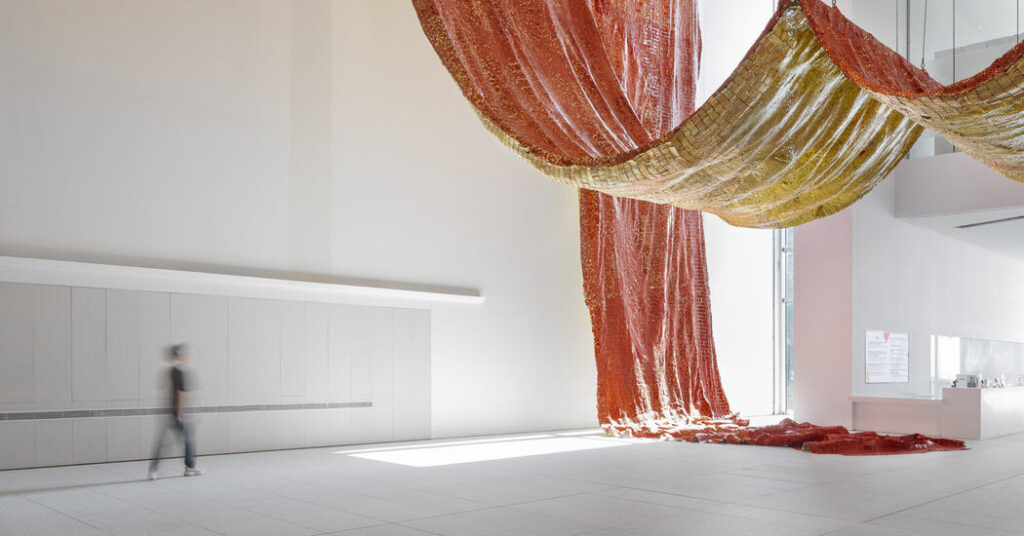
Rows of well-dressed patrons convened one evening in early March in the London headquarters of Sotheby’s for an auction of multimillion-dollar works by the likes of Claude Monet, Alberto Giacometti, Lucio Fontana and David Hockney. One highlight was a gleaming wall sized sculpture made of discarded liquor-bottle caps and foil seals, their brand names sometimes still visible.
“G6,” a 2023 work by the Ghanaian artist El Anatsui, sold for $995,000 that night, and the proceeds were donated to London’s Royal Academy of Arts (Anatsui is an honorary Academician). It was well shy of the record $2.23 million which “Prophet” — also composed of found aluminum bottle caps, stitched together with copper wire — fetched at Christie’s in New York in 2023.
Anatsui’s creations look from afar like vast and spectacular draperies or tapestries — only there is no fabric, material or embroidery involved. These are not textiles: They’re outsized sculptures made purely of liquor bottle caps.
His works are in the world’s most prestigious museum collections, and in 2023-24, he was selected to take over Tate Modern’s cavernous Turbine Hall with a site-specific installation.
Anatsui’s mother died when he was a toddler, and he left his birthplace of Anyako, Ghana, to live with his uncle, a reverend, in a mission house. He is now back living in Ghana after 45 years as a professor of art at the University of Nigeria in Nsukka, Nigeria. It was near Nsukka that one day in 1998, he chanced upon a bag of bottle caps that would transform his art.
Anatsui has been represented since 1993 by the October Gallery in London. He currently has two exhibitions with the White Cube gallery in Hong Kong and Seoul, coinciding with Art Basel Hong Kong, featuring double-sided bottle-cap works.
He was recently interviewed by telephone from Ghana. The conversation has been edited and condensed.
Your work never looks the same: It changes depending on how it is hung and where the creases fall. How do you feel about that?
I feel that should be the way that art is experienced. It shouldn’t be something that is frozen in time. The form itself, when I finish it, is so fluid. You can’t repeat it. Minutes after you’ve thrown it, you pick it up and throw it again, and it will give you different things. It’s like life: giving you different experiences and fortunes each time.
‘Art is life’ is a cliché, but it’s something that is very dear to my process of working. All living things grow, mature, fade off. There’s always that dynamic in life. Artworks should be able to do that, rather than present life as one particular view or experience.
What will your works look like in 50 years, when the bottle caps fade?
As an artist, my reason for working with material is that I believe it will change over time, and change is a continuation of the life of the artwork.
I recently exhibited work outside, in a desert in Morocco, for six months, and the desert sun is very harsh. When it was returned, I noticed that the colors were bleached. I thought the bleached colors looked even more beautiful than the raw colors.
So now, I have some pieces up on the roof of my studio, exposed to the sun to hasten their growing old, and to give them the patina of age.
I always have fights with conservators, because their understanding of things is different from mine. Let the thing grow, and let’s see what it grows into. Art is life.
The bottle caps that are your main medium come from bottles of liquor that Europeans imported into Africa and exchanged for enslaved people, who then went to America and grew sugar canes from which more alcohol was made and imported into Africa. There was a kind of horrible colonialist cycle. Yet your works have an incredible joie de vivre about them.
It’s like creating joy out of gloom. You have the option to keep it gloomy or give it some joy, and I select the joy. It’s not as if I select the joy. The bottle caps themselves come with joy. Visually, they are very joyful colors and shapes to look at. So they imbue the works with their kind of joy, which is telling us that we do not always have to sit down and mourn over things that have happened. What do we do with the fact that we are alive now, and we know about those things? Do we go on being gloomy?
It is up to the artist to lighten the load.
Your Tate Turbine Hall installation was powerful and successful. That space is difficult for artists to inhabit. How was it?
It took me a long time to get used to or understand the Turbine Hall. I had been passing through to see exhibitions in the Tate Modern, but I had never really sat down to take in the Turbine Hall. Even when they invited me and I visited, my understanding of it was rather rudimentary.
I was supposed to do the Turbine Hall commission the year before my actual installation went up. My idea did not fit in the place, so they had to quickly get another artist to do it and gave me an extra year. On the second visit, after the first idea failed, I saw something which gave me an understanding of the space.
You are one of the most successful artists on the auction market. Your works fetch high prices. How do you feel about that?
Artists don’t determine the prices at auction. People see the work, and they think that it makes sense for them to buy it at that price, and they do so.
One of the ways that auctions are useful to me is that they tell me what the worth of my works is. Although a lot of people say that the price is kind of artificial, if artificially your work has sold at this price consistently for two to three years, then it means that should be the price that it should be worth even on the primary market.
You grew up with your maternal uncle, a reverend, in a mission house, and you are back living in Ghana today. Why?
What the mission life does is that it blinkers you. The town in which I grew up is the cultural capital of my people. But I wasn’t able to get exposed to that culture, because living in a mission, you’re not allowed to do this, not allowed to do that — there are regulations and conventions and all kinds of things around life in the mission house. So you are kind of caught in that.
It makes it possible for you, in old age, to long for knowledge of your culture. You want to know about your culture, which you were prevented from knowing because of the circumstances of your upbringing. This is one of the reasons why I had to come back from running around the world: to get to understand my roots.
Eventually, wherever one goes, one has a need to come back home. You need to return and start something. I’m trying to come to see how much I can gain from my roots.
And maybe know yourself better?
Yes, yes. To know myself better.
The post From Bottle Caps and Seals Has Come Colorful, Cascading Art appeared first on New York Times.