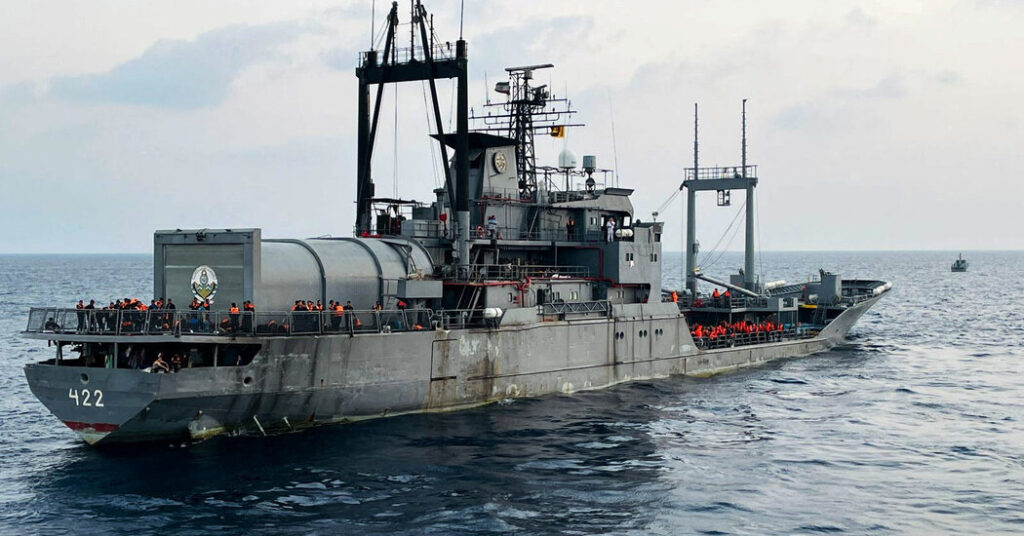
The fate of Iranian sailors stranded by war thousands of miles from their country remains undecided.
More than 250 sailors of the Iranian Navy have been stuck in Sri Lanka, an island nation in the Indian Ocean, since the opening days of the war launched by the United States and Israel. So far, the Sri Lankan government has kept the sailors, who include survivors of an Iranian warship torpedoed by a U.S. submarine, in protective custody.
Iran’s ambassador has asked Sri Lanka to repatriate them, saying that since their countries are not at war, they should be able to come to an agreement.
However, Sri Lanka is not so sure.
It feels caught between the two sides in the conflict, eager to keep good relations with both Iran and the United States while avoiding antagonizing either one. To preserve its neutrality, Sri Lanka earlier declined an American request to land military aircraft there.
The same balancing act has also left Sri Lankan officials trying to figure out what to do with the Iranian sailors, who number 253.
As a result, they have been stuck in limbo, unable to leave. While the Iranians are closely surveilled and monitored, Sri Lanka says it is taking good care of them, tending to their physical and mental health.
One expert in diplomatic history said the sailors had been effectively marooned in Sri Lanka by the country’s determination to maintain its neutrality.
“This is a very unique situation,” said George I. H. Cooke, a visiting lecturer at the University of Colombo in Sri Lanka. “Keeping them is an expense, an obligation and a security issue for us.”
Thirty-two of the sailors were rescued from the Dena, an Iranian frigate torpedoed on March 4 off the Sri Lankan coast. The other 221 came from the Bushehr, an Iranian Navy supply ship that docked the following day after suffering engine trouble.
Sri Lanka has already repatriated 84 bodies recovered from the Dena. Another 20 crewmen remain missing and presumed dead.
After giving the Iranians 30-day visas on humanitarian grounds, Sri Lanka has housed most of them at military facilities until it decides what to do with them all.
Since then, diplomats at the Iranian Embassy have held daily talks with Sri Lankan officials, trying to negotiate the sailors’ return. Details of the discussions were not previously reported.
Iran considers the release of its sailors to be a “bilateral” issue that can be resolved directly, since the two countries are on friendly terms, Alireza Delkhosh, Iran’s ambassador to Sri Lanka, said in an interview on Thursday.
However, one sticking point has been the legal status of the Iranian sailors. Mr. Delkhosh said they should be free to go because Sri Lanka is not a participant in the hostilities, meaning the sailors are not prisoners of war. He also said many of the sailors were cadets still in training.
“They are not belligerents, they are not fighters, they are just students,” he said. “And here is not the battleground.”
While Sri Lankan officials agree that the Iranians are not captives, they say they cannot just release them, either.
“They are not prisoners,” Sri Lanka’s foreign affairs minister, Vijitha Herath, said in an interview. “But that doesn’t mean, give them all freedom.”
Mr. Herath also disagreed with the characterization of the Iranians as students. “They were in the warship,” he said.
Another question has been how to transport the sailors safely, if and when they are returned. To repatriate the bodies of those killed in the torpedo attack, the Iranian government chartered a special plane. However, it is unclear if another flight would make it without harm, given the intensity of the air campaign over Iran.
While the supply ship remains seaworthy, Mr. Herath said Sri Lanka cannot allow the Iranians to sail home with American submarines still prowling offshore. “It’s hard to guarantee that someone won’t attack the ship,” he said.
At present, the captain of the Bushehr and 14 of its sailors remain onboard the vessel, which is still in Sri Lanka. The rest of the ship’s crew are at a Sri Lankan Navy camp in Welisara, about 12 miles north of Colombo, the capital, Mr. Herath said.
He said the 32 survivors of the Dena are at a separate camp operated by the Sri Lankan Air Force.
The Iranians are in comfortable quarters with access to open spaces where they can exercise and walk around, according to Mr. Herath. He said the sailors are also being closely monitored for mental health problems while they cannot go home.
The Iranian ambassador agreed that the sailors are being well treated. They are able to communicate with their families and are in regular contact with Iranian Embassy officials, who provide them with support, Mr. Delkhosh said.
Mr. Herath said the Sri Lankans have provided telephones that the sailors can use to talk to family members, but those communications occur under supervision.
Earlier, crew members on the Bushehr were using satellite phones to communicate with Tehran, but Sri Lankan officials stopped them since the calls could be intercepted, he said.
Anupreeta Das covers India and South Asia for The Times. She is based in New Delhi.
The post Iranian Sailors, Including Survivors of Torpedoed Ship, Remain in Limbo appeared first on New York Times.