When Jason Haaheim, a principal timpanist for the Metropolitan Opera Orchestra, found himself furloughed indefinitely, without an apartment and newly obsessed with climate change during the coronavirus pandemic, he had ample time to think about the fragility of being an artist in an unstable, unpredictable society.
If a viral disease could displace him and take away his livelihood, so could a natural disaster. He needed a plan.
So in 2023 he signed up for what was then a new online course, the Personal Climate Strategy Workshop, developed by the futurist Alex Steffen. The monthlong seminar teaches participants how to navigate and prepare for the mounting disruptions of global warming.
The workshop is part of a growing cottage industry catering to fears about climate change and societal breakdown. And the options are constantly expanding, from the extreme, like survival camps and bunker design companies, to the calculating, like boutique firms that specialize in financial, real estate and insurance decisions, to the hand-holding ones, like Mr. Steffen’s workshop, which offers life-planning advice in an almost therapy-like environment.
“The demand for climate information is going up,” said Sarah Kapnick, global head of climate advisory for J.P. Morgan. The position at the bank, created two years ago for Dr. Kapnick, a former chief scientist with the National Oceanic and Atmospheric Administration, underscores the desire in the business world to understand the risks and opportunities of global warming, she said.
These days, the hunger for that knowledge extends to Americans outside of the C-suite, who face skyrocketing energy bills and uninsurable homes, while images of wildfires, floods and droughts — both real and fictional — flash across their screens. As books, television shows and movies offer scorched, dystopian depictions of life in the future, current data offers an equally bleak picture. The last three years were the costliest in terms of climate disaster on record, according to Climate Central, a nonprofit research and communications group.
“I don’t know anybody who isn’t feeling a sense of deep disorientation, deep despair and fear, which can make many turn inward,” said Rebecca Weston, a co-executive director of the Climate Psychology Alliance North America, a six-year-old nonprofit whose membership of mental health experts has grown from single digits to more than 700 climate-aware practitioners.
Patients and therapists, Ms. Weston said, are seeking new strategies and emotional support as they attempt to make connections between global warming and the existential fears that crop up around topics such as democratic governance, nuclear war, artificial intelligence and dwindling natural resources.
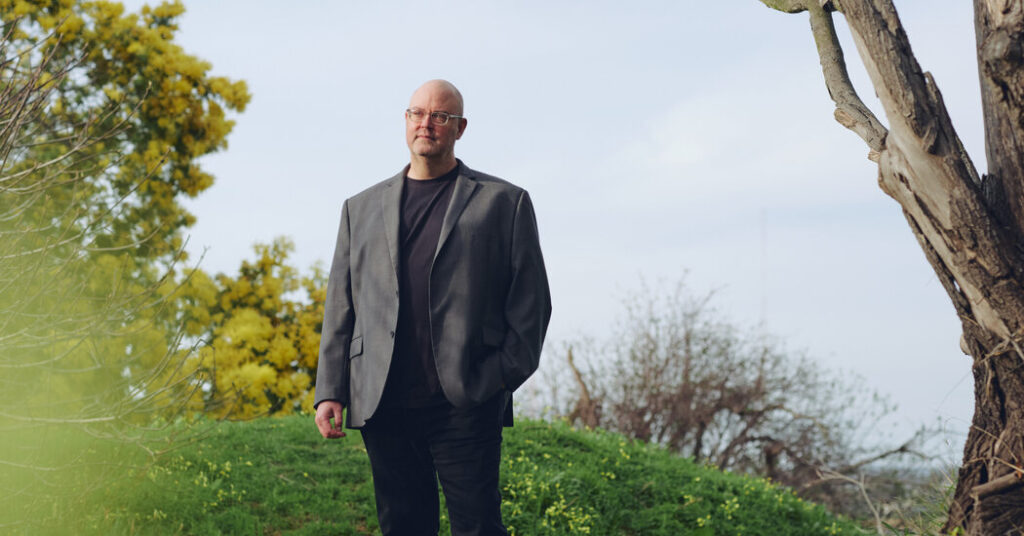
Mr. Steffen, 58, saw this need coming. When he was younger, he was a freelance environmental reporter, focusing on solutions-based journalism to solve the climate crisis, while consulting for organizations including the Nature Conservancy and the Global Business Network. But about a decade ago, he had the “grim realization” that the solutions weren’t arriving fast enough, he said.
In 2021, he published an essay asserting that society had entered an era of “discontinuity” — when past experiences can no longer help with future decisions — because of global warming. It went viral. Mr. Haaheim, the timpanist, read it. People started asking Mr. Steffen for advice, so he created the class in 2023, charging about $2,500 per student. That same year, the Yale Journal of Biology and Medicine published a paper declaring that climate change had caused a psychological condition of “systemic insecurity.”
Mr. Steffen’s course, while not a cure-all, offers a safe environment for the climate-obsessed, who are uncomfortable bringing up the topic in everyday conversations because it can be so distressing. A recurring joke among many students is that no one wants to talk to them at parties. But for 75 minutes, twice a week, the online course welcomes their questions and concerns, no matter how depressing or quirky.
The sessions are part lecture (“We are heading really quickly into a massive collision with our own unreadiness,” Mr. Steffen warns, against a backdrop of data-driven slides), part strategy (he recommends looking up the bond ratings of cities, which provide a lens into infrastructure hardiness) and part spiritual guidance (“Doom looping is never a good strategy; self-care is important.”)
But mostly, the course focuses on where to live, and why. Suggested spots in the United States are mostly in the north, and away from the coast, though Mr. Steffen is careful to remind participants that climate havens do not exist. One student, who had moved to Asheville, N.C., one month before Hurricane Helene inundated the city, learned this the hard way. For those who must remain in riskier areas, Mr. Steffen suggests that they buy or start to research second homes in a safer locale, and for those who can’t afford to do that, he offers tips on what he calls “ruggedizing in place.”
Most New Yorkers who take the seminar want to stay in the city, despite its risks of extreme heat and flooding, and buy themselves second homes elsewhere, Mr. Steffen said.
Mr. Haaheim, 46, who could barely afford his rental apartment when he returned to New York at the end of the pandemic, knew he didn’t have the money to buy a home in the country of his own. But after taking the workshop, he realized that he and his partner, a cellist, had to do something. “My intuition basically told me that our lives here in the city were unsustainable in the long run,” he said.
The couple decided to stay in Manhattan, where they could earn money as musicians, while also developing side gigs to diversify their cash flow (a disposable, flexible income is one of the most important tools in navigating societal breakdown, Mr. Steffen often reminds his students).
But the couple’s big decision was the one to pool funds with another couple to buy land within driving distance of the city.
The property, Mr. Haaheim said, would serve as both an outdoorsy getaway and a bolt-hole in the event of a disaster in the city. In early 2025, the two couples closed on 40 acres in the Catskills, about 110 miles north of the city.
When he was looking at land, Mr. Haaheim applied what he had learned in Mr. Steffen’s course, and focused on parcels near municipalities with strong governments and solid infrastructure. The property, close to a walkable village halfway between New York City and Albany and near a major thruway, fit the bill.
The couple plan to put a camper on the land, because they can’t afford to build a house yet. “It’s our poor person’s approach to managing this,” Mr. Haaheim said. Although there is a wildfire risk in the area, Mr. Haaheim’s rule of thumb is “we will not build more than we can afford to lose,” he said. Should the camper go up in flames, he figures, the couple’s finances would survive.
Mr. Steffen is not encouraging his students to move to rural areas. He remains bullish on cities, saying last fall that he would never bet against New York. The zombie apocalypse portrayal of abandoned cities, he said, is not a realistic prediction of the future.
The most dangerous places in the country, he said, are rural or exurban, because they tend to lack amenities, infrastructure and a sense of community.
One of the most popular graphic slides in the course is a risk assessment map from First Street, a climate risk group in Manhattan, which Mr. Steffen has marked up with green circles to share his take on the most resilient American cities. (Miami and New Orleans do not make the cut; cities in the Great Lakes region, like Buffalo and Rochester, do.)
Mr. Steffen encourages students to use a holistic approach — taking into account proximity to friends and family, earning potential and cultural interests — in determining where and how they want to live.
And social cohesion, he emphasized, is a must. “If you are guarding canned foods with guns, you’ve already lost,” Mr. Steffen said in a recent class. “The real first responders are your neighbors.”
Hilary Howard is a Times reporter covering how the New York City region is adapting to climate change and other environmental challenges.
The post Fearing Chaos of Climate Change, Some Seek Answers in Virtual Classroom appeared first on New York Times.