One year ago, the Trump administration froze $400 million in federal research funding for Columbia University because of what the White House called an antisemitism and harassment problem on its campus. The move sent shock waves through higher education, as Columbia became the first major target of a Trump campaign to bring elite universities to heel. Columbia decided to negotiate, reaching a preliminary agreement with the White House on March 21 and then a final deal in July.
The atmosphere at Columbia is quite different from what it was in March 2025, in part because of these agreements. The leadership has also changed. A year ago, Dr. Katrina Armstrong was the interim president, but she was replaced by Claire Shipman, who is the acting president. Another change is imminent: Jennifer Mnookin, the chancellor at the University of Wisconsin-Madison, was chosen in January to lead Columbia and will start in July.
But did Columbia follow through on all of its pledges? One year on, where does Columbia stand?
Student Discipline
In its March 2025 letter, the Trump administration demanded a mask ban for protesters, comprehensive rules for demonstrations to prevent them from being disruptive, and strict punishment — meaning expulsion or multiyear suspensions — for the students who had participated in pro-Palestinian encampments or occupied a campus building in April 2024.
Columbia agreed, with some modifications, to these conditions. But not everything has worked out as planned.
Columbia overhauled student discipline by moving the panel that oversees rules infractions from the jurisdiction of the 111-member university senate, which is led by faculty members, to the provost’s office. Students no longer serve on the judicial panels.
Columbia administrators also took control of establishing protest rules, removing the senate’s role. The Trump administration, and other critics, believed the senate was insufficiently committed to cracking down on rule violations by demonstrators.
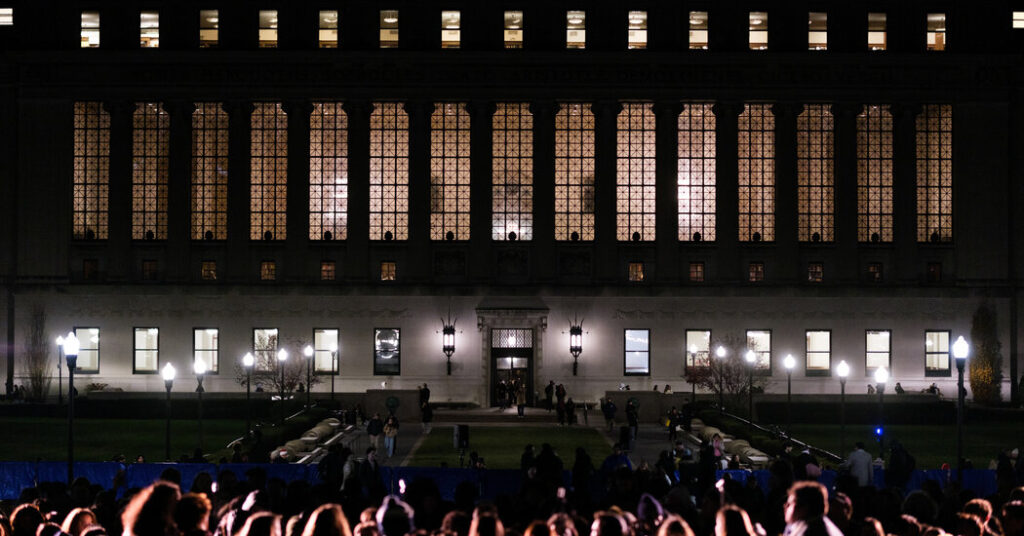
The change seems to have led to swifter, harsher discipline than had been typical at Columbia. In July, more than 70 students who had briefly occupied Butler Library during a May 7 pro-Palestinian demonstration were punished with expulsions, suspensions or revocation of their degrees.
These tougher punishments were criticized by many on campus for being out of alignment with Columbia norms. They also may be vulnerable to a legal challenge. On March 3, a state judge vacated the punishments of the students who had occupied a campus building, Hamilton Hall, in 2024, ruling that Columbia’s actions had broken state laws and university rules. Columbia is weighing an appeal.
Samantha Slater, a Columbia spokeswoman, said the recent changes had improved the disciplinary process, by increasing efficiency in investigating and adjudicating cases, and improving oversight to make certain that rules are applied and enforced fairly and effectively.
Tightening Protest Rules
While Columbia did not ban masks at demonstrations, it did agree to punish masked student protesters who break rules and refused to identify themselves when asked. That happened during the Butler Library protest, when demonstrators who did not show identification were held in a room and arrested.
Columbia also promised last March to “clarify” its protest rules in order to reduce disruptions on campus, including establishing limits on when and where protests could happen. But while Columbia made its rules stricter, it did not necessarily make them clearer, some students and faculty members say.
The rules state, for the first time, that “protests in academic buildings, and other places necessary for the conduct of university activities, are not acceptable” because they could disrupt academic activities.
That appears to forbid all indoor demonstrations, such as the sit-ins at a class taught by Hillary Clinton that took place in 2024. But the broad phrasing could also ban some outdoor protests, “though heaven knows where,” said the vice president of the American Association of University Professors at Columbia, Michael Thaddeus, who is critical of the changes.
Ten days’ notice is now required to organize campus events that would attract more than 25 people. Columbia can require that the venue for an event be changed for security concerns, as happened last November, when it denied permission for Mahmoud Khalil, a pro-Palestinian activist, to attend a film screening at the journalism school unless the screening was moved to a bigger location off the main campus.
Students are deterred from attempting to demonstrate by rules that aren’t always clear and the threat of potentially serious consequences, Professor Thaddeus said. As a result, organizers now frequently choose to hold events outside of the Columbia gates.
Some people who were targeted by aggressive protesters appreciate the changes.
A class called History of Modern Israel, taught by Avi Shilon, a visiting professor from Israel, was disrupted in January 2025 by masked pro-Palestinian demonstrators, who accused the class of whitewashing Israeli actions and handed out fliers that said “Crush Zionism.”
Professor Shilon said that he had expected at least some disruption at a symposium he helped to organize nine months later, titled “The State of Zionism after October 7,” which included scholars from Israel, the United States and Europe.
Instead, he said by email this week from Tel Aviv, the symposium was constructive and well-attended. Columbia provided security, but it wasn’t needed.
“Disagreements remain, and that is healthy,” Professor Shilon said. “But it appears that steps taken by the university have helped restore a sense of safety and allow academic discussion to proceed.”
More Control Over Middle East Studies
The Trump administration demanded that Columbia’s Middle East, South Asian and African Studies Department be placed under academic receivership for five years, an extreme step that would remove its independence. From the start, Columbia did not assent, viewing the order as a threat to academic freedom, one of its red lines.
In its March 2025 agreement, Columbia pledged only to review the department, and to suggest new programs and teaching positions. It then appointed a new senior vice provost, Miguel Urquiola, who in turn selected a committee of experts — including a scholar from the Middle East studies department — to recommend reforms.
Those recommendations, issued in February, focused on hiring more professors in the social sciences with expertise in the Middle East. Timothy Mitchell, the Middle East studies professor who served on the committee, said that “nothing has been done to curtail the academic independence of the department.”
The review “correctly identified that the larger problem was the problem of the social sciences abandoning expertise on the Middle East and other regions, not with MESAAS,” he added, using an acronym for the department.
The Trump administration and pro-Israel students and alumni had taken issue with the department because its professors, in general, are highly critical of Israel. The new scholars would join other departments, such as economics, or a new undergraduate major that may be started at the international affairs school. The plan is to jointly name several to Columbia’s Institute of Israel and Jewish Studies, an academic center that explicitly “supports the State of Israel’s right to exist and to flourish.”
Within the Middle East, South Asian and African Studies Department, professors critical of Israel continue to teach, including Joseph Massad, who wrote an online essay on Oct. 8, 2023, that described the Hamas-led invasion of Israel as “astonishing” and “remarkable.”
“As reiterated in the resolution agreement, Columbia maintains its independence as regards academic freedom, hiring, admissions decisions and freedom of expression,” Ms. Slater, the Columbia spokeswoman said.
Other Commitments Met and Unmet
More oversight of student groups: As part of its pledge to punish student groups for violating its rules, Columbia adopted a “zero tolerance policy” toward organizations “that promote violence or encourage disruptions of our academic mission.” The primary target was Columbia University Apartheid Divest, or CUAD, the coalition behind the 2024 encampments.
The 100 or so campus organizations that supported CUAD in 2023 have had to renounce their ties with the group to remain recognized by Columbia, the university announced. CUAD now has no link to the university, the group affirmed in social media posts recently.
Defining antisemitism: Columbia agreed in July to consider the International Holocaust Remembrance definition of antisemitism in its disciplinary system, a step that the Trump administration had demanded. The definition considers some criticism of Israel — such as “drawing comparisons of contemporary Israeli policy to that of the Nazis” or “denying the Jewish people their right to self-determination”— as antisemitic. As a result, it can be used to accuse anti-Zionist protesters of antisemitism.
Rashid Khalidi, a retired Palestinian scholar at Columbia, said in a published essay that the newly adopted definition “made it impossible for me to teach modern Middle East history” by limiting what he, teaching assistants and students could say without fear. He canceled a course he had planned to teach this academic year.
Columbia officials disagree on whether this rule chills academic discourse. None of its anti-discrimination policies may be construed to “abridge academic freedom and inquiry or principles of free speech, or the university’s educational mission,” the university wrote in an August statement.
Goals that didn’t make the final cut: Columbia agreed to some goals last March that did not make it into the final agreement in July. Ms. Slater, the Columbia spokeswoman, said that the March letter was not legally binding, because it was “a framework for continuing discussions with the federal government” that was superseded by the final deal.
One example involves Columbia’s Tel Aviv Global Hub. The university had pledged last March to start programs in Tel Aviv, one of its many international centers, by mid-2025. That has not happened, and a new timeline has not been finalized “due to ongoing challenges in the region,” Ms. Slater said.
Columbia had also said it would develop a free, online curriculum for K-12 schools focused on topics such as dialogue across differences, and antisemitism. This goal has been “de-prioritized” as the university focuses its energies on fulfilling its legally binding commitments, the spokeswoman said.
Sharon Otterman is a Times reporter covering higher education, public health and other issues facing New York City.
The post One Year After Trump’s $400 Million Ultimatum, a Different Columbia appeared first on New York Times.