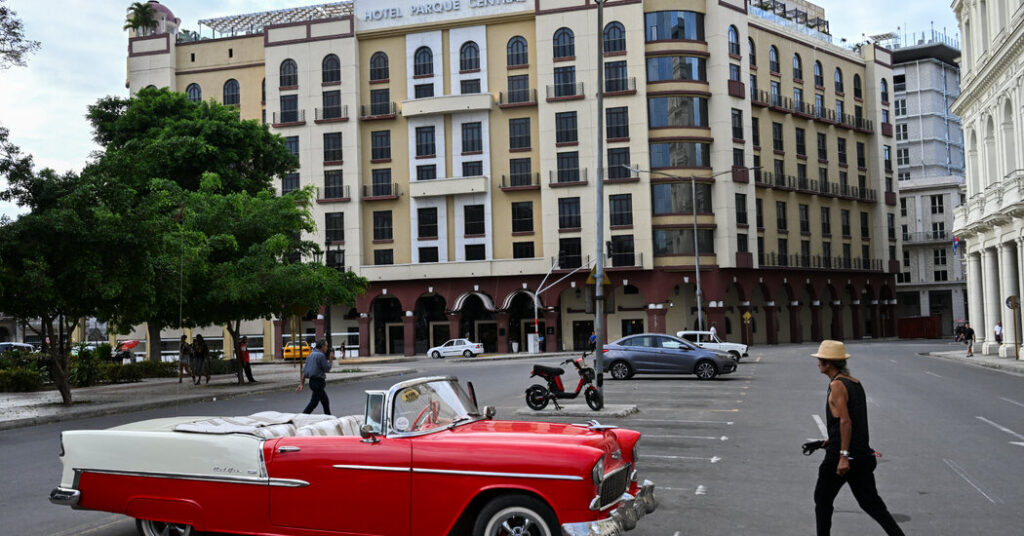
This month, under pressure from the Trump Administration, the Cuban government opened the door to allow Cubans living abroad to invest directly in businesses on the island.
But that change may not be enough of a lifeline to offset the steep decline in tourism that Cuba has seen over the past few years. Roughly 2 million people visited the island last year, down from a peak of over 4 million in 2019, according to the Cuban government’s Office of National Statistics and Information. And travel to the tourism-dependent island is becoming more fraught every day.
After weeks of electrical blackouts, the national grid suffered a “complete disconnection” on March 16, according to the energy ministry. Cuba generates most of its energy from oil, but in January, the Trump administration ordered Venezuela to stop supplying the island with fuel. The country’s president, Miguel Díaz-Canel, said earlier this month that Cuba has had no oil imports in three months.
“I’m recommending that people hold off on a trip to Cuba right now,” said Laz Pujol, 53, the owner of Bespoke Cuba Travel, a travel agency that has been sending Americans to Cuba for 26 years.
“Even if you are staying in the best neighborhood in Havana, you’re still going to go long stretches without electricity,” he said when reached by phone in Miami.
Here’s what you need to know about traveling to Cuba right now.
Are airlines flying to Cuba?
In February, some Canadian and Russian airlines suspended their flights to the island, citing concerns about the availability of jet fuel. Air Canada flights remain suspended until at least Nov. 1 because of the fuel shortages, the company said in a statement. Other Canadian carriers like WestJet and Air Transat have also canceled their flights. WestJet is automatically refunding passengers with flights to Cuba through April 25. Air Transat said in a statement it would resume flights in June.
According to data from the flight tracking site FlightAware, some carriers from the United States and other countries continue to fly to the island, mostly to Havana, the country’s primary gateway.
Among those operating flights are: American Airlines, Delta Air Lines, Southwest Airlines, AeroMexico, Copa Airlines, Air France and Turkish Airlines. American Airlines also continues to fly to the towns of Varadero and Santiago de Cuba.
Some flights may carry enough fuel from their departing cities to cover the return trip. That is the case for Delta, which, according to a spokeswoman, operates one flight daily between Miami and Havana.
Can United States citizens travel to Cuba?
Yes, but not for tourism. The State Department has a list of 12 authorized categories for visitors, including family visits, educational activities and humanitarian projects. Most U.S. visitors use a category called “support for the Cuban people.”
But visitation numbers have been falling. According to the latest numbers from the Cuban government, only half as many Americans arrived in Cuba this January as last year: about 7,000 in January 2026, down from 14,000 in January 2025. That number includes Cubans living in the United States who are usually visiting to see family.
During the same time period, the number of Canadians and Russians arriving to the island slightly increased.
Currently, the U.S. State Department maintains Cuba at a Level 2 travel advisory because of crime and unreliable electrical power.
What about people from other countries?
People from outside the United States generally have no restrictions on visiting the island. Canadians make up the largest portion of the island’s visitors — almost half. Many of them travel on all-inclusive packages. Other top source countries include Russia, Mexico, Argentina and Spain.
Are hotels and short-term rentals operating?
Because most Cuban hotels have ties to the Cuban government, American citizens aren’t legally allowed to stay at them. The U.S. government maintains a list of businesses and hotels that U.S. citizens are prohibited from frequenting, which includes hotels operated by large international brands like Melia and Iberostar. (Some smaller, independent hotels are permitted.)
Many U.S. travelers stay in private homes, called casas particulares, which function like short-term rentals. Those home stays may be booked directly through the host or through a platform like Airbnb. As of this week, Airbnb showed many listings with availability in Cuba,
Locally, though, Cuban Airbnb hosts are reporting a wave of cancellations. “Since three months ago we are having a lot of cancellations,” said Alejandro Lopez, who manages two Havana apartments that are listed on Airbnb, via WhatsApp. “In the streets you see Cubans, but you barely see tourists.”
Visitors who stay in private homes may experience the consequences of the electricity shortage just as local residents do, which may mean no running water, power or air-conditioning.
Mr. Pujol, the tour operator, said that all of his customers who had booked Airbnbs were offered a full refund by Airbnb because of the situation on the island. Airbnb did not respond to a request for comment.
For visitors staying in resort areas like Varadero, Cayo Coco and Cayo Santa Maria, the situation may be better. Those popular luxury beach destinations have seen the lights stay on because some of the hotels have their own generators. A representative of Starfish Resorts, which operates seven hotels in Cuba, including in Varadero, said in a WhatsApp message that their hotels remain open with “guaranteed energy” because they have generators. It’s unclear how long the fuel supply will last if shortages persist.
Is it possible to drive?
Visitors who rent cars can patronize gas stations, but they may not have gasoline to sell.
“For those brave enough to still go to Cuba, the problem is getting around,” said Mr. Pujol. “There’s no gas, or it’s $6 to $12 a gallon on the black market,” he said, adding that one of his drivers was stopped by government agents in January and fined for buying black-market fuel. “I have never seen it this bad,” Mr. Pujol said.
Additionally, traffic signals and streetlights may not be working. Hiring a private driver is the best workaround, because they may know the roads and where fuel is available — if there is any to be found.
What do U.S. authorities say?
According to a statement from the U.S. Embassy in Cuba, “Cuba’s national electrical grid is increasingly unstable and prolonged scheduled and unscheduled power outages are a daily occurrence across the country.”
The U.S. government advises that travelers prepare for prolonged power outages by keeping mobile phones and portable battery banks charged, having flashlights and spare batteries easily accessible, stocking up on nonperishable food and water, and preparing alternative methods to meet medical needs, such as medical devices requiring power or medicines requiring refrigeration.
The State Department urges U.S. citizens to register with the Smart Traveler Enrollment Program (STEP), follow the Security Updates for U.S. Citizens channel on WhatsApp, and keep an eye on the department’s Cuba webpage.
Follow New York Times Travel on Instagram and sign up for our Travel Dispatch newsletter to get expert tips on traveling smarter and inspiration for your next vacation. Dreaming up a future getaway or just armchair traveling? Check out our 52 Places to Go in 2026.
The post Electrical Blackouts, Suspended Flights: What to Know About Travel to Cuba appeared first on New York Times.