The corner of Caton Avenue and Fort Hamilton Parkway was still and quiet before dawn, the bustle of a workday having not yet begun. But by 4:30 a.m., at least one apartment on the block, in the Kensington neighborhood of Brooklyn, was roaring to life, the sounds of laughter, prayer and sizzling food emanating from its electric-blue galley kitchen.
In it, three women — South Asian immigrants, Muslims and New Yorkers — huddled together on Wednesday to prepare the staple dishes of a suhoor, or sehri, the predawn meal eaten during Ramadan and meant to sustain a person through a daylong fast from food or drink.
They were longtime friends who had helped organize their Bangladeshi community for Zohran Mamdani’s mayoral campaign through the group Desis Rising Up and Moving, or DRUM. They said that now that Mr. Mamdani leads City Hall as New York City’s first Muslim mayor, Ramadan this year has felt especially poignant.
“This is a very happy moment for us,” one of the women, Jhumur Akter, 44, said in Bangla.
Having watched Mr. Mamdani observe the holiday throughout the month, traversing the city to break fast at iftar dinners with delivery workers, police officers and teachers and documenting it on social media, she added, “I feel proud to have a Muslim mayor of New York City.”
On Friday, just blocks from Ms. Akter’s apartment, the mayor spoke at a prayer service marking Eid al-Fitr, which comes at the end of Ramadan, Islam’s holiest month. He prayed alongside Muslim community leaders and allies, and spoke of how observing the holiday as mayor for the first time had enabled him to take part in a range of experiences. But there was one through line, he said: the shared meals.
“The beauty of Ramadan is that we break fast not by asking the person next to us of their name or their faith,” he said. “But simply by asking if they are hungry.”
Ramadan has always been among the most important seasons in the lives of New York City’s hundreds of thousands of Muslims. But against the backdrop of geopolitical crises, surging Islamophobia and the ascendance of Mr. Mamdani, the monthlong holiday, which is characterized by fasting, prayer and service, has taken on added significance as an expression of faith and much-needed community.
It has also led some of the city’s Muslims to take stock of the changing face of their faith in the city.
“More and more, I’m seeing Muslim folks really define themselves and define their communities, in anticipation of monikers and stereotypes that are often thrown at them,” said Louisa Benarbane, the manager of New York State’s L.G.B.T.Q. Health and Human Services Network, which hosted an iftar for L.G.B.T.Q. Muslims this month.
“I really think that the evolution of Muslim people in New York City and the spaces they carve out is a direct reflection and refraction of the political environment,” she said.
With the rise of Mr. Mamdani, Muslims are more represented than ever before in the city’s highest rungs of political power.
Iftars have grown from small group dinners at family homes or mosques to sold-out affairs that hundreds of people attend at event halls and city properties. They have been sponsored by community organizations, local leaders and by the mayor himself.
Mr. Mamdani sought to use his own public observance of the holiday as a way to model the diversity of Muslim life in the city.
Almost every evening, he broke fast with groups that share his faith and shaped the contours of the novel voter coalition that lifted him to power last year. Many of the groups have held iftars in the past, but said that Mr. Mamdani was the first sitting mayor to join them.
Taxi drivers and city employees have joined him for prayer and a meal, as have inmates on Rikers Island, organizations of Black Muslims and Bosnian Muslims, and Mahmoud Khalil, the pro-Palestinian activist who was detained by the Trump administration last year for his role in protests at Columbia University.
In early March, Mr. Mamdani joined Muslim firefighters for an iftar at the Fire Department’s Brooklyn headquarters, where he listened as a young emergency medical worker spoke of the challenges of fasting while putting out fires or administering field medicine to a person in critical condition.
The mayor joined food delivery workers in Brooklyn for dinner later that week, noting that their long hours and unpredictable schedules can make it hard for them to break their fasts on time — something he said can be a lonely experience for many. At the iftar, he celebrated the group’s push for fair tipping practices that resulted in a $16.8 million settlement with DoorDash last year, and described their work as “defined by solidarity.”
The following week, Mr. Mamdani joined the city’s top Muslim political club for dinner at an upscale Queens restaurant overlooking the Long Island City skyline, where he held court with some of his most senior aides and allies.
Days later, he demonstrated how the meal could provide a unique bully pulpit: Speaking from an official mayoral lectern at the Museum of the City of New York, during an iftar his office hosted for city workers, he described Islamophobic insults he had recently faced and named the Republican politicians who had levied them.
“When I speak to Muslims across our five boroughs, what I so often hear is the pressure to fit oneself into an ever-narrowing box — to suppress parts of oneself in the hopes of finding acceptance,” he said in his remarks, after describing the loneliness and isolation the attacks made him feel. “Within that story is a yearning to be understood as any other New Yorker.”
On Friday, the mayor posted a video on social media that reflected on his first Ramadan as mayor, and included scenes from prayers and iftar dinners he shared with Muslim New Yorkers over the past month.
Other groups in the city have also hosted iftars, including those representing school-aged Muslim children and supporting Muslim migrants, offering them as places for the city’s wide range of Muslim communities to gather.
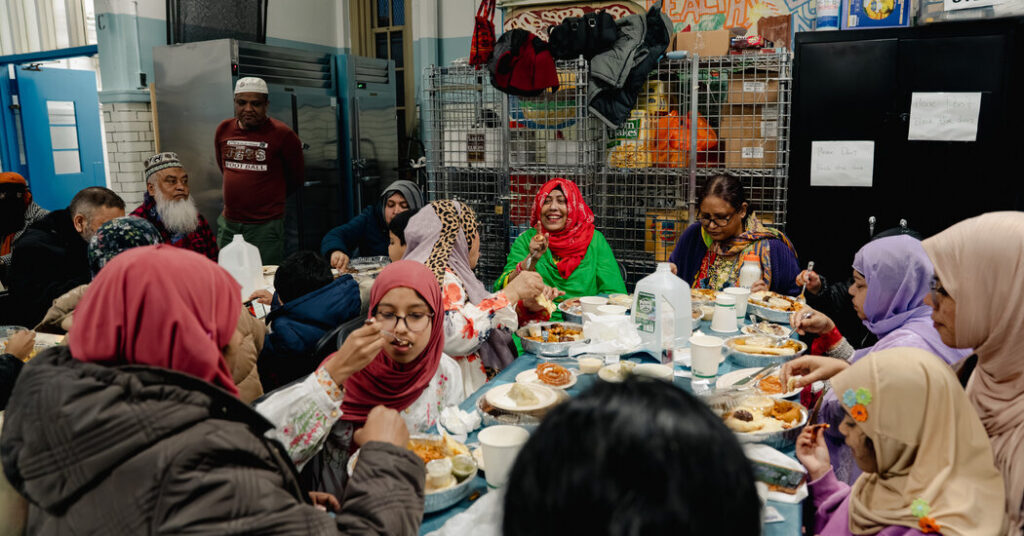
In the cafeteria of P.S. 179 in Kensington, an iftar that in past years hosted 25 people drew more than 400 attendees who caught up and posed for selfies. Children ate alongside elders and elected officials like Shahana Hanif, the first Muslim woman elected to the City Council.
Ramadan came this year during what has been an unbearably dark period for many Muslims in New York and around the world. The war in Iran, which began during the holiday, and ongoing suffering in the Gaza Strip have profoundly affected many New Yorkers with relatives and roots in the region.
The holiday itself, a period of introspection, has been trying. Sheikh Faiyaz Jaffer, the executive director and chaplain at the Islamic Center at New York University, said many students had come to him for guidance.
“I can’t keep my office open — like my door to my office open — without having people walk into it, wanting to share with me about what their families are going through at this moment,” he said.
But global events have also put into perspective the power of the iftar meal itself, and of the ritual of breaking fast with loved ones.
“There is that reality happening of war and bombs and all this other stuff, but this is reality also,” said Hasiba Haq, the program director for the nonprofit group Arts and Democracy, which helped organize the Kensington iftar. “I think you can get caught up in what’s happening there, and it’s hard not to, but this is my reality and this is my community.”
Dionne Searcey contributed reporting.
The post New York City Celebrates Its First Ramadan With a Muslim Mayor appeared first on New York Times.